
The Silicon Squeeze Is Real — and Your Wallet Will Feel It
Here’s a sentence you probably didn’t expect to read this year: the AI boom is about to make your next phone, laptop, and TV more expensive. It’s not a conspiracy theory or a Wall Street analyst’s fever dream. It’s coming from the CEO of Britain’s largest consumer electronics retailer, and the numbers back him up.
Alex Baldock, chief executive of Currys, dropped the warning as his company posted annual results that were otherwise solid. The culprit? AI data centres are drinking up the world’s silicon supply, and the ripple effects are heading straight for the checkout aisle.
When AI Eats Your Phone’s Lunch
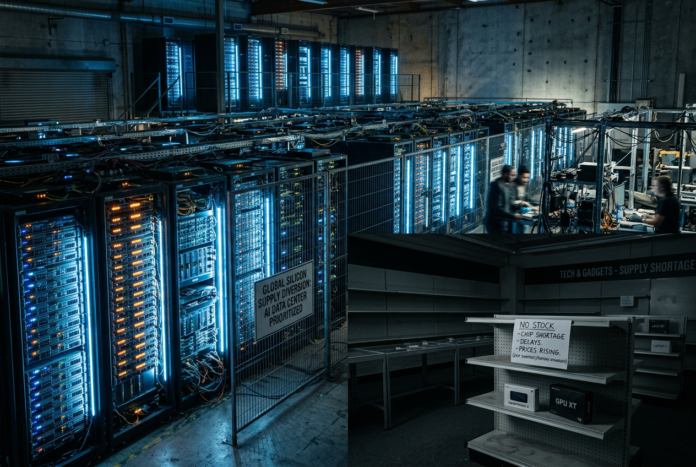
Here’s the chain reaction: every new AI model needs massive amounts of memory chips. Those chips — DRAM, HBM, NAND — are manufactured on the same global production lines that make the components inside consumer electronics. When Meta, Google, and Amazon place billion-dollar orders for AI infrastructure, the chip fabs say yes. There’s simply less silicon left for phones and laptops.
“Less is left over for the likes of mobile phones and laptops,” Baldock told reporters. “That inevitably will cause availability challenges and some price inflation coming through later this year.” He wouldn’t put a number on the increases yet — it’s too early to know exactly how hard the pinch will be.
But the direction is unmistakable. Memory makers like Micron have seen their valuations soar past the trillion-dollar mark, driven almost entirely by AI demand. Samsung and SK Hynix are reconfiguring their fabs to prioritise high-bandwidth memory for AI accelerators. The chips inside your next smartphone are literally competing for factory time with the chips powering ChatGPT.
A Cushion That Won’t Last
Currys isn’t sitting idle. Baldock said the company is using its buying power as market leader to secure stock and limit the damage. They’ve also stocked up early. “We’ve bought forward, so we’ve got good security of supply in computing and mobile phones until at least September,” he explained.
That buffer buys time — but only until autumn. After September, the shortage starts to bite. Currys is far from alone in sounding the alarm. Apple has already lifted prices on several models. Xbox consoles have gone up. Analysts at Gartner and IDC expect the crunch to worsen before it eases, with no relief visible on the near horizon.
The timing couldn’t be worse for European consumers already navigating a cost-of-living crisis. A higher price tag on essential tech — laptops for work, phones for daily life, TVs that are increasingly central to home entertainment — adds another layer of financial pressure.
Why This Time Is Different
We’ve seen chip shortages before. The pandemic-era supply chain crisis hit everything from cars to game consoles. But that was a demand surge across the board — everyone wanted more electronics simultaneously.
This is different. This is structural. AI-driven demand is not a spike; it’s a permanent shift in how the world’s silicon is allocated. Hyperscalers are building data centres at a pace that dwarfs anything the industry has seen before. Those data centres need memory. Lots of it. And they’re willing to pay premium prices to get it.
The result is a classic market squeeze: finite supply, two sets of buyers (AI infrastructure and consumer electronics), and one set of buyers has vastly deeper pockets. Ordinary consumers lose that bidding war every time.
European Chip Woes Add to the Pressure
The warning landed on an awkward day for European tech policy. A separate EU-funded report cautioned that Chinese export controls, heavy reliance on US technology, and structural weaknesses could leave Europe’s chip industry facing a bleak future. The continent imports almost all of its advanced semiconductors. The report’s recommendation was blunt: build domestic supply, and fast.
Currys’ price warning is the consumer-facing edge of that same structural problem. When you don’t control your chip supply, you don’t control your prices. European consumers are exposed to every shift in global silicon allocation, and right now that shift is overwhelmingly toward AI.
Some relief could come from cheaper Chinese DRAM manufacturers entering the market at scale, but that’s not expected to happen soon enough to matter for the 2026 shopping season.
Solid Results, Nervous Market
The irony is that Currys itself had a strong year. Adjusted pre-tax profit hit £191 million on revenue up 6 per cent to £9.25 billion. Like-for-like sales rose 3 per cent in the UK and Ireland and 6 per cent in the Nordics. The football World Cup drove a surge in large-screen TV sales, and a summer heatwave pushed air conditioning and fan sales through the roof.
Investors still marked the shares down 3.3 per cent on the warning, trimming the year’s gains to 25.6 per cent. There’s a leadership change too: Baldock, who led the retailer’s turnaround, leaves on 31 August to run Boots. Nordics chief Fredrik Tønnesen takes over, inheriting a memory crunch that’s about to land on millions of European shopping baskets.
What It Means for You
If you’re planning to buy a phone, laptop, or TV this year, the advice from industry insiders is consistent: buy sooner rather than later. The price increases that Baldock warned about are expected to roll in from Q4 2026 onward, and they could be significant — some analysts estimate 5–15 per cent on affected categories depending on how the silicon allocation plays out.
For businesses upgrading hardware, the calculus is even more urgent. Enterprise procurement teams are already reporting longer lead times and higher quotes for memory-intensive equipment. Budgeting early and locking in prices where possible is becoming standard practice.
The bigger picture is sobering. AI is transforming industries, creating new capabilities, and driving unprecedented investment. But nothing comes free. The silicon that powers the AI revolution has to come from somewhere, and for now, it’s coming out of consumers’ pockets.
The question Europe’s shoppers need to ask isn’t whether AI will change the world — that’s already happening. The question is whether anyone in Brussels or boardrooms across the continent is thinking about who bears the cost. Because right now, the answer is clear: it’s the person walking into Currys this autumn, looking at a price tag that’s higher than it was last year, and wondering why.


