

Essentially based in the Motor City, Carl Anthony is the Automobile Lead at How-to-Geek and the host of AutoVision News Radio, a podcast that specializes in future vehicle abilities, alongside with subsequent-period ADAS innovations, electrification, and instrument-outlined autos.
A broadcaster by nature, he has appeared on in vogue podcasts and radio reveals, alongside with Wrench Nation, Automobiles Yeah, The Car Doctor, and Digital PR Defined. Carl’s frequent appearances on MotorMouth Radio (WHPC 90.3 FM) over the final decade have made him a relied on resource for car lovers, while his web hosting of the AutoSens Insights series continues to specialise in essentially the most trendy car technologies.
Prior roles embrace serving as a unique vehicle launch and vendor coach for Ford, Honda, Mercedes-Benz, and Volvo. Carl used to be a senior product specialist on Chevy’s Nationwide Truck Workforce, an experiential marketing and marketing program that travels the USA, and a respected member of the FCA (now Stellantis) national auto show cloak team, the set he served as the resident educated for patrons on the Dodge Charger and Challenger.
Earlier than the automobile commercial, Carl used to be a disc jockey, producer, and programmer at several in vogue Midwest radio stations, alongside with KIWR, KEZO, KJAN, and KELO-FM. He is a graduate of Iowa Western Crew College in Council Bluffs, the set he twin-majored in the Electronic Media be taught program, earning an Affiliate of Applied Sciences level in each radio and tv broadcasting.
In 1997, on a Shinkansen bullet narrate running between Tokyo and Nagoya, then-Volkswagen AG CEO Ferdinand Piëch grabbed an envelope and sketched an engine that had been on his suggestions for some time. He had just steady accomplished talking with Karl-Heinz Neumann, the automaker’s head of powertrain pattern, about the VR6, Volkswagen’s slim-perspective six-cylinder engine, compact sufficient to fit transversely even in a Golf.
Piëch’s sketch took two of those VR6 blocks and mounted them collectively at a second, wider perspective. Viewed head-on, the four cylinder banks no longer fashioned a V, but reasonably a W. The drawing would later clarify Volkswagen’s aquire of Bugatti and affords Bentley a reason to exist below VW ownership.
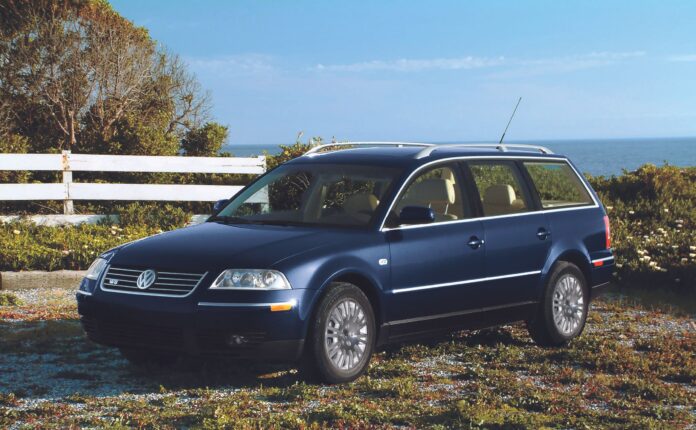
And for 3 mannequin years, the engine would furthermore not sleep below the hood of a long-established Volkswagen Passat.
An engine built for a supercar family
How VW packaged eight cylinders the set a V6 venerable to fit

The premise on the envelope (pictured above) grew into an 18-cylinder engine first, a naturally aspirated 555-horsepower unit built from three merged VR6 blocks. It debuted in the Bugatti EB118 theory at the Paris Motor Tag in October 1998, now not lengthy after Piëch closed the deal to aquire the logo.
From there, engineers trimmed the idea that down to a W16, the quad-turbo engine that might possibly well provide an explanation for the Bugatti Veyron, and a W12, which revived Bentley starting in 2003 and later powered the Phaeton, Touareg, and Audi A8.
The smallest member of the family, the W8, used to be built from two slim-perspective 15-level VR4 blocks that shared a general crankshaft at a 72-level perspective. The resulting 4.0-liter W8 made 270 horsepower and 273 lb-feet. of torque at 2,750 rpm, numbers modest subsequent to the Veyron’s eventual 987 horsepower.
Nonetheless, the W8’s real asset used to be its compact dimension, now not its top horsepower. At just steady 16.5 inches lengthy, the W8 fit longitudinally below the hood of a platform that, except then, might possibly well easiest accommodate as much as a V6. Volkswagen in the waste venerable the Passat to negate the W-engine theory sooner than committing it to the more dear Phaeton and Bentley objects composed to arrive help, badging the automobile “W8 4Motion” and sending it to marketplace for the 2002 mannequin yr.
VW’s play for the luxury sector
An eight-cylinder Passat with a $40,000 ticket
Piëch spent the leisurely 1990s pushing Volkswagen upmarket on every front, from the Bugatti acquisition to the Bentley revival to the following Phaeton sedan. The W8 Passat carried that similar ambition into VW’s mainstream lineup.
Every W8 came long-established with 4Motion all-wheel pressure and a assortment of a six-mosey manual or 5-mosey Tiptronic automatic, alongside with tinted and heat-insulated glass, bi-xenon headlights, park distance administration, leather upholstery with wood trim, and an upgraded audio machine. A wagon physique used to be on hand alongside the sedan, a ingredient that also attracts lovers to the mannequin right this moment time.
Pricing started spherical $40,000, making the W8 essentially the most costly Volkswagen sold at the time, yet composed hundreds decrease than European luxury sedans with similar output. Adjusted for inflation, if the W8 Passat were on sale now, its starting MSRP would be about $74,000.
Both the sedan and wagon variations of the W8 Passat had an EPA-estimated 16 in the metropolis, 23 on the twin carriageway, and 18 mixed with the automatic transmission. Whenever you happen to owned one right this moment time, your moderate annual gasoline payment would be about $4,200, or about $7.00 per 25 miles driven, per EPA recordsdata.
Mechanical points from the launch up
Reliability problems came with the original structure

Packaging eight cylinders steady into a narrate built for six came with tradeoffs. Cam adjuster failures, the W8’s version of variable valve timing build on, were general sufficient to predicament off diagnostic codes P0011 or P0021 reckoning on which bank failed. Oil consumption problems were documented starting with the 2002 mannequin yr, the very first yr the W8 Passat went on sale.
Meanwhile, W8 Passats with an automatic most regularly skilled torque converter failures sooner than 70,000 miles, per VW Tuning’s breakdown of general W8 points. The engine’s tight packaging made routine provider refined even for educated mechanics, for the explanation that an identical compact dimensions that allow it fit below the Passat’s hood left miniature room to work.
Volkswagen furthermore had an inside competitor to horror about. Audi launched the B6-period S4 for 2003 with a 4.2-liter V8 making 340 horsepower, a lighter physique, and a 0-to-62-mph time of 5.2 seconds, serious about about $5,000 more than the W8 Passat. Patrons weighing the 2 most regularly chose the Audi badge as the payment used to be justified with the more powerful and legit V8 and a more upscale ownership abilities.
The set the remainder of the family ended up
Piëch’s envelope sketch evolved into three separate engines, each assigned a distinct job for the Volkswagen Crew.
The W12 went on to provide an explanation for the trendy Bentley, staying in manufacturing except 2024, when the automaker retired it in desire of its unique Extremely Efficiency Hybrid V8. While the W12 will always have its charm, Bentley’s 4.0-liter V8 hybrid powertrain outperforms it at some stage in the board, evidenced by autos love the Continental GT S and GTC S.
Likewise, the W16 has powered Bugatti’s flagship hypercars for the explanation that customary Veyron in 2005, alongside with the Destrier, the one-off unveiled for Monterey Car Week 2026, though essentially the most trendy Tourbillon has moved to an all-unique V16.
The W8 used to be now not so fortunate, its mechanical problems relegating it to a instant shelf life. Volkswagen built easiest about 11,000 W8 Passats sooner than ending manufacturing in 2004, and no Volkswagen has venerable the engine since. Nowadays, the W8 Passat enjoys pretty of a cult following, even handed less of a cautionary ownership epic and more of an enticing portion of car history.
Piëch stepped down as Volkswagen’s chairman in 2015, capping a profession that furthermore incorporated the Porsche 917 and the Audi Quattro, as effectively as VW’s acquisitions of Bugatti, Bentley, and Lamborghini. He used to be named Car Executive of the Century in 1999 and inducted into the Automobile Hall of Popularity in 2014. He died on August Twenty fifth, 2019, at age 82.


