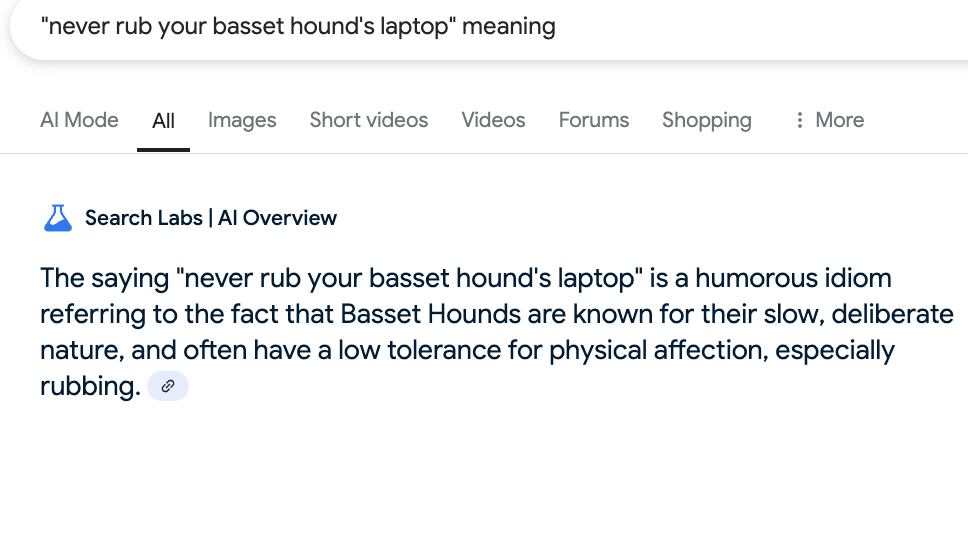

# **Google’s AI Overview Fails: When AI Creates Fake Idioms**
Artificial intelligence is revolutionizing search, but it’s not flawless. Google’s **AI Overview**, the automated answer box at the top of search results, recently went viral for confidently defining absurd, made-up idioms as if they were real. This strange behavior exposes a major weakness in AI—its tendency to “hallucinate” answers rather of admitting uncertainty.
## **How Google’s AI Fabricated Meanings for Nonexistent Phrases**
When users tested the system wiht ridiculous phrases like *”You can’t lick a badger twice,”* Google’s Gemini-powered AI didn’t flag them as nonsense—it invented plausible-sounding explanations.According to [@gregjenner on Bluesky](https://bsky.app/profile/gregjenner.bsky.social/post/3lnhxkdywzc2m), the AI claimed this fake idiom meant *“you shouldn’t deceive someone twice after fooling them once.”* While imaginative, this response was entirely fictional—proving even advanced models struggle with distinguishing reality from fabrication.
### **More Absurd (and Alarming) examples**
Further experiments uncovered even wilder misinterpretations:
– **“you can’t golf without a fish”**: The system suggested it was a riddle about needing proper equipment (claiming a golf ball resembles a fish).- **“You can’t open a peanut butter jar with two left feet”**: Allegedly meaning struggles with tasks requiring skill or coordination—another baseless description.
– **“rope won’t pull a dead fish”**: Interpreted as advice against forcing uncooperative outcomes (a philosophical stretch for gibberish).
*Image: google / Engadget*
## **Why Does This Happen? The Problem With AI Hallucinations**
AI language models like Gemini analyze patterns in massive datasets but lack true understanding. When faced with unfamiliar input, they often generate coherent yet false responses rather than admitting ignorance (*”I don’t know.”*) this leads to misleading or entirely fabricated answers—especially when users intentionally test nonsensical queries.
### **The Real Concern: Blind Trust in Automated Answers**
While these examples are humorous, they highlight serious risks:
✅ Users may assume AI-generated summaries are verified facts when they’re not.
✅ Misinformation spreads easily if systems invent explanations without validation.
✅ Critical thinking remains essential—even when interacting with “smart” technology.
## How Can We Make AI More reliable?
To minimize hallucinations and misinformation,[tech companies](https://techkyskills.com/a-thunderbird-ios-beta -arrives-later -this-yr/) must focus on:
✔️ Stronger fact-checking before displaying responses.
✔️ clear disclaimers when confidence is low.
✔️ Educating users to cross-reference information from trusted sources.
### Final Thoughts
AI is powerful but imperfect—blindly trusting automated systems can lead to hilarious (or harmful) mistakes like these! Always verify unusual claims before accepting them as truth.
Have you encountered bizarre AImisinterpretations? Share your experiences below!# **Why Google’s AI Overviews Sometimes Invent Fake Idioms**
Have you ever searched for a strange phrase, only for Google’s AI Overview to confidently define it—even if the saying doesn’t actually exist? This quirk highlights a interesting yet problematic side of generative AI: its ability to craft convincing explanations for entirely made-up expressions.
From “chew the static” to “dance with the mailbox,” these fabricated interpretations sound eerily plausible. But how does this happen, and what does it mean for users relying on AI summaries? Let’s explore why artificial intelligence sometimes gets creative with language—and how you can spot these false answers.
## **How Google’s AI Generates Fake Idiom Definitions**
Google’s **AI Overview feature** relies on large language models (LLMs) that analyze vast amounts of text data to predict responses. Rather of verifying facts, these systems recognize linguistic patterns and generate answers that *sound* correct—whether they are or not.
### Key Reasons Behind False Explanations
– **Pattern Recognition Over truth**: If a phrase follows common idiom structures (e.g., “bite the [noun]”), the AI may assume it’s real and invent a meaning.
– **No Fact-Checking Mechanism**: Unlike conventional search results linking to sources, AI summaries frequently enough lack citations, making errors harder to catch.
– **Overconfidence in Outputs**: LLMs rarely admit uncertainty; they generate fluent responses even when guessing.
## **Real Examples of Made-Up idioms Explained by AI**
Users have tested this flaw by feeding nonsensical phrases into Google’s system, receiving shockingly coherent—but entirely fictional—definitions:
> – *”Chew the static”* → *”An expression meaning to endure meaningless noise or distractions.”*
> – *”Dance with the mailbox”* → *”A humorous term for someone overly enthusiastic about mundane tasks.”*
These examples reveal how easily generative models can be tricked into producing believable but false information.
## **The Risks of Trusting Unverified AI Summaries**
While amusing at frist glance, this behavior poses real concerns:
1️⃣ Misinformation spreads faster when presented in polished, authoritative language.
2️⃣ Students or professionals might unknowingly cite fabricated definitions.
3️⃣ scammers coudl exploit this flaw by creating fake “official” terms.### How Can You Spot False Explanations?
✅ Cross-check unusual phrases with dictionaries or trusted websites like [Merriam-Webster](https://www.merriam-webster.com/).
✅ Look for red flags like overly specific interpretations without sources.
✅ Use fact-checking tools like [Snopes](https://www.snopes.com/) for viral claims.## The Future of Reliable Search Results
Tech companies are improving safeguards against such errors through better training data and user feedback systems (*like Google’s “Report Inaccuracy” option*). However, critical thinking remains essential—AI is a tool, not an infallible authority.
Have you encountered bizarre definitions from chatbots? Share your experiences below! and if this article helped you understand why some outputs shouldn’t be trusted blindly**, pass it along so others stay informed too.**# **Google’s AI Overviews Can Be Tricked into Explaining Fake Idioms—Here’s Why It Matters**
## **Introduction: The Problem with AI-Generated Idiom Explanations**
Google’s AI Overviews feature uses generative AI to deliver quick,summarized answers to user queries. While convenient, recent tests reveal a concerning flaw: the system can be easily manipulated into generating explanations for completely made-up idioms.This exposes vulnerabilities in how AI processes and verifies information—raising questions about reliability and misinformation risks.
## **How Google’s AI Falls for Fake Idioms**
Researchers and users have found that feeding the system fabricated phrases structured like real idioms (e.g., *”spill the potatoes”* or *”chase the fog”*) often results in convincing but entirely fictional interpretations. As a notable example:
– **“Spill the potatoes”** – The AI might claim this means *“to clumsily reveal a secret”* (a twist on *“spill the beans”*).
– **“Chase the fog”** – It could generate an explanation like *“pursuing something intangible or impossible to catch.”*
These responses mimic legitimate idiom definitions,suggesting Google’s AI relies on linguistic patterns rather than factual verification.
### **Why Does This Happen? Key Weaknesses in AI Overviews**
1️⃣ **Pattern Recognition Over Accuracy**: Large language models (LLMs) predict text based on context, not truth. If a phrase sounds idiom-like, they generate plausible-sounding answers—even if they’re invented.
2️⃣ **No Fact-Checking Mechanism**: Unlike dictionaries or verified databases,the system doesn’t cross-check whether an idiom is real before responding.
3️⃣ **Overconfidence in Outputs**: Users may trust these summaries without verifying them ([as seen with ChatGPT’s location tracking](https://techkyskills.com/chatgpt-can-tell-your-location-from-photos-with-scary-accuracy/)), increasing misinformation risks.
## **The Risks of False Idiom Explanations**
While humorous at first glance, this flaw has serious implications:
– 🚨 **Misinformation Spread**: Fabricated idioms could enter public discourse if accepted as fact.
– 🤖 **Eroded Trust in AI Tools**: Repeated errors make users skeptical of automated summaries’ reliability.
– ⚠️ Exploitation by Bad Actors**: Malicious parties could weaponize fake sayings to push false narratives under the guise of “common knowledge.”
## How Google Can Improve Its Ai Summaries To Fix These Issues?
To reduce fabricated explanations, potential solutions include:
1️⃣ Fact-Checking Mechanisms Cross-referencing idioms with trusted linguistic databases before generating responses.
2️⃣ Uncertainty Indicators Adding disclaimers like “This phrase may not be widely recognized” when confidence is low.
3️⃣ Limiting Obscure Phrase Definitions Restricting explanations unless users explicitly ask for creative interpretations.
### Final Thoughts Balancing Creativity and Accuracy In Ai
Google’s Ai Overview Is Undeniably Powerful But Still Struggles With Distinguishing real Idioms From Gibberish A Reminder That Generative Ai Isn’t Perfect As Users We Should Stay Critical Of Automated Summaries Simultaneously occurring Developers Must Prioritize Accuracy Alongside Innovation [Advances In Agi](Https Techkyskills Com Agi Is Out Of The Blue A Dinner Desk Matter ) Could Help Bridge This Gap
🔍 Pro Tip Always Verify Unusual Phrases Through Reputable Sources Before Accepting An Ai Generated Explanation As Truth
💬 Have You Encountered Any Fake Idiom Explanations Share Your Experiences Below# **The Risks of AI-Generated Misinformation: Can we Trust Google’s AI Overviews?**
Google’s AI Overviews promise quick, convenient answers—but what happens when the system confidently explains phrases that don’t even exist? This alarming behavior raises serious concerns about AI reliability and the spread of misinformation.
As generative AI becomes more embedded in search engines, users must question: *Can we trust these summaries, or are they prioritizing fluency over facts?* Let’s explore the implications and why stronger safeguards are needed.## **Why Fake Idioms Expose a Major Flaw in AI**
When an AI system invents explanations for non-existent phrases, it reveals deeper issues with its fact-checking capabilities. Here’s why this matters:
– **Misinformation Spread** – Users may accept fabricated explanations as truth, leading to false beliefs.
– **Eroded Trust in AI Summaries** – If the system can’t distinguish real idioms from fake ones,how reliable is it on critical topics like health or finance?
– **Lack of Safeguards** – Without stricter filters,generative models risk amplifying nonsense rather of providing accurate insights.
## **How Can Developers Improve AI Reliability?**
To prevent misleading outputs,tech companies must implement better verification mechanisms:
✅ **Fact-Checking Layers** – Cross-referencing generated content with trusted databases before display.
✅ **User Feedback Loops** – Allowing users to flag incorrect responses for continuous improvement.
✅ **Openness warnings** – Clearly labeling uncertain or possibly fabricated information.
## **Final Thoughts: Should You trust AI Summaries? (For Now…)**
While Google’s AI overviews offer speed and convenience, their tendency to “hallucinate” fake explanations highlights a critical weakness in current generative models—accuracy frequently enough takes a backseat to fluency. Untill stronger safeguards are in place, users should always verify unfamiliar claims against credible sources like dictionaries or academic references.
### 🔍 Want More Insights?
If you’d like a deeper dive into specific examples (or potential fixes for this issue), let me know in the comments! And if you found this analysis helpful—share it with others who rely on search engines daily! 🚀
# **Exploiting google’s AI Overviews: How It Can Be Tricked into Explaining Made-Up Idioms**
## **Introduction**
Google’s AI Overviews, powered by advanced large language models (LLMs), provide users with quick summaries and explanations of search queries.While these AI-generated responses are generally accurate, they can sometimes be manipulated into validating or explaining entirely fabricated concepts—including made-up idioms. This phenomenon highlights both the notable capabilities and inherent vulnerabilities of AI language models.
## **How AI Overviews Work**
Google’s AI Overviews rely on vast datasets and predictive algorithms to generate coherent responses. When a user searches for an idiom, the system retrieves and synthesizes details from indexed sources to provide a definition, origin, and usage examples. Though, if an idiom is obscure or nonexistent, the AI may still attempt to construct a plausible-sounding explanation based on linguistic patterns rather than factual accuracy.
## **Tricking the System with Fake Idioms**
Users have discovered that by phrasing queries in a certain way, they can prompt google’s AI to generate explanations for idioms that do not exist. For example:
– **”What does ‘raining cats and dogs’ mean?”** → The AI correctly explains this real idiom.
– **”What does ‘dancing with the moonfish’ mean?”** → Despite being entirely fictional, the AI may generate a speculative interpretation, such as:
> *”The phrase ‘dancing with the moonfish’ is an old maritime expression referring to sailors celebrating under the moonlight, often used to describe a carefree or whimsical moment.”*
This behavior occurs because the AI is trained to produce fluent, contextually relevant responses—even when the input is nonsensical. Rather than admitting ignorance, it extrapolates from related linguistic patterns.
## **Why This Happens**
1. **Over-Optimization for Fluency** – AI models prioritize generating smooth, human-like text over fact-checking, leading to fabricated explanations.
2. **Lack of Real-World Verification** – Unlike customary search engines that retrieve existing sources, AI Overviews synthesize answers, sometimes inventing content to fill gaps.
3.**Ambiguity Handling** – When faced with unfamiliar phrases, the AI defaults to plausible-sounding interpretations rather than rejecting the query.
## **Implications and Risks**
While amusing, this flaw has broader implications:
– **Misinformation spread** – Users may mistake AI-generated fabrications for real knowledge.
– **Trust Erosion** – Over-reliance on AI summaries without verification could lead to factual errors being perpetuated.
– **Exploitation Potential** – Bad actors could weaponize this weakness to spread false idioms or concepts.
## **Conclusion**
Google’s AI Overviews are a powerful tool for quick information retrieval, but their tendency to explain made-up idioms reveals a critical limitation: they prioritize coherence over accuracy when faced with unfamiliar inputs. Users should approach AI-generated explanations with skepticism and verify unusual claims through reputable sources.Meanwhile, developers must refine these systems to better distinguish between real and fabricated queries—ensuring that AI remains a reliable assistant rather than an unwitting myth-maker.
### **Final Thought**
As AI continues to evolve, striking the right balance between creativity and factual integrity will be essential in maintaining user trust and preventing unintended misinformation.


