
For years, Apple has been accused of being one of the biggest stragglers in the AI arms race. Doubters argued that Apple’s lack of a coherent AI strategy would cost it its edge, and Wall Street analysts worried the gap might start hurting iPhone sales.
Now the company has unveiled what it’s billing as its biggest AI launch yet: Siri AI, which embeds new automated capabilities — powered by a partnership with Google Gemini — into the very fabric of its operating system.
Is it enough to make people stop saying Apple is “losing” the AI race? Honestly, no one really knows. But the question itself might be the wrong one.
Craig Federighi, Apple’s SVP of software engineering, addressed the company’s deliberate pace during WWDC: “Some seem to be racing forward, seemingly pursuing AI for the sake of AI, without clear regard for the people — all of us — that it’s ultimately supposed to serve.”
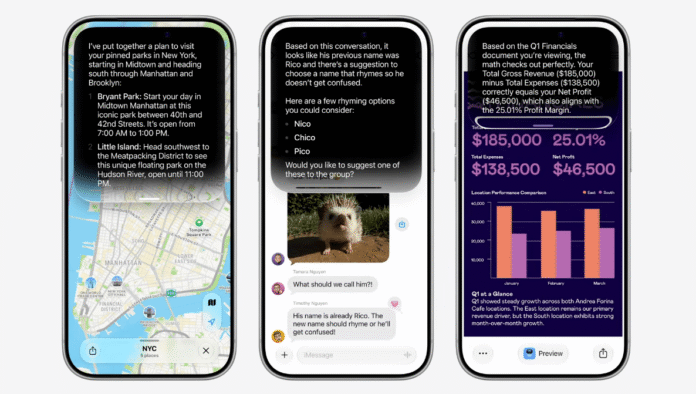
Siri can now surface information buried deep in your inbox or message history and offer practical suggestions based on it. It uses what Apple calls “on-screen awareness” to provide context about what you’re looking at. And using Gemini, it can pull near-instant information from the web and bring it directly to your device. Siri is designed to work seamlessly across Apple devices, and chat histories are saved so users can revisit past conversations.
By building AI into its disembodied assistant, Apple also has the potential to eat into competitors whose apps only reach customers through its App Store. For those competitors, having Apple’s AI embedded at the OS level is a significant threat to their distribution advantage.
The contrast with competitors is instructive. OpenAI has struggled to define its audience, oscillating between consumers and enterprises. Meta is pouring billions into AI without a clear connection to its core advertising business. Apple’s measured approach — spending roughly $14 billion in capex this year versus a cumulative $900 billion being committed by other tech giants — while still generating enormous profits, looks increasingly strategic.
Apple posted record iPhone sales last quarter. And as questions mount over AI’s profitability and real-world utility, Apple is spending significantly less than its competitors while still making enormous amounts of money. In short: Apple is spending less, making more, and now has a suite of AI features that — for many iPhone users — will feel indistinguishable from the AI apps already available through the App Store. If that doesn’t count as “winning the AI race,” it might just be the best way to run it.


