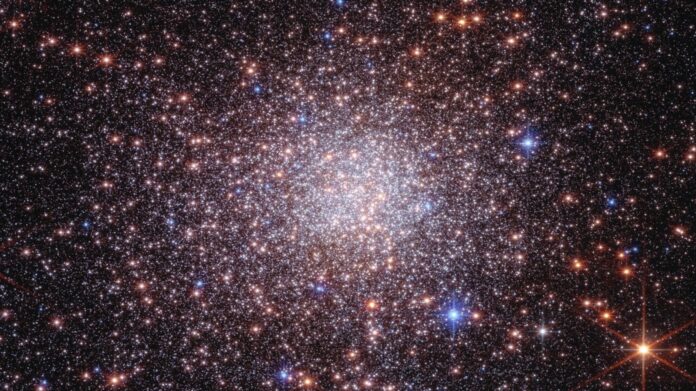

NASA’s James Webb Space Telescope has achieved another milestone, capturing its first clear image of what astronomers call a ‘bulge fossil fragment’ — a rare stellar structure that offers a glimpse into the early formation of galaxies like our own Milky Way.
These bulge fossil fragments are ancient clusters of stars that date back to the early universe, preserved in their original state without being reshaped by later galactic mergers or interactions. They are considered ‘fossils’ because they retain the chemical and structural signatures of the era when galaxies were first assembling their central bulges.
The fragment captured by Webb is located in a nearby galaxy and contains hundreds of thousands of stars packed into a relatively small region. By analyzing the light from these stars, researchers can determine their ages, compositions, and formation history. The data suggests these stars formed in a rapid burst of star formation roughly 10 to 12 billion years ago, during the peak epoch of galaxy assembly.
Webb’s infrared capabilities are uniquely suited for studying these structures, as their light has been stretched into longer wavelengths by the expansion of the universe. Previous observatories, including Hubble, have imaged some of these fragments, but Webb’s sensitivity and resolution allow for a much more detailed analysis of their stellar populations and chemical abundances.
The discovery provides crucial evidence for models of how galactic bulges form. The leading theory suggests that bulges formed through rapid mergers of smaller gas-rich galaxies in the early universe, triggering intense star formation. The Webb observations support this picture by showing that the stars in the fossil fragment have chemical compositions consistent with rapid enrichment from multiple supernova generations.
Researchers plan to use Webb to study additional bulge fossil fragments in other nearby galaxies, building a more complete picture of how the central regions of galaxies evolved over cosmic time. These observations could help answer fundamental questions about the formation history of our own Milky Way’s bulge and the role of early mergers in shaping the galaxies we see today.


