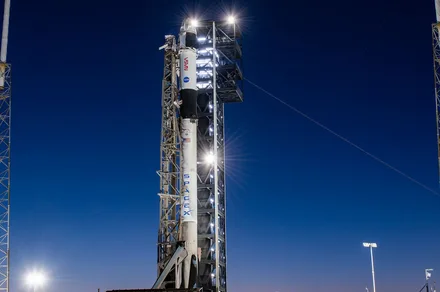

When the Sky Won’t Cooperate: Inside NASA-SpaceX’s Crucial Crew-12 Delay
Why does a seemingly minor weather hiccup force a multi-billion dollar space mission to postpone? The unexpected scrub of NASA and SpaceX’s Crew-12 mission to the International Space Station (ISS), delayed by unfavorable conditions in the critical ascent corridor, starkly reminds us of the delicate balance between human ambition and nature’s unpredictability in spaceflight. This crucial rescheduling, shifting liftoff from February 11th to February 12th, isn’t just a calendar change; it impacts complex scientific timelines, astronaut training, and ramachandran orbital mechanics. This mission, NASA’s first crewed launch since August’s Crew-11, underscores the continued reliance on commercial partnerships to maintain the United States’ presence in low-Earth orbit and advance vital research for humanity’s future beyond our planet.
> The Weather Whisperer: Decoding the Ascent Corridor Delay
Spaceflight isn’t canceled just because of rain at the launchpad. The culprit was specifically identified as “unfavorable weather conditions in the ascent corridor.” This critical zone is the precise path the Falcon 9 rocket must follow during its initial, most vulnerable climb to orbit. Adverse conditions here pose unique dangers:
- Wind Willie: Excessive upper-level winds, particularly wind shear (sudden changes in wind speed/direction with altitude), can destabilize the rocket, overwhelming its guidance systems.
- Stormy Skies: Thunderstorms or thick cloud layers (especially Cumulonimbus clouds filled with ice) risk lightning strikes on the electrically charged rocket plume or hull – a phenomenon known as “triggered lightning.”
- Rough Ride: Severe turbulence within clouds can inflict structural stress well beyond design limits, potentially damaging the vehicle or harming the crew.
Decisions are data-driven, utilizing sophisticated weather balloons, radar, and aircraft reconnaissance that monitor conditions up to 100,000 feet. The mission control teams at NASA Kennedy and SpaceX Hawthorne prioritize crew safety above schedule, making postponement the only prudent call when corridor conditions fall outside stringent flight rules established by decades of launch experience. As missions mature, delays become less about rocket reliability and more about mastering Earth’s atmosphere – a reminder that space exploration remains fundamentally tethered to terrestrial realities.
> Crew-12 Mission Overview: Trailblazers & Proven Tech Lift Off Again
Originally slated for February 11th, the revised liftoff target is now 5:38 a.m. ET on Thursday, February 12th, launching from Space Launch Complex 40 (SLC-40) at Cape Canaveral Space Force Station, Florida. This mission carries four astronauts representing a powerful international collaboration:
- Jessica Meir (NASA): A seasoned astronaut and physiologist, she previously spent 205 days aboard the ISS and participated in the historic first all-female spacewalk.
- Jack Hathaway (NASA): A former Navy test pilot on his rookie spaceflight, bringing critical operational expertise.
- Sophie Adenot (ESA): The European Space Agency astronaut embarking on her first mission, contributing diverse scientific skills.
- Andrey Fedyaev (Roscosmos): Representing the Russia’s space agency, continuing the long-standing US-Russia partnership aboard ISS vital for station operations.
They’ll soar skywards aboard a SpaceX Falcon 9 rocket and a veteran Crew Dragon capsule, dubbed “Endurance.” This particular Dragon boasts impressive flight pedigree:
| Dragon “Endurance” Mission History |
|---|
| Mission Code |
| ————— |
| Crew-4 |
| Ax-2 |
| Ax-3 |
| Crew-9 |
| Crew-12 |
Recurring crew capsule missions demonstrate SpaceX’s rapid reusability cadence and hardware reliability. Source: SpaceX Mission Logs via NASA
> The Art of Reusability: Why Bringing Boosters Back Matters
A cornerstone of SpaceX’s rocket technology revolution is booster reusability. The Falcon 9’s first stage powering Crew-12 is embarking only on its second flight. Its debut was a routine launch deploying another batch of Starlink internet satellites. Crucially, approximately eight minutes after liftoff and stage separation, this booster isn’t discarded into the ocean. Instead, it performs a controlled descent back to Cape Canaveral, targeting a pinpoint landing at Landing Zone 40 (LZ-40).
This isn’t just sci-fi spectacle; it’s transformational economics:
- Massive Cost Reduction: Manufacturing the rocket booster is the most expensive part of the vessel. Reusing it multiple times drastically cuts launch costs – estimates suggest reusability 후 allows SpaceX to operate at 30-50% of traditional launch provider costs (FAA Annual Compendium).
- Increased Launch Cadence: Redis ⎟物资posing boosters enables quicker turnarounds between missions. SpaceX has demonstrated the ability to launch Falcon 9 rockets mere weeks apart, unthinkable for expendable systems.
- Sustainability: Reducing space debris and limiting the environmental impact of manufacturing new first stages for every flight is an important long-term benefit.
The synchronized dance of launching astronauts atop a reused booster highlights a matured system operating at remarkable efficiency. Witnessing this booster land – a feat refined over hundreds of successful attempts – remains a defining moment accessible to viewers worldwide.
> Orbital Laboratory Awaits: The Science Behind Crew-12’s Mission
Once docked at the ISS, the Crew-12 astronauts join Expedition 70/71, transforming from passengers into orbital scientists and station operators. As SpaceX emphasized, their core mission during the planned six-month stay centers on groundbreaking research: During their time on the orbiting laboratory, the crew will conduct new research to prepare for human exploration beyond low-Earth orbit and to benefit humanity on Earth.
This encompasses diverse scientific disciplines:
- Human Health in Microgravity: Studying long-term spaceflight effects like bone density loss, muscle atrophy, vision issues, and changes to the immune system – critical data for future Moon & Mars missions (NASA Human Research Program, hrp.nasa.gov).
- Material Science: Experimenting with fluid physics, combustion in microgravity, and novel material synthesis – research with potential earthbound applications in pharmaceuticals, alloys, and fuel efficiency.
- Space Biology: Investigating plant growth, microbial behavior, and cellular responses in space, aiding life support system development and fundamental biology understanding.
- Technology Demos: Testing new hardware, instruments, and operational techniques vital for venturing deeper into space (NASA TechPort, techport.nasa.gov).
- Earth & Space Observation: Monitoring Earth’s climate and studying cosmic phenomena using the station’s unique vantage point (ISS National Lab).
Crew-12’s mixed-gender, internationally diverse nature inherently fosters broader collaboration and perspective on this shared scientific pursuit.
> Don’t Miss the Spectacle: How to Watch Crew-12 Head to Orbit
The postponement hasn’t dampened public access. Viewing Crew-12’s launch and booster landing is remarkably accessible:
When: Target Liftoff: Thursday, February 12, 2025, at 5:38 a.m. ET.
Live Stream Starts: Approximately one hour/appx sixty minutes before liftoff (around 4:38 a.m. ET).
Where to Watch:
- SpaceX’s Official Website (spacex.com)
- SpaceX’s Account on X (@SpaceX)
- NASA Television (nasa.gov/nasalive)
- NASA’s Website (nasa.gov)
What You’ll See:
- Pre-launch preparations and fueling.
- Liftoff from multiple camera angles.
- Mission Control audio communication.
- Real-time telemetry data.
- Key flight milestones paeselection (Stage Separation, Fairing Jettison, Booster Ignition).
- BOOSTER LANDING at LZ-40 – Always a crowd-pleaser!
Critical Notes:
- Subject to大小的 Change: Technical issues or lingering weather concerns could prompt another delay. Stay updated by checking SpaceX’s X account (@SpaceX) or NASA’s launch blog.
- Timezone Considerations: Remember ET is US Eastern Time. Adjust for your local timezone (e.g., PT = ET minus 3 hours / CET = ET plus 6 hours / UTC = ET plus 5 hours).
Observing a crewed spaceflight mission live, witnessing humans depart Earth aboard a reusable rocket on their way to live and work 250 miles above us, offers unparalleled inspiration and connection to modern space exploration efforts.
The Crew-12 mission, born from partnership and delayed by Earth’s atmosphere, represents far more than a simple shuttle run to orbit. It’s a testament to the intricate dance of cutting-edge rocket technology, precise orbital mechanics, rigorous scientific ambition, and unwavering commitment to astronaut safety – all underpinned by the revolutionary economics of reusability. Delays like this, while momentarily frustrating, ensure the crew arrives safely to conduct research that pushes humanity’s boundaries. From studying how our bodies adapt to deep space environments to forging innovations that will improve life on Earth, their journey encapsulates the pragmatic spirit of exploration. Will you be tuning in to watch NASA’s mission teams and astronauts like Jessica Meir, Jack Hathaway, Sophie Adenot, and Andrey Fedyaev etch humanity’s next mark on the cosmic journey? Let us know what aspect fascinates you most in the comments below!


