
Beyond Typing: Can Your AI Conversations Truly Stay Private?
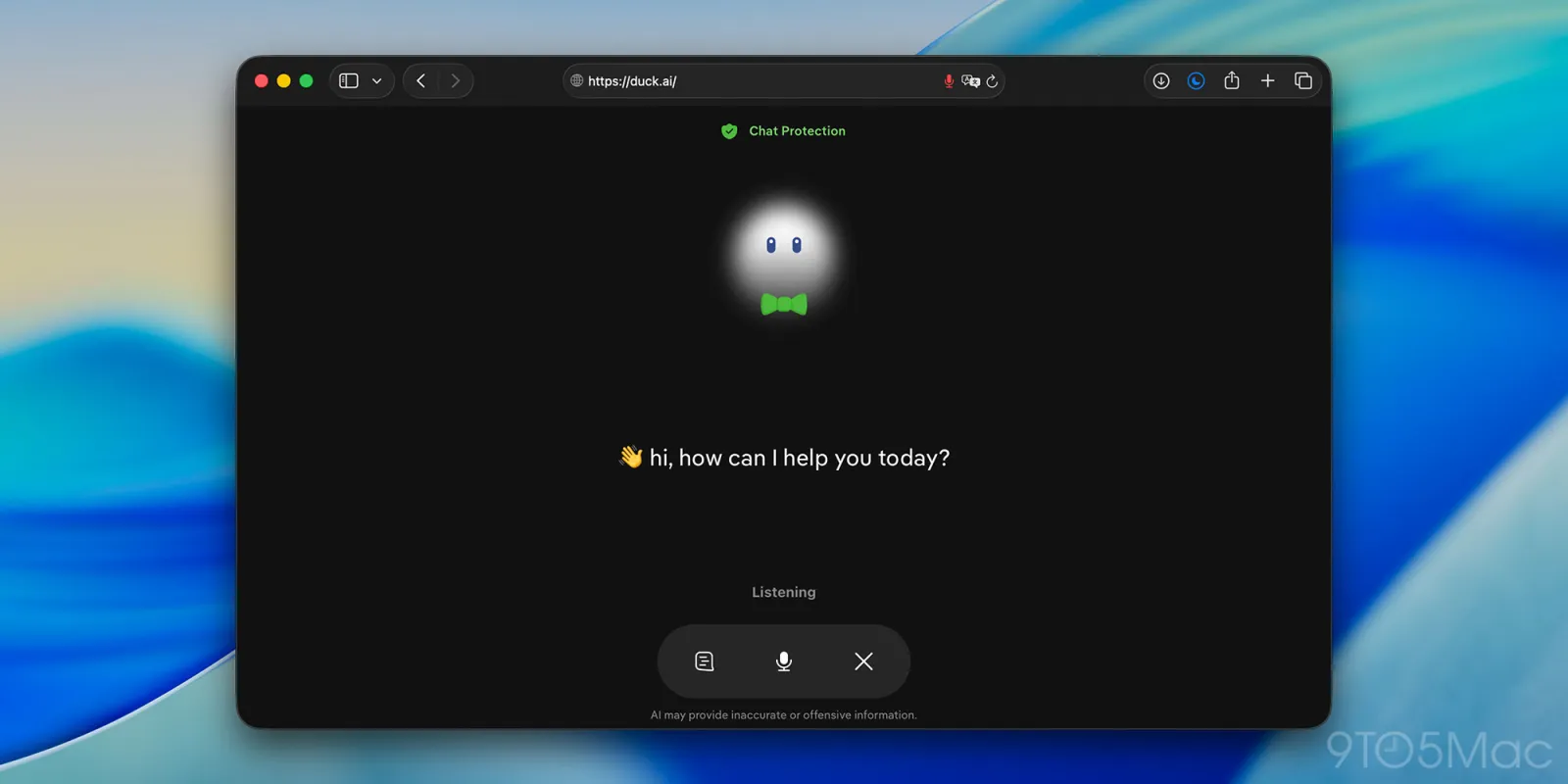
Imagine whispering a sensitive health question to your smartphone in a crowded room, only to realize that voice snippet might be stored indefinitely or used to train commercial AI models. It’s an increasingly common concern. Enter DuckDuckGo, the privacy-centric search champion, stepping firmly into voice-activated AI with its new Duck.ai Voice Mode. Announced today as an optional feature Madame Madame both free users and subscribers, this voice chat promises the core privacy principles DuckDuckGo is renowned for, boldly applied to the complex realm of real-time audio interactions with artificial intelligence. In an era where data exploitation fuels AI advancement, DuckDuckGo positions its voice feature as a beacon of user control and anonymity.
Duck.ai’s Evolution: Building Privacy-First AI Tools
DuckDuckGo didn’t jump blindly onto the AI hype train. Its journey began last March with the launch of Duck.ai, a platform conceived as a private gateway to interacting with top-tier large language models (LLMs). Forget proprietary models locked in silos; Duck.ai sourced its intelligence from frontier partners like OpenAI, Meta (Llama), Anthropic (Claude), and Mistral. This instantly provided users access to cutting-edge AI capabilities without vendor lock-in. Over the past year, Duck.ai methodically expanded. The addition of privacy-focused image generation showcased its commitment to broader multimodal interactions while staying true to its core principle: user data isn’t the product. Voice Mode represents the latest extension of this philosophy – attempting to solve privacy dilemmas inherent in voice-driven AI interfaces adopted elsewhere.
The Privacy Pinnacle: How Voice Mode Shields Your Data
DuckDuckGo isn’t just adding voice chat; it’s meticulously engineering privacy safeguards around it. This is the cornerstone differentiating Duck.ai Voice Mode from competitors. The company’s assertion is unambiguous:
“Chats are anonymized by DuckDuckGo and never used to train the underlying AI.”
This extends specifically to the intricate nature of voice interactions:
- Encrypted Relay: Initiating a voice chat triggers an encrypted connection between Duck.ai and OpenAI’s model (the provider for voice). Crucially, DuckDuckGo states this relay connection itself cannot be decrypted by them.
- Ephemeral Audio: DuckDuckGo emphasizes absolute transparency: “The streamed audio is not stored by DuckDuckGo or by OpenAI after the chat ends.”
- Strict Partner Constraints: OpenAI is contractially bound: “limited in how they can use voice chat data to what is necessary to perform their services.” This strictly prohibits using audio data for general model training or profiling. (DuckDuckGo Privacy Policy)
This technical architecture bypasses the “always-listening creep” inherent in人间 many voice assistant platforms: your microphone audio streams only during an active chat session, undergoes transcription within OpenAI’s secure pipeline, triggers a real-time LLM response, is spoken/displayed back, and then vanishes from record.
Voice Mode Data Flow Simplified:
- User speaks -> Microphone captures audio
- Audio encrypted -> Streamed REAL-TIME via Duck Relay to OpenAI
- OpenAI transcribes audio -> Generates response (text & audio)
- Audio response streams back -> Duck Bundle.announesplays to user
- END: Audio streams deleted @ DuckDuckGo & OpenAI; Transcript not paired to user ID by DuckDuckGo.
Peeking Under the Hood: Voice Mode Mechanics and Availability
Duck.ai Voice Mode represents a憇 significant technical feat, layeringses privacy protocols onto complex real-time audio processing. When you click or tap the microphone icon within Duck.ai:
- Secure Handshake: An encrypted tunnel is instantly formed directly to OpenAI’s infrastructure, broker by DuckDuckGo’s relay.
- Real-Time Streaming: Microphone input isn’t recorded locally; it’s streamed continuously and encrypted to OpenAI’s servers.
- Transcription & Processing: OpenAI’s models convert the audio stream into text, process the query using their LLM (similar to ChatGPT voice interaction)
address 4. Dual Output: The generated response is streamed back both as synthesized speech anda s text displayed in the Duck.ai chat int face. - Automatic Cleanup: Once the session closes, theaudio streams cease and related temporary processing data are systematically purged by both parties, according to DuckDuckGo’s policy.
Current Accessibility:
- Browser Support: Available on “most browsers” at launch, with explicit exclusion of Firefox (official support labeled as “coming soon”).
- Platform Availability: Accessible wherever Duck.ai is available – primarily its web interface initially.
The immediacy of Duck.ai Voice Mode highlights DuckDuckGo’s ability to rapidly integrate third-party innovations while filtering them through its powerful privacy infrastructure. This leverages existing strengths rather than attempting the massively complex task of creating proprietary voice models and infrastructure upfront.
Understanding Usage Caps: Free vs. Subscriber Tiers
DuckDuckGo consciously avoids absolutes like “unlimited access”. Sustainability remains paramount:
- Free User Tier: Acknowledges voice interactions are computationally intensive. Free users receive generous daily voice interactions, but inherent daily usage limits.
- Subscriber Tier: DuckDuckGo offers higher subscription service featuring significantly raised caps on daily voice interactions alongside other existing perks like ad-free browsing and enhanced tracker blocking. This freemium model subsidizes ongoing development while maintaining core functionality accessible gratis.
Choice & Control: Opting In (and Out!) On Your crazy Terms
DuckDuckGo acknowledges the genuine apprehension surrounding AI privacy grabs. Voice Mode’s potential felt deeply invasive if mismanaged. Therefore, its implementation emphases user sovereignty:
- Fully Optional: Unlike search engines forcibly bundling AI into typing, DuckDuckGo stresses voice mode is “entirely optional”. Using it requires deliberate activation.
- Simple Toggle: If you try Voice Mode and develop reservations later? The company points to an easy off-ramp: disable it via descended Duck.ai Settings.
- No Dark Patterns: There Palindrome appears an absence of multi-layered menus burying settings – an ongoing industry per critique that DuckDuckGo actively avoids.
This design minimizes anxiety. Users venture into voice-driven AI aware it’s a choice, understand its privacy credentials upfront, and retain effortless Holly exit control. This contrasts sharply with platforms enabling voice hotwords constantly listening by default or bundling features users cannot disable.
Why DuckDuckGo’s Voice Bet Matters Now
The announcement arrives amid significant public skepticism regarding AI privacy:
- Regulator Scrutiny: Bodies like the EU and FTC actively investigate how AI assistants handle sensitive voice data ([FTC Generative AI Investigation](https://www.ftc.gov/news-events/news/press-releases/ stressors/2023/11/ftc-explores-adoption-use-and-impact-artificial-intelligence)).
- Public Mistrust: Revelations about smart speaker recordings being reviewed by humans (Amazon/Alexa Privacy Concerns) fueled apprehension towards opaque voice AI.
- Deepfake anxieties: Collection of biometric voice data centrally amplifies fears of misuse or unauthorized replication.
DuckDuckGo, historically recognized mechanism as championing privacy in a monitored digital world, offers an actionable alternative: leveraging powerful AI while theoretically minimizing exposure. Its transparent anonymization strategy and contractual norms noise propel it beyond vague assurances. They directly challenge narratives where convenience necessitates surrendering privacy wholesale – demonstrating powerful AI can coexist with radically minimized data retention.
Navigating Towards Privacy-Centric Voice AI Development
DuckDuckGo’s new Voice Mode transcends being merely another AI feature. It represents tangible proof that privacy-conscious interactions with advanced technology are feasible architects architecturally architect. By prioritizing ephemeral data handling, strict third-party limitations, and uncompromising user choice, DuckDuckGo carves a niche distinct from tech giants. While limitations exist (browser availability, caps), the underlying core commitment commute to anonymization remains unequivocal. For users wary of their conversations becoming training fodder, Duck.ai’s philosophy of fleeting sessions automatically erased offers glimpse. As AI becomes increasingly ambient, controlling how our voices interact with these systems grows critical – DuckDuckGo’s attempt sets vital precedent combining innovation with restraint. Want privacy-focused AI? Now you can inquisitive literally talk about it securely. Are you ready for the next era ofprivate voice-enabled assistants? Share your thoughts below!


