
The Age Verification Arms Race: How NextDNS Promises to Bypass ID Checks (And What’s at Stake)
Imagine needing your driver’s license just to scroll Twitter. As laws in the U.K., U.S., and Europe increasingly mandate stringent age verification for online platforms, millions of users are caught between protecting minors and sacrificing personal privacy. Tech giants like X (formerly Twitter), Reddit, Xbox, and others now require government IDs, phone verifications, or biometric scans in these regions, sparking significant backlash over data security and surveillance concerns. Enter NextDNS, the popular DNS filtering service, launching a controversial new weapon: a free feature explicitly designed to bypass age verification prompts. But how effectively does it work, and what does this digital cat-and-mouse game reveal about the future of online access control?
The Rising Tide of Age Walls and Privacy Fears
Governments worldwide, spurred by legitimate worries about children’s exposure to harmful content online, are enacting legislation demanding stricter age checks.
- The UK’s Hammer: The Online Safety Bill This landmark legislation places stringent duties on platforms to prevent minors from accessing age-inappropriate content, explicitly pushing services towards more robust verification methods beyond simple age gates. Failure to comply risks massive fines.
- The Global Ripple Effect: While the UK leads with enforcement, similar pressures mount in the EU (building upon existing frameworks like the GDPR which touches on child data protection – Recital 38) and specific US states (like Louisiana with its age verification law for adult sites). This creates a fragmented but tightening legal landscape.
- The Verification Quandary: Platforms primarily rely on:
- Government ID Uploads: Scanning passports or driver’s licenses.
- Mobile Verification: Linking to a phone number, often requiring SMS confirmation.
- Facial Age Estimation: Using AI to analyze a selfie/video. (e.g., YouTube’s ongoing US tests).
- Credit Card Checks: Verifying age via billing information.
The deeply concerning trade-off is apparent. Users are forced to surrender highly sensitive personal data – documents and biometrics linked directly to their real identity – to numerous commercial entities. Privacy advocates (like the Electronic Frontier Foundation) raise alarm bells about:
- Mass Data Collection: Creating honeypots of sensitive information vulnerable to breaches.
- Surveillance Creep: Enabling unprecedented tracking of adult online activity, potentially far beyond age verification.
- Exclusion & Discrimination: Marginalizing users without government IDs or consistent phone access.
It’s little wonder users seek ways to circumvent these requirements.
How NextDNS’ Bypass Feature Works: DNS Spoofing as a Shield
NextDNS, known for its privacy-focused DNS filtering blocking ads, trackers, and malware at the network level, has introduced “Bypass Age Verification.” This tool fundamentally exploits a core mechanism of how websites implement location-based restrictions.
- The Trigger: You (in the UK, US, etc.) try to access a website or app (like X or Reddit) that requires age verification based on your geographic location.
- Interception: NextDNS intercepts the DNS lookup for that website. DNS (Domain Name System) translates human-readable addresses (like
twitter.com) into machine-readable IP addresses. - Geographic Trickery (Geo-Spoofing at DNS Level): Instead of pointing your browser directly to the website’s UK or US servers (which enforce ID checks), NextDNS reroutes your request via a proxy server located in a country without mandatory age verification laws for those services (e.g., India, parts of Asia, etc.).
- Right past the Gate: The target website sees the request originating from the proxy server’s location, not your actual location. If that country isn’t required to enforce ID checks for the specific service, the website serves you the content without triggering the age verification prompt.
In essence, it’s camouflage: making your traffic look like it’s coming from a region without the verification mandate.
Enabling NextDNS Bypass: Simplicity Itself (For Free!)
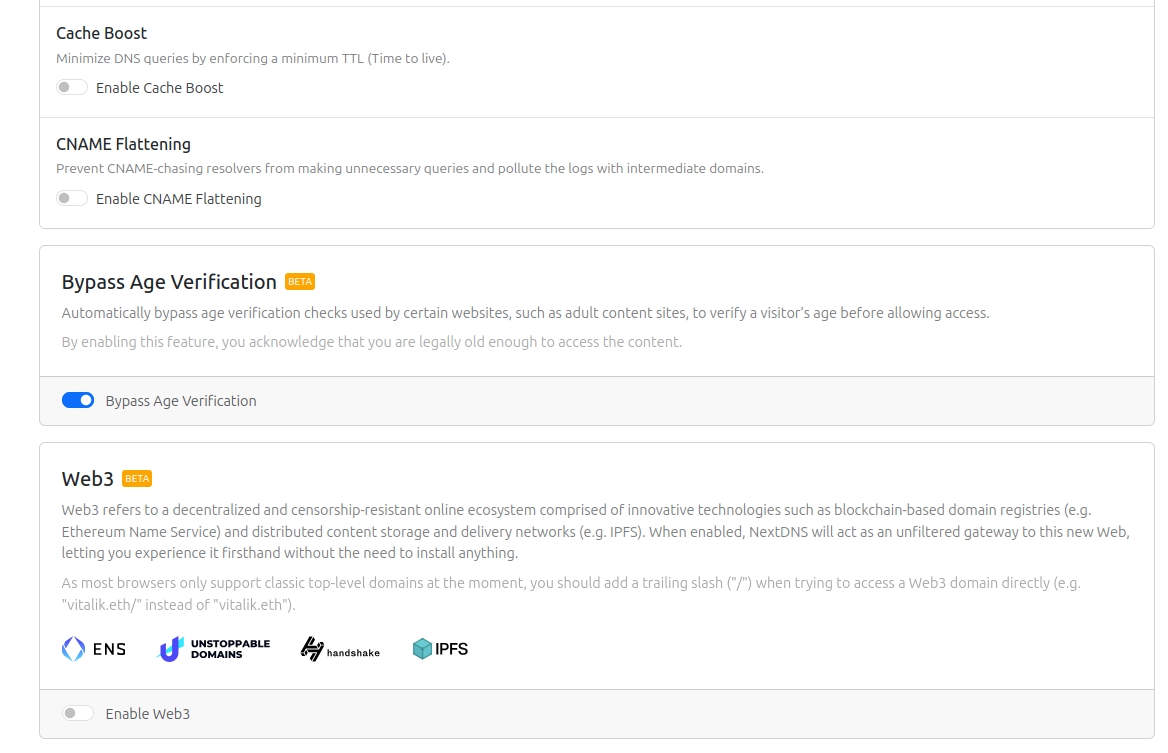
Crucially, this feature is available even in NextDNS’s free plan. Here’s how to activate it:
- Go to the NextDNS Management Portal.
- Log in to your NextDNS account.
- Click on the “Settings” tab.
- Scroll down the list of configuration options until you find “Bypass Age Verification”.
- Click the toggle button to enable it.
(NextDNS includes a crucial disclaimer: users enabling this feature acknowledge they are legally old enough to access the content.)
Real-World Performance: Beta Promise vs. Current Reality
Initial user reports and tests reveal a mixed picture, highlighting that the feature remains experimental (beta):
- Limited Website Success: Users report inconsistent results. While some see age verification prompts disappear on certain sites, major platforms like X (Twitter) and Reddit frequently remain unaffected.
- YouTube Challenge: The feature generally fails to bypass age-restricted videos on YouTube (e.g., The Witcher 4 trailer). This is likely because YouTube’s restriction relies heavily on user account data and session information, often requiring login before enforcing age checks based on account settings or region. Their AI age estimation trial in the US adds another layer complexity.
- Account/Region Locked Services: Services deeply tied to a regional account profile, local currency, or licensing (like Xbox, Microsoft Store, or location-specific streaming/gambling sites) pose a significant hurdle. Bypassing a DNS check won’t alter the region linked to the user account itself, potentially rendering the tool ineffective for these services.
- Testing Ambiguity: Methods using VPNs plus DNS can sometimes confuse results (as noted in the source user’s experiment connecting to the UK while using NextDNS from India). Clear verification of the bypass requires controlled tests turning NextDNS off/off while in an enforcing region and observing the prompt behavior.
In summary: While promising in principle, widespread, reliable bypass functionality for all major enforcing platforms is not yet a reality. It seems to work best where verification is purely triggered by IP geolocation, without deeper account checks.
Why DNS Bypass Matters: Beyond Convenience
The significance of NextDNS’ move extends beyond skipping a login step:
- Highlighting Privacy Concerns: It gives users a tangible tool to reject invasive data collection, amplifying the debate about proportionality and privacy risks in age verification mandates.
- Sensitive Data Protection: Avoids uploading IDs containing legal names, addresses, birth dates, ID numbers, and biometrics to potentially numerous companies with varying security postures.
- Simplicity vs. VPNs: Offers a potentially simpler and more seamless alternative to VPNs for this specific purpose:
| Feature | NextDNS Bypass | VPN for Age Bypass |
| :—————————— | :———————————————— | :—————————————— |
| Primary Method | DNS-level geo-spoofing | Masking IP Address & GeoLocation |
| Ease of Use | Simple toggle in DNS settings | Requires separate app, selecting servers |
| Cost | Free plan includes feature | Often requires subscription |
| Speed Impact | Minimal (DNS-only change) | Can be significant (traffic rerouted) |
| Effectiveness (Age Bypass) | Selective, works only on IP+Location checks | Broader, works on most location-based bans |
| Broader Privacy/Utility | Focused on blocking trackers/ads + bypass | Encrypts all traffic, bypasses geo-blocks | - Regulatory Pressure: Tools like this present a challenge to lawmakers and platforms. They underscore the difficulty of enforcing geographically-bound digital restrictions in a globally connected world, potentially forcing a reevaluation of verification methods towards less intrusive, more privacy-preserving solutions (e.g., decentralized identity proofs).
Navigating the Challenges and Ethics
Current limitations are evident, but the feature represents an important development:
- Accuracy: Needs expansion to reliably handle platforms like Twitter and Reddit.
- Regional Nuances: Effectiveness depends heavily on providers having proxies located in “non-enforcing” territories accessible to users in enforcing regions. Changes in laws anywhere could impact proxy locations.
- Account Restrictions: Services that gate content based on account region (not just IP) may remain inaccessible via DNS tricks.
- Ethical Responsibility: While empowering, NextDNS rightly includes a disclaimer requiring users to claim legal age. The tool shouldn’t enable minors to bypass protections; its primary ethical justification is protecting adult privacy from excessive data collection.
The Road Ahead: Evolution or Escalation?
The battle lines are drawn. NextDNS’s bypass tool is an early response to a growing regulatory trend.
- Platform Countermeasures: Expect affected services to adapt, potentially implementing deeper checks that look beyond simple IP address location (like pairing IP with account data, browser fingerprinting, or advanced session analysis). YouTube’s account-centric restrictions foreshadow this.
- Regulatory Reaction: Lawmakers, particularly in the UK driven by Ofcom’s enforcement of the Online Safety Bill, might condemn such tools or push platforms to develop verification methods harder to bypass. Calls for “device-side” verification or digital ID systems could intensify.
- Tech Development: NextDNS will likely iterate, seeking proxies in more favorable regions and refining its spoofing techniques based on user feedback. Competitors may emerge.
- Privacy by Design Demand: Ultimately, this arms race fuels the argument for fundamental redesign – urging policymakers and platforms to innovate age assurance methods that prioritize user privacy and data minimization from the start.
Conclusion: Privacy, Access, and the Shifting Border of the Digital World
NextDNS’s “Bypass Age Verification” feature is a significant, though currently imperfect, salvo in the escalating conflict between mandatory online age restrictions and user privacy. While its effectiveness varies and is still maturing, its very existence powerfully demonstrates user resistance to intrusive data collection methods like government ID uploads. It highlights the inherent limitations (and surveillance risks) of solely geo-location-based enforcement as seen with laws like the UK’s Online Safety Bill and emerging US state regulations. Whether this tool evolves to become a reliable privacy shield or sparks a new wave of digital countermeasures remains to be seen. One thing is certain: the struggle to balance child protection with adult privacy and frictionless access in the fragmented landscape of online regulation is far from over, underscoring the urgent need for less invasive, more sophisticated solutions. Have you encountered intrusive age verification walls? Have you tried NextDNS or other methods to bypass them? Share your experiences and thoughts in the comments below!
Sources & Further Reading:
Original article at www.ghacks.net


