
Smart speakers have spent the past few years looking for a compelling second act. Beyond music, timers, and controlling your lights, they’ve struggled to justify taking up space on the kitchen counter. AI promised to change that.
Amazon debuted its new hardware powered by a revamped Alexa last fall, and now it’s finally Google’s turn. The Google Home Speaker is the company’s first new smart speaker in six years and its first “built for Gemini.” After years of neglect, Google appears to be finally getting serious about the smart home — all over again. The new speaker is the clearest sign yet. Gemini for Home, on the other hand, still feels unfinished.
Hardware Highs
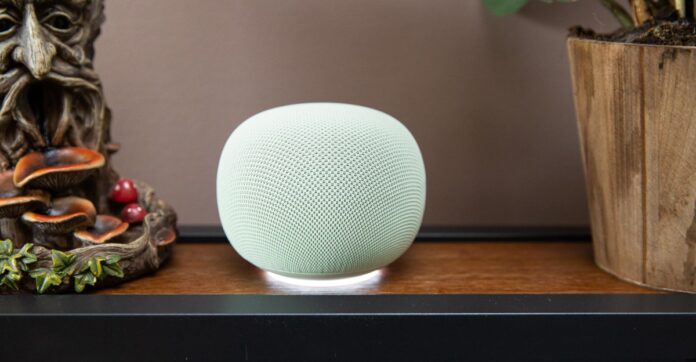
As a piece of hardware, the $99.99 Google Home Speaker is a delight. It is the Goldilocks of smart speakers: large enough to sound good, small enough to blend into a room, attractive without drawing attention, and affordable enough to consider buying more than one.
The Home Speaker fits in seamlessly everywhere I tested it: bedside table, kitchen counter, or two paired below the TV. The soft green jade color blends in without being boring. My only disappointment is the lack of a color-matched cable, something both Apple’s HomePod Mini and Amazon’s Echo Dot Max provide. (Oh, and while the cable finally uses USB-C for the wall brick, it’s not detachable from the speaker itself, which is a problem if you need a longer cable run or if it ever starts to fray.)
There are no visible controls to mar the mesh cloth-covered body, and the voice indicator light ring encircling the base is subtle enough not to be distracting. If it is — for example, when using two speakers below a TV in a dark room — you can turn the light off in settings, something no other speaker offers. The invisible controls, which frustrated me on older Google speakers, are far more responsive. A tap on top stops or starts audio or quickly silences the assistant, and a tap on either side raises or lowers the volume, with faint white dots to show you’ve hit the right spot.
As my colleague David Pierce wrote in his hands-on with the speaker, the sound is good for its softball size. I enjoyed listening to music and podcasts on it. As expected, side by side with the Nest Audio — Google’s taller, previous-generation speaker, which was also priced at $99.99 — the Home Speaker doesn’t sound as good. The Audio had both a woofer and a tweeter; the new speaker has only a single driver, and its bass is thinner since it’s smaller. However, the smaller size makes it easier to find a place for it around the home. It does provide 360-degree sound, which the Audio didn’t, and it’s a huge improvement over the smaller, previous-gen Nest Mini.
I had two review units, so I was able to test the Home Speaker’s stereo pairing feature, and it was a significant upgrade. At 80 percent volume, it filled the room with clear, crisp audio. Bass, however, is barely there.
Compared to the competition — the $99.99 Echo Dot Max and the now pricier $129 HomePod Mini — the Home Speaker came in a close third on audio quality. Testing with the Echo Dot Max brought a bit more bass and a fuller sound, while the HomePod Mini is quieter but cleaner. The Home Speaker is loud and clear and holds its own on mids and vocals, though they stretch a bit thin at times, and the bass falls short — which it does on most speakers this size.
This is the first Google smart speaker you can pair with a Google TV Streamer (and only a Streamer) as an audio output. You can use just one, but adding two gives you simulated spatial audio. My experience was mostly positive. The sound synced well with no dropouts. Streaming YouTube was great; voices came through loud and clear. But watching the World Cup, it sounded like the commentators were talking in a tin can, requiring a switch back to my far more expensive Sonos system.
The Home Speaker also listens well, which is a crucial ability for a smart speaker. It has three far-field microphones and a neural processing unit that handles background noise. It performed well in every scenario I tested, hearing me even from across the room or when it was playing loud music. It was more responsive than the HomePod Mini, but a bit less so than the Echo Dot Max.
As with the competition, the Home Speaker is a Matter controller, so you can use it to add and control Matter devices via Google Home. It’s also the first Google Home audio speaker that can act as a Thread border router.
Software Lows
If you’re considering a Home Speaker, the hardware is the main reason to buy one. On the software side, Gemini for Home — Google’s new smart home voice assistant powered by Gemini models and designed to be more conversational, more functional, and smarter — works on all Google Home speakers. In my testing, it was mostly the same experience on the Nest Audio, Nest Hub (2nd gen), and Nest Hub Max.
That’s good news — Google isn’t locking its latest AI features to new hardware. But it also means there’s little reason to upgrade to the new speaker if you’re happy with what you already have.
Because it’s built for Gemini for Home, I expected the Home Speaker to be noticeably snappier than existing devices, but it wasn’t any faster than the Nest Audio when responding to commands. Sometimes, requests that require the cloud took close to 10 seconds, and even local commands like “Turn on the lights” occasionally lagged just as long.
While Gemini handled complex requests well — I asked it to turn off one room, set the thermostat, and turn on the lights in another room in one sentence — it took 10 seconds to do so. Alexa Plus completed the same request in under three seconds.
Speed aside, Gemini was very accurate with natural conversational control. I could say “Hey Google, I’m cooking and I don’t want to get too hot,” and it knew to turn down the AC. “Hey Google, it’s too dark in here,” and it brightened the lights. When I said I thought there was someone outside, it offered to show my camera feed on a smart display and check my locks. These feel like genuine quality-of-life improvements because they make voice control more natural.
However, Gemini has the memory of a goldfish. While following a recipe, Gemini started walking me through making a cherry tomato pasta sauce until I paused too long and it completely lost the thread. Gemini Live fixes some of this by keeping the conversation open until you tell it to stop and remembering past conversations. But this experience feels bolted on. You invoke it differently, by saying “Hey Google, let’s talk,” and unlike Gemini for Home, it can’t take any actions for you — it’s just for chatting. Gemini Live is also behind a $10-a-month Google Home Premium subscription.
For general knowledge, Gemini is excellent. It’s significantly better than Google Assistant ever was. I couldn’t stump it with questions about the World Cup’s bewildering brackets, and I was genuinely impressed when I asked which of the matches that had already been played that day were worth watching. It summarized them without revealing the scores — correctly inferring that I planned to watch them.
As a home assistant, it feels less reliable. Mid-cooking, I’d ask “When do I add the tomatoes?” only to be told Gemini couldn’t answer unless it verified my voice. This same thing happened fairly often when adding items to my shopping list — despite Google’s Voice Match being set up.
This AI Misses the Mark
The biggest problem with Gemini for Home is that I can’t trust it. Like most LLMs, Gemini is sometimes confidently wrong. It recognized the correct title when I asked for a specific song, then played a completely different track. Then, when I told it had played the wrong song, it played another wrong one. When I asked if I could change the Home Speaker’s voice, it insisted it had no alternative voice options — it does. Then the same question on the Nest Hub Max caused it to hallucinate a list of names that weren’t actual Gemini for Home voices.
At one point, it misinterpreted a command to adjust the thermostat as a security question, telling me instead that if I wanted a summary of what was happening in my home, I needed to upgrade to Google Home Premium Advanced. It then proceeded to spell out the upgrade URL.
TV controls were the least reliable. Sometimes “Turn on the TV and play YouTube TV” worked. Sometimes Gemini claimed content wasn’t available when it was. Other times it announced “Turning on the Living Room TV and launching ESPN,” and then did nothing.
After spending five days testing Gemini for Home on the Home Speaker, I give the edge to Alexa Plus and its Echo Dot Max. While Gemini for Home’s inference abilities were superior in my testing, Alexa Plus has narrowed the gap significantly in terms of general knowledge. It also has better smart home controls, and I can ask it to set up routines with my voice, something Google doesn’t offer.
Google built the smart speaker its ecosystem needed: good sound, a cleaner, more modern design, and the radios and processing power to anchor a modern smart home. But Gemini for Home isn’t there yet as an assistant. It’s more conversational than Google Assistant ever was, and much smarter. But right now it’s slow and less reliable. Add the subscription requirement for some of its more compelling features, and the result is a great smart speaker waiting for its AI to catch up.


