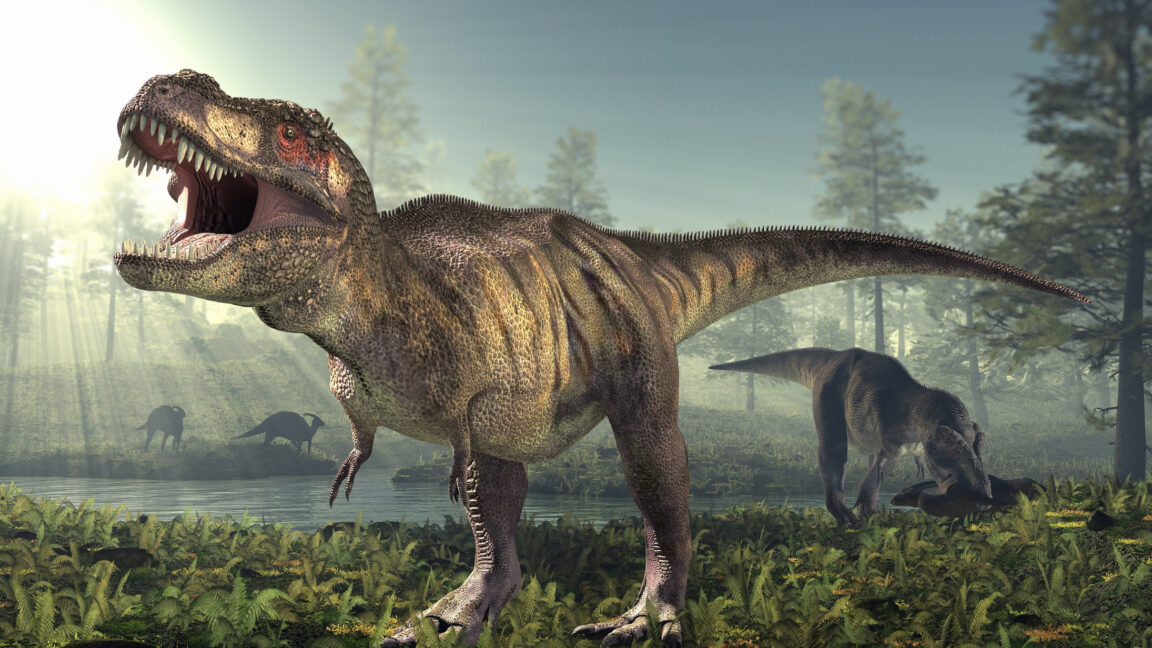

The Dinosaur Feeding Frenzy: Why T. rex’s Bone-Crushing Reign Was Built Different
Was the epic Jurassic Park III battle between T. rex and Spinosaurus a thrilling clash of titans, or pure Hollywood fantasy? While the spectacle captured imaginations, paleontological research reveals a far more fascinating truth: these iconic predators occupied entirely different ecological niches, driven by radically distinct hunting strategies and anatomical adaptations. The dinosaur feeding strategies of the Late Cretaceous were not a one-size-fits-all affair. Recent analysis, highlighted by paleontologist Thomas Holtz and others, underscores that Tyrannosaurus rex and its spinosaurid cousins like Spinosaurus and Baryonyx represent contrasting evolutionary solutions to survival – one a specialized bone-crushing powerhouse, the other a versatile, semi-aquatic generalist. Understanding this divergence is crucial, not just for correcting pop-culture myths, but for unraveling the complex dynamics that ruled Mesozoic ecosystems long before mammals rose to dominance.
Decoding Spinosauridae: The Semiaquatic Generalists
The Spinosauridae family, including giants like Spinosaurus aegyptiacus and its relative Baryonyx walkeri, present some of the most bizarre and intriguing body plans among large theropods. Long, crocodile-like snouts, conical teeth lacking serrations, and evidence suggesting significant aquatic adaptations paint a picture far removed from the classic terrestrial predator image.
- The Shoreline Stalker: As paleontologist Scott Rowe references, studies by scientists like Dave Hone and Thomas Holtz paint Spinosaurus as a creature uniquely suited to aquatic and shoreline hunting. “[Spinosaurus was] waiting on the shorelines, waiting for food to go by that it could fish out,” Rowe summarizes. Its elongated jaws studded with conical, interlocking teeth were perfect for grasping slippery fish.
- Dietary Versatility Beyond Fish: Crucially, however, spinosaurid diet wasn’t solely piscivorous. Fossil evidence reveals impressive dietary range:
- A pterosaur (flying reptile) bone found preserved within a Spinosaurus stomach demonstrates they opportunistically snatched aerial prey, likely snatching them from the air or scavenging carcasses near water.
- Iguanodon herbivore remains discovered within the jaws of a Baryonyx fossil provide unequivocal evidence of these spinosaurids hunting or scavenging terrestrial dinosaurs. This Baryonyx evidence is particularly telling as it involves the actual consumption of prey, not just an attack.
- Jaw Mechanics and Function: Unlike the bone-crushing tyrannosaurs, spinosaurid skulls were likely more kinetic. Their jaws were built for speed and precision snatching rather than transmitting massive bite forces. Rowe states, “They had great diversity in their diet. They were generalists…” This generalized feeding strategy allowed them to exploit a wider variety of food sources in their riverine and coastal habitats. Their teeth, while effective for gripping, weren’t suited to shattering bone like a T. rex’s could. They probably swallowed prey whole or in chunks after killing with a rapid bite or with claws.
Table 1: Key Spinosaurid Feeding Adaptations
| Feature | Description | Function for Feeding |
|---|---|---|
| Elongated Snout | Long, narrow jaws with conical teeth | Grasping slippery aquatic prey (fish), probing |
| Conical Teeth | Straight, pointed, unserrated teeth | Piercing and holding, minimizing drag in water |
| Sensory Foramina | Numerous nerve openings on snout tip | Detect movement/pressure in water (like crocs) |
| Forelimb Claws | Large, hooked claws (esp. on thumb) | Potentially hooking fish or restraining prey |
| Possible Sail/Hump | Large neural spines | Thermoregulation/display (indirect feeding link?) |
The Tyrannosaur Blueprint: Masters of Overpowering Force
In stark contrast to the spinosaurid’s versatile toolkit, the Tyrannosauroidea lineage, culminating in the legendary Tyrannosaurus rex, pursued an evolutionary path defined by sheer power and specialization for tackling the largest, most dangerous prey.
-
The “Akinetic Skull”: Foundation of the Bone Crusher: Rowe emphasizes a critical anatomical difference: “…stiff, akinetic skulls, meaning they had very little mobility in the joints.” While other large theropods, including allosaurs and spinosaurids, possessed joints allowing some skull elements to flex (kinetic skulls), tyrannosaur skulls were fused and reinforced. This wasn’t a limitation; it was the ultimate adaptation for their predatory behavior.
-
High Stress, High Power Strategy: This rigid skull acted as a supremely stable platform. “The T. rex skull could and most likely did withstand very high stress,” Rowe states, describing their “‘high stress, high power’ strategy, entirely different from other large carnivores.” Imagine a biological hydraulic press – immense bite forces could be channeled directly through the skull and teeth without the structure buckling or flexing excessively. Rowe draws the parallel: “They were very much like big crocodiles with extremely strong, reinforced jaws and powerful muscles that could pulverize bones.” Biomechanical studies back this, estimating T. rex bite forces exceeding 8,000 pounds per square inch – powerful enough to shatter bone. (Source on bite force, e.g., Bates & Falkingham 2012).
-
The Ambush Specialist: Tyrannosaurus rex wasn’t built for prolonged chases or delicate feeding on fish. Rowe argues it was a specialist – “an ambush predator that attacked large, highly mobile prey, aiming to subdue it with a single bite.” Its powerful hind limbs allowed for sudden bursts of speed, closing the gap quickly. Its binocular vision provided depth perception crucial for targeting a lethal strike. The infamous “puncture-pull” feeding technique involved biting deeply, holding on, and using immense neck muscles to tear away flesh and bone.
-
Irrefutable Fossil Evidence: Theory becomes tangible reality with fossils. Rowe cites a compelling example: “In the Museum of Natural History in New York, there is a Hadrosaur… and there’s a T. rex tooth embedded in its back.” Critically, “there are healing marks around the stuck tooth.” This tells a dramatic story:
- Attack: The T. rex successfully ambushed and bit the hadrosaur.
- Tooth Loss: During the struggle, a tooth broke off and lodged in the hadrosaur’s spine.
- Escape & Healing: The hadrosaursurvived the initial attack and lived long enough for bone to begin healing around the embedded tooth fragment.
This fossil is concrete proof of active predation and the immense stresses involved in Tyrannosaurus rex attacks – stresses powerful enough to shatter the attacker’s own teeth. “[They] pulverize bones,” Rowe reiterates. Studies of coprolites (fossil dung) attributed to T. rex are riddled with fragments of pulverized bone, further confirming this bone-processing capability was a key part of their energy intake.
Table 2: Tyrannosaurus rex vs. Spinosaurus: A Predatory Comparison
| Characteristic | Tyrannosaurus rex | Spinosaurus | Evolutionary Implication |
|---|---|---|---|
| Primary Habitat | Terrestrial | Semi-aquatic / Shoreline | Dictated different prey bases |
| Skull Type | Starkinet (Rigid, fused joints) | More kinetic (Some flexibility) | T. rex for brute force; Spino for speed/precision |
| Dietary Strategy | Specialist (Large Prey Hunt) | Generalist (Fish, Pterosaurs, Dinos) | Broader ecological niche for Spino |
| Hunting Method | Ambush Predator (High Power Bite) | Ambush/Pursuit (Shoreline/Fishing) | T. rex relied on sudden power; Spino on opportunity |
| Prey Size/Type | Large Herbivores (Hadrosaurs, etc.) | Fish, Pterosaurs, Small-Med Dinosaurs | T. rex tackled heavily armored prey |
| Signature Trait | Bone-Crushing Bite Force | Aquatic Adaptations & Diverse Diet | Ultimate power vs. Ecological flexibility |
Myth Versus Reality: Settling the Jurassic Park Rivalry
The iconic battle in Jurassic Park III where Spinosaurus kills the T. rex has fueled endless debate. However, paleontological evidence strongly weighs against such an outcome. “The fight with the Spinosaurus most likely wouldn’t go the way it did… The T. rex was built to fight like that; the Spinosaurus really wasn’t,” Rowe concludes succinctly. While Spinosaurus was large (possibly exceeding T. rex in length), its build – a likely less stable center of gravity due to different limb proportions and sail, a skull built not for high-stress combat but for grabbing fish and lighter prey, and potentially less robust vertebrae – made it unsuited for a direct, bone-on-bone brawl with a bone-crushing hyped-up tank like T. rex. T. rex possessed the specialized anatomical weaponry evolved specifically for overwhelming large, struggling, terrestrial prey.
- Complementary Existences: Crucially, these giants likely rarely, if ever, directly competed. T. rex dominated inland floodplains and forests of Late Cretaceous North America (Laramidia), targeting its massive herbivore inhabitants. Spinosaurus prowled the river systems and coastal deltas of North Africa, leveraging its aquatic adaptations. Their paths simply wouldn’t have crossed in nature. This geographical separation further highlights how evolution tailored these distinct giant predator strategies to specific environments and prey sources. The notion of a habitual rivalry is purely a product of modern imagination.
The Enduring Legacy of Mesozoic Adaptations
The divergence between spinosaurid generalists and tyrannosaurid specialists isn’t just academic trivia. It showcases the raw power of natural selection:
- Form Dictates Function: The deep-sea fisherman build of Spinosaurus (hydrodynamic snout, sensory pits, potentially webbed feet inferred from limb bone structure) and the sledgehammer design of T. rex (reinforced skull, banana-sized serrated teeth, massive hind limb muscles) are masterclasses in how anatomy evolves for specific, high-stakes ecological jobs.
- Ecosystem Roles: Generalists often play crucial roles in stabilizing ecosystems by utilizing multiple resources, potentially buffering against fluctuations in any one food source. Specialists, however, can act as powerful regulators of dominant prey populations, like the huge herds of hadrosaurs T. rex hunted. Both strategies were successful, serving different purposes in the complex Cretaceous food web.
- The Power of the Bone Crush: T. rex’s bone-crushing hyper-carnivory represents an apex adaptation amongst land predators. By consuming entire carcasses, bones and all, it maximized nutrient intake and minimized waste, potentially allowing it to achieve and maintain its colossal size in resource-rich environments.
Conclusion
The dinosaur feeding strategies revealed by fossils and cutting-edge biomechanical research paint a nuanced picture of Cretaceous predation. Spinosaurus, the “weird” giant fisherman of the river deltas, leveraged its semi-aquatic adaptations and a generalist palate to thrive along shorelines, snagging fish, opportunistic pterosaurs, and smaller dinosaurs. Its cousin Baryonyx mirrored this dietary versatility. In contrast, Tyrannosaurus rex, king of the terrestrial domains, embodied raw power—a fierce ambush predator engineered through its akinetic skull and unparalleled bite force to hunt, kill, and utterly consume the largest herbivores, bone marrow and all. The infamous movie clash was pure spectacle; nature crafted these dinosaurs for radically different battles. Their contrasting anatomies weren’t flaws, but evolutionary perfection for their unique predatory roles. One flexibly conquered the water’s edge; the other ruled the jungle by sheer, bone-shattering dominance. So, who truly wore the crown? In its own realm, each reigned supreme. What do you think – was ecological specialization more impressive than brute force? Share your prehistoric predator preferences below!
Sources & Further Reading:
Original article at arstechnica.com


