
AMD Flexes AI and Gaming Might: CES 2026 Unveils Refined Laptops, Powerful Desktop King, and Future AI Titans
(Hook) Are you still clinging to a pre-AI laptop, or wondering if AMD can maintain its gaming processor crown? At CES 2026, CEO Dr. Lisa Su showcased AMD’s strategic roadmap, answering these questions with tangible upgrades and tantalizing glimpses into the future. Beyond hype, this year’s announcements solidify AMD’s position across consumer laptops, high-performance gaming desktops, enterprise solutions, and bleeding-edge AI acceleration. The Ryzen AI 400 series laptops sharpen AMD’s edge against Intel’s incoming Panther Lake, a boosted Ryzen 7 9850X3D aims to fend off next-gen Intel desktop chips, and Strix Halo expands for creative pros, while enterprise chips and monstrous future accelerators paint AMD’s wider AI ambitions.
(Castle Walls Rise: The Laptop Defense – Ryzen AI 400 Series)
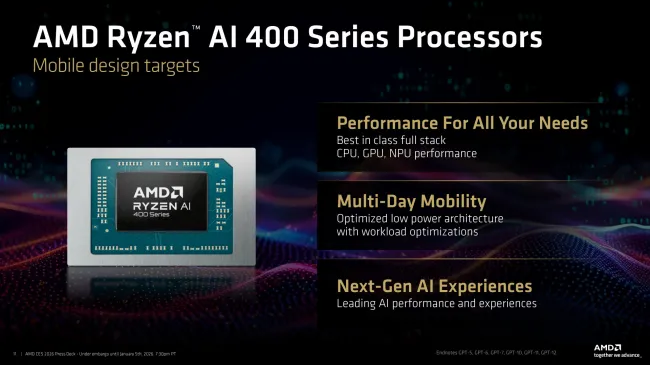
Building on the well-received Ryzen AI 300 series, AMD isn’t reinventing the wheel. Instead, it’s polishing it to near perfection based on the existing Zen 5 architecture. The strategy is clear: leverage proven silicon efficiency while extracting more performance through higher clockspeeds and refined components, positioning strongly against Intel’s imminent Panther Lake mobile processors. The AI 300 series already set a high bar, particularly dominating Intel’s Lunar Lake and Arrow Lake under Linux environments. The AI 400 series aims to raise that bar incrementally but meaningfully.
So, what’s actually better? Here’s the spec bump:
- CPU Speed: Maximum boost clock jumps to 5.2 GHz, promising snappier application and multitasking performance.
- GPU Power: The integrated RDNA 3.5 graphics now boost up to 3.1 GHz, translating to smoother visuals and potentially better casual gaming or creative workflows without a discrete GPU.
- AI Focus: The headline upgrade is the XDNA 2 NPU, supporting up to 60 AI TOPS (Trillion Operations Per Second). This caters directly to the exploding demand for on-device AI processing in Windows and Linux ecosystems.
- Memory Speed: Support for faster DDR5 8533 MT/s memory enables bandwidth-hungry applications and contributes to overall responsiveness.
This refresh provides a clear value proposition: It’s the ideal upgrade path for users on laptops several years old. If you’re already using an AI 300 series laptop, the improvements, while nice, likely don’t justify an immediate switch. AMD itself positions this as a “wait for Zen 6” moment for current AI 300 owners. However, the real battleground begins later this quarter when AI 400 laptops hit shelves. Independent testing, particularly Linux compatibility and performance benchmarks (crucial for developers and power users), will be key to assessing its true competitiveness against Panther Lake.
(Fortifying the High Ground: Expanding Strix Halo)
For users demanding significantly more graphics muscle than standard laptop APUs provide, AMD significantly bolstered its Ryzen AI Max+ line-up within the premium Strix Halo platform. Strix Halo uniquely pairs potent Zen 5 CPUs with GPU complexes rivaling entry-level discrete graphics – ideal for content creators and engineers needing powerful graphics in a portable form factor or Small Form Factor (SFF) desktop.
The new additions provide more flexible performance tiers:
- Ryzen AI Max+ 392: Combines the 12-core / 24-thread CPU configuration previously seen in the Max 390, but grafts on the powerful 40 Compute Unit (CU) RDNA 3.5 GPU previously exclusive to the flagship Max+ 395. This offers potent compute and graphics synergy.
- Ryzen AI Max+ 388: Pairs an 8-core / 16-thread Zen 5 CPU with that same top-tier 40 CU graphics unit. This caters to users prioritising immense graphics horsepower over maximum CPU threads.
- This strategic expansion bridges the gap between CPU-centric and GPU-centric configurations, giving OEMs and end-users more flexibility. Expect these powerful chips to appear in premium creator laptops and innovative compact desktops throughout 2026. Improving AMD’s ROCm (Radeon Open Compute platform) software ecosystem, especially its Linux support and performance, was also highlighted – critical for professional applications leveraging these GPUs.
(Securing the Throne: Desktop Gaming Dominance with Ryzen 7 9850X3D)
While desktops took a backseat to AMD’s mobile wave at this CES, a crucial upgrade emerged: the Ryzen 7 9850X3D. Designed explicitly to retain the “world’s fastest gaming CPU” crown amidst Intel’s upcoming Nova Lake and potential Arrow Lake refreshes, this is evolution, not revolution.
- Core Specs: Retains the proven formula: 8 cores / 16 threads using AMD’s breakthrough 3D V-Cache packaging technology, delivering a massive 104MB total cache. This huge cache pool significantly boosts performance in latency-sensitive applications like games.
- Key Upgrade: The game-changing boost? A skyrocketing 5.6 GHz boost clock frequency. That’s a +400 MHz jump over its predecessor, the 9800X3D. While IPC (Instructions Per Cycle) remains constant on the Zen 5 architecture, this substantial clock speed increase directly targets delivering higher frame rates and smoother gaming performance in titles that aren’t severely bottlenecked by cache access.
This move highlights AMD’s confidence in the 3D V-Cache formula. Facing entirely new competing architectures from Intel (Nova Lake), AMD didn’t redesign the chip. Instead, it optimized aggressively for clock speeds within the existing thermal envelope, pushing its unique advantage – massive cache backed by faster clocks – to maintain leadership. Real-world benchmarks comparing it against Intel’s future offerings will be crucial, but strategically, the 9850X3D shores up AMD’s desktop defense.
(The Future Battleground: Enterprise Expansion and AI Frontiers)
AMD’s ambitions extend far beyond traditional consumer PCs. CES 2026 saw significant announcements targeting embedded systems and high-performance computing – areas increasingly driven by AI.
- Ryzen AI Embedded P100 Series: Tailored for demanding embedded applications. Offers configurations differentiated by segment:
- Up to 6 cores for immersive experiences (Digital Signage, Advanced Cockpits)
- Up to 12 cores for Industrial Automation and Edge Control workloads
- Succeeding the Ryzen Embedded 8000 series (BGA packaging)
- Combines Zen 5 CPU cores, XDNA 2 NPU for localized AI inference, and RDNA 3.5 graphics.
- Availability: First Half of 2026.
- Ryzen AI Embedded X100 Series: Targets heavy-duty enterprise & server-edge workloads demanding maximum compute density.
- Up to 16 powerful Zen 5 CPU cores.
- Features the same integrated XDNA 2 NPU and RDNA 3.5 graphics for AI visualization/compute convergence.
- Availability: Second Half of 2026.
- Learn more about AMD Embedded Processors
These embedded platforms underline the integration of NPUs into diverse computing endpoints powering smart factories, interactive displays, medical imaging, and more, enabling on-device intelligence without cloud dependency.
Yet, the most jaw-dropping reveal was Lisa Su’s tease for the data center: the next-generation Instinct MI500 series, slated for 2027. Targeting a staggering up to 1,000 times the AI performance of the already potent Instinct MI300X, this ambition underscores AMD’s determination to challenge NVIDIA’s dominance in large-scale AI training and inference. The scale of this leap hints at revolutionary architectural changes, potentially leveraging advanced packaging, new compute paradigms, and significant memory system innovations. While futuristic, it sets the tone for unprecedented AI compute density, crucial for the next wave of massive language models and scientific discovery. Expanding the current roadmap, AMD also provided more technical details on the Instinct MI430X and MI440X accelerators near-term, and their integrated Helios rack-scale systems.
(Victory Lap and Call to Arms)
AMD’s CES 2026 wasn’t solely about revolutionary new products, but a calculated refinement and diversification of its portfolio. The Ryzen AI 400 series sharpens AMD’s laptop spearhead for the clash with Intel’s Panther Lake, offering tangible improvements in CPU/GPU clocks and significant NPU uplift for Windows and Linux users. The Strix Halo expansion empowers creators with flexible high-performance APUs. The Ryzen 7 9850X3D‘s clock speed boost strengthens AMD’s grip on the gaming desktop throne ahead of Intel’s next-gen onslaught. Simultaneously, AI-focused embedded P100/X100 chips expand AMD


