
Is Arm About to Dominate the AI PC and Smartphone Landscape? Introducing Lumex.
Are you ready for a seismic shift in the performance of your next smartphone or PC? Arm, a leading provider of processor designs, recently unveiled Lumex, a new compute subsystem platform meticulously crafted for the age of Artificial Intelligence (AI). This platform promises to revolutionize the way AI tasks are handled on next-generation devices. The Arm Lumex platform represents a significant step forward, combining cutting-edge hardware and optimized software to deliver unparalleled AI performance on both PCs and smartphones. This article delves into the details of Lumex, exploring its key components and potential impact on the future of mobile and personal computing.
Decoding the Arm Lumex Platform: A Deep Dive
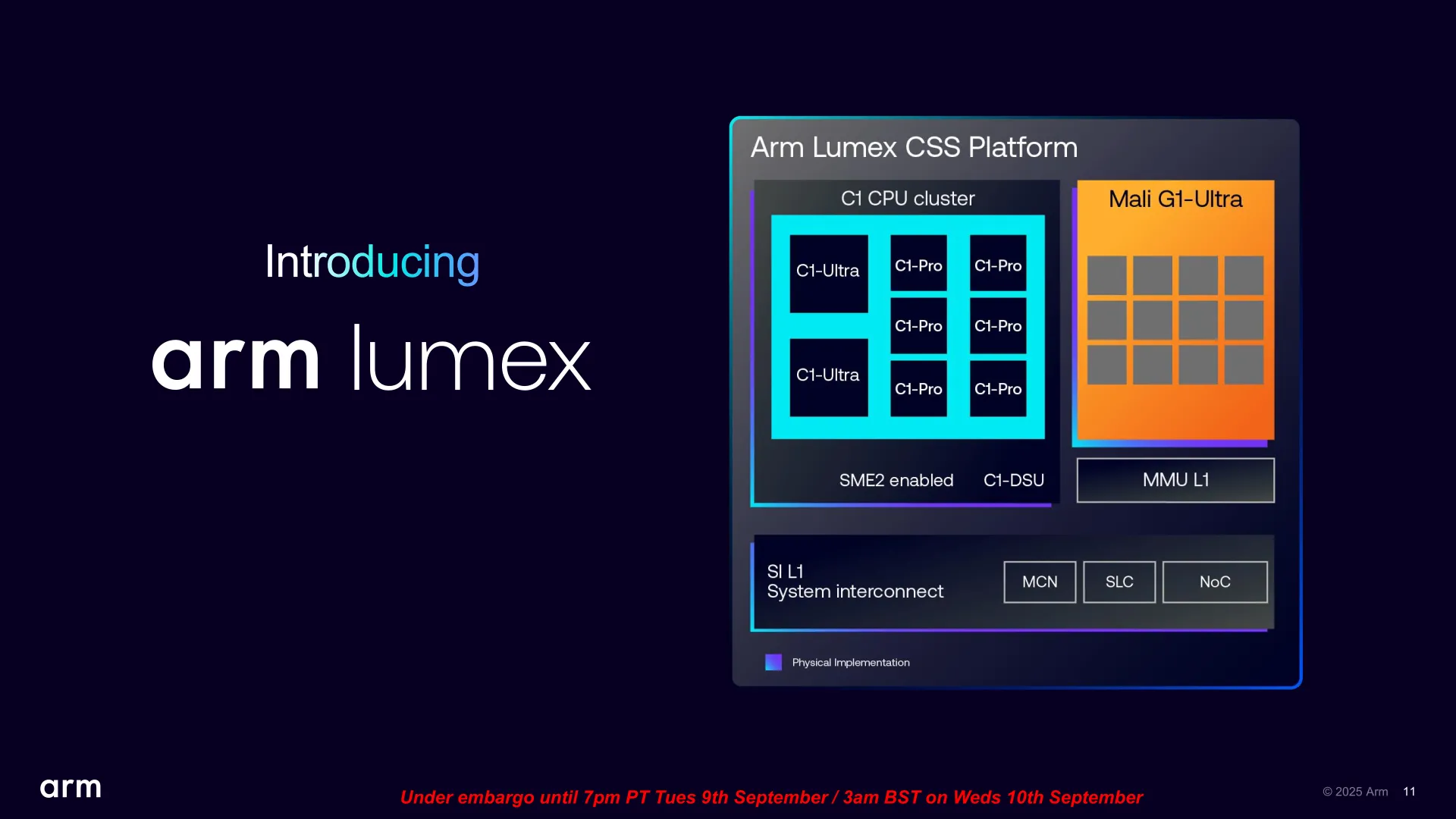
The Arm Lumex platform isn’t just a single processor; it’s a complete compute subsystem designed from the ground up for AI acceleration. This comprehensive approach encompasses CPUs, GPUs, and other system IP, all working in harmony with an optimized software stack. The key here is integration – making sure everything works together seamlessly to maximize performance and efficiency. Let’s break down the core elements that make up Lumex.
Arm’s Advanced AArch64 CPUs with Scalable Matrix Extensions 2 (SME2)
At the heart of the Lumex platform are Arm’s latest AArch64 CPUs, built on the Armv9.3 architecture. These processors are the workhorses of the system, handling general-purpose computing tasks and, more importantly, accelerating AI workloads through the integration of Scalable Matrix Extensions 2 (SME2).
SME2 is crucial. These extensions provide specialized instructions that significantly speed up matrix multiplication, a fundamental operation in many AI algorithms, particularly in deep learning [Source: Research Paper on Matrix Multiplication Optimization]. Think of it like this: traditional CPUs are like general contractors who can build anything, while SME2 is like a team of specialists dedicated to constructing a specific type of structure (in this case, matrix operations) much faster and more efficiently.
The Lumex platform boasts a range of CPU options, including:
- C1 Ultra: Positioned as the flagship offering, the C1 Ultra aims for a staggering 25% increase in single-threaded performance year-over-year (YoY) and promises double-digit gains in Instructions Per Clock (IPC). This means faster overall performance and improved responsiveness for demanding applications.
- C1 Premium: A new addition to the lineup, the C1 Premium sits below the C1 Ultra, offering a balance of performance and efficiency for a wider range of devices.
- C1 Pro: Likely targeted towards mid-range devices, the C1 Pro provides a solid performance foundation for everyday AI tasks.
- C1 Nano: Designed for ultra-low-power applications, the C1 Nano focuses on maximizing battery life while still providing adequate performance for basic AI functions.
The availability of multiple CPU tiers allows Arm to cater to a diverse range of devices, from high-end smartphones and powerful laptops to more budget-friendly options.
The Power of the Mali G1-Ultra GPU
Beyond the CPU, the Arm Lumex platform integrates the Mali G1-Ultra GPU. While details remain somewhat scarce, it’s clear that this new GPU IP is designed to complement the CPU in handling AI workloads. Modern AI tasks increasingly leverage the parallel processing capabilities of GPUs to accelerate training and inference [Source: NVIDIA CUDA Documentation]. The Mali G1-Ultra is likely optimized for these tasks, offering improved performance and efficiency compared to previous generations.
The integration of a powerful GPU alongside SME2-enabled CPUs creates a formidable AI processing engine. This combination allows Lumex to handle a wider range of AI tasks, from image recognition and natural language processing to complex simulations and gaming applications.
DynamIQ Shared Unit (DSU) and Deep Software Integration
The DynamIQ Shared Unit (DSU) plays a vital role in connecting the various components of the Lumex platform. It acts as the central hub, providing a coherent and efficient memory system that allows the CPU, GPU, and other system IP to access data quickly and reliably. This shared memory architecture is crucial for minimizing latency and maximizing overall system performance.
Furthermore, Arm emphasizes deep software integration as a key element of the Lumex platform. This includes optimized drivers, libraries, and tools that allow developers to easily leverage the full potential of the hardware. A well-optimized software stack is essential for unlocking the true performance of the underlying hardware. Without it, even the most powerful hardware can be bottlenecked.
The Significance of Scalable Matrix Extensions 2 (SME2)
The widespread support for Scalable Matrix Extensions 2 (SME2) is a major highlight of the Arm Lumex platform. As mentioned earlier, SME2 provides specialized instructions for accelerating matrix multiplication, a fundamental operation in many AI algorithms.
Why is this so important?
- Increased AI Performance: SME2 allows devices to perform AI tasks much faster and more efficiently, leading to improved responsiveness and a better user experience.
- Wider Software Adoption: The availability of SME2-enabled hardware encourages developers to adopt and optimize their software for Arm platforms. This creates a virtuous cycle, where more hardware support leads to more software adoption, which in turn drives further hardware innovation.
- Competitive Advantage: SME2 gives Arm a significant competitive advantage in the AI space, allowing it to compete more effectively with x86-based processors from Intel and AMD, which offer similar extensions like AVX-512 and AMX [Source: Intel AMX Architecture].
The following table highlights the key benefits of adopting SME2:
| Feature | Benefit |
|---|---|
| Matrix Acceleration | Faster AI inferencing and training speeds |
| Energy Efficiency | Reduced power consumption for AI tasks |
| Software Ecosystem | Encourages developer adoption and optimization for ARM |
| Competitive Edge | Positions ARM as a leading platform for AI workloads |
Linux Testing and Benchmarking: The Next Frontier
While the initial announcement of Lumex provides a comprehensive overview of the platform, the real test will come when the hardware is available for independent testing and benchmarking. Linux support is particularly important, as it’s a popular operating system for developers and researchers working on AI projects.
Detailed benchmarks will reveal the true performance of Lumex in real-world AI workloads. These benchmarks will also help to identify any potential bottlenecks or areas for optimization. The Linux community is known for its ability to push hardware to its limits, so thorough testing on Linux will be crucial for validating Arm’s claims.
The Future of AI on Arm: Lumex’s Potential Impact
The Arm Lumex platform has the potential to significantly impact the future of AI on mobile and personal computing devices. By combining cutting-edge hardware with optimized software, Lumex promises to deliver unparalleled AI performance and efficiency. This could lead to a wide range of new and innovative applications, from more intelligent virtual assistants and enhanced image recognition to personalized recommendations and advanced gaming experiences.
Key takeaways:
- Lumex is a complete compute subsystem designed for AI acceleration.
- SME2 is a key feature that significantly speeds up matrix multiplication.
- The platform includes a range of CPU options and a new Mali G1-Ultra GPU.
- Deep software integration is crucial for unlocking the full potential of the hardware.
- Linux testing and benchmarking will be essential for validating Arm’s claims.
What do you think about Arm’s new Lumex platform? Will it revolutionize AI on PCs and smartphones? Share your thoughts in the comments below!
Sources & Further Reading:
Original article at www.phoronix.com


