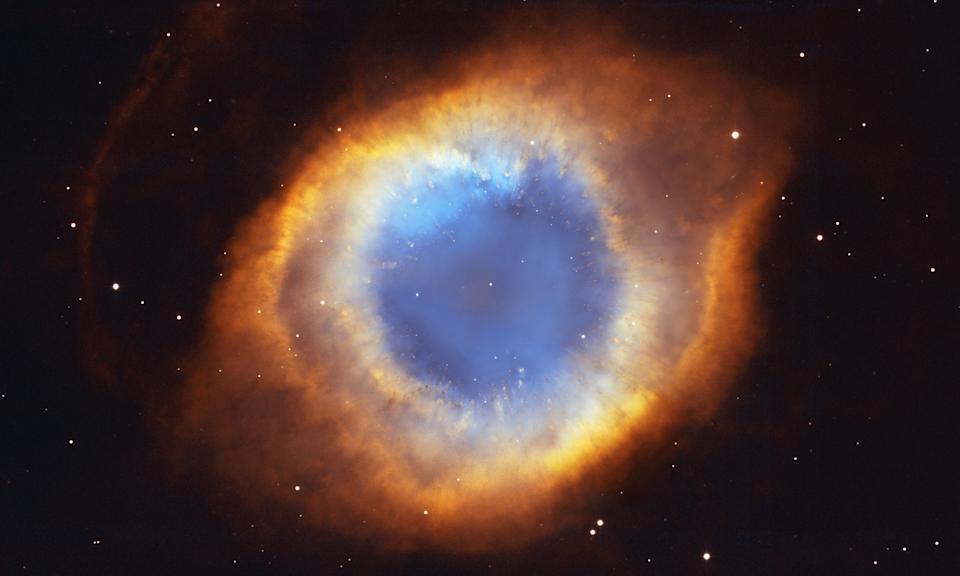

The Nebula Next Door: JWST Unveils Stellar Recycling Bin
Ever wonder where dying stars go to become cosmic fertilizer? At just 655 light-years away, the Helix Nebula serves as Earth’s nearest observable showcase of stellar death and rebirth. Nicknamed the “Eye of God” due to its eerie resemblance to a celestial iris, this planetary nebula recently revealed unprecedented details through NASA’s James Webb Space Telescope (JWST). Its latest portrait transforms abstract astronomy into visceral understanding—demonstrating how expired stars forge the raw materials for future cosmic generations.
From Hubble’s Eye to Webb’s Microscope
The HelixVeil Nebula’s history began with its 19th-century discovery in constellation Aquarius. Hubble’s 2004 imagery established its iconic status, revealing a structure spanning light-years where ultraviolet radiation sculpts interstellar gas. But Webb’s Near-Infrared Camera (NIRCam) zooms beyond superficial grandeur into quantum-level processes:
Hubble vs. Webb Capabilities
| Feature | Hubble (2004) | JWST (NIRCam) |
|——————|————————|————————|
| Resolution | 0.05 arcseconds | 0.03 arcseconds |
| Wavelength Range | Ultraviolet/Optical | Near/Mid-Infrared |
| Detail Revealed | Macro-structure | Molecular interactions |
| Knot Observation | Fuzzy silhouettes | Chemical composition |
While Hubble showed the nebula’s skeletal framework, Webb exposes its cellular activity—capturing processes that could seed new solar systems.
Autopsy of a Dying Star
The nebula’s drama centers on a collapsed stellar core inching toward white dwarf status. As it shed outer layers across millennia, it created an expanding shell resembling an “eye.” Unlike fiery supernovae, such stars expire gradually—pe явления though planetary nebulae (a misnomer from 18th-century astronomers who mistook them for planet progenitors).
The Helix exemplifies stellar recycling:
- Ejected hydrogen/helium forms filaments cooled to 10,000°C
- Carbon/Oxygen/Nitrogen enrich surrounding gas clouds
- Shockwaves compress matter into molecular hydrogen nurseries
ESA scientists confirm: “This expanding corpse contains as much mass as 500 Earths converted into organic compounds.” Dust particles formed here could eventually coalesce into protoplanetary disks—making stellar death a galactic compost heap.
Decoding Webb’s Infrared Palette
Webلها بب بب’s false-color imagery acts as a cosmic thermometer:
- Electric Blue Halos: 20,000°C gas energized by UV photons
- Golden-Yellow Rings: Hydrogen bonding at molecular levels (∼1,000°C)
- Crimson Fringes: Dust clouds cooling below 500°C
These hues map thermodynamics invisible to human eyes. Near the central “pupil,” ultraviolet radiation strips electrons from atoms—creating aurora-like ionization. Further out, thickening carbon-rich soot dims emissions in rust-colored thronesquarters.
The Mystery of Cometary Knots
JWST’s star revelation was ≥10,000 mysterious “knots”—previously unseen tadpole-shaped structures NASA described as “blistering winds colliding with cold gas.” Each averages 100B milesisonés across (larger than our solar system) and contains:
- Hydrogen cyanide ice coatings
- Cyanopolyyne carbon chains
- Amorphous silicate cores
Dynamics Included:
- Hot stellar winds accelerate knots to 300,000 mph
- Shadowing effects cause tails trailing 80AU long
- Sputtering slowly releases carbon into interstellar medium
These structures act as incubators for cosmic soot while migrating away from the dying star—illustrating nebular templeتخیلی evolution in real-time. As Professor Margaret Meixner noted in NASA’s ADS database papers, their survival hints at unknown magnetic confinement mechanisms.
Why This Nebula Matters
At 655 light-years away, the Helix offers a ring-side seat for studying universal recycling processes normally obscured by distance. Compare this to the more distant Butterfly Nebula (3,800 light-years away), where JWST observed bipolar gas outflows. The Helix’s proximity allows researchers to:
- Track molecular recombination rates
- Measure carbon isotope ratios in dust
- Model pollution of nebulae by stellar winds
As telescopes probe deeper, such Waste-to-Wealth transitions rewrite cosmology. The Helix will likely evolve into a diffuse cloud rich with planet-forming minerals within 20,000 years—a cosmic hourglass we’ve now watched invert.
Gazing Through the Cosmic Keyhole
While nicknames like “Eye of God” hint at cosmic mystique, the Helix Nebula embodies astrophysical pragmatism. Its whispered lesson? That stellar death fuels stellar rebirth. Webb didn’t just photograph an ancient star’s remnants—it documented a galactic engine converting nuclear ash into future worlds.
What invisible phenomena might JWST unveil next纯度在—perhaps young protoplanets forming within these recycled clouds? Share your thoughts on nebular mysteries below!
Sources: ESA Webb Archive, NASA Astrophysics Data System (ADS), O’Dell et al. (Vanderbilt), Planetary Nebulae Research Compendium (Cambridge Press)


