
The Hidden Value of Wi-Fi 6E: Can This Extender Really Outshine Wi-Fi 7?
Ever feel like Wi-Fi dead spots haunt every corner of your modern home? You’re not alone—studies show up to 39% of homeowners report persistent connectivity issues even after upgrading routers. Enter the TP-Link AXE5400, a powerful range extender leveraging the often-overlooked Wi-Fi 6E standard. Offered at $139.99/£119.14, this powerhouse outperforms newer Wi-Fi 7 rivals while eliminating coverage gaps. Its emphasis on accessible tri-band technology provides a lifeline for anyone grappling with inconsistent Wi-Fi, blending competitive pricing with unexpectedly robust performance.
Wi-Fi 6E: The Underdog With Serious Muscle
Wi-Fi 6E arrived as the “missing link”—adding the pristine 6GHz band to Wi-Fi 6’s existing 2.4GHz and 5GHz bands. Congestion-plagued lower bands throttled speeds despite Wi-Fi 6 adoption surging. Yet Wi-Fi 6E’s momentum stalled prematurely as Wi-Fi 7’s hype surfaced. Development resources shifted, creating a “generation gap” filled today by heavily discounted Wi-Fi 6E devices like the AXE5400. Unlike Wi-Fi 7 solutions requiring costly router upgrades, 6E benefits from mature pricing while delivering high-speed efficiency ideal for modern 1Gbps broadband networks.
Price Analysis: Why Forgetting Wi-Fi 6E Pays Off
The AXE5400 flips pricing conventions upside down. Released after TP-Link’s entry-level Wi-Fi 7 BE3600 extender ($149.99), its targeted price-point undermines newer hardware, dropping to $139.99/£119.14 despite higher specs:
- Dual-band Wi-Fi 7 (BE3600): 3.6Gbps top speed
- Tri-band Wi-Fi 6E (AXE5400): 5.4Gbps top speed
Regionally, Australia illustrates TP-Link’s strategic skip, offering only older Wi-Fi 6 devices or Wi-Fi 7 options—backing Wi-Fi Alliance findings that manufacturers prioritize newer tech in high-adoption regions. Yet in the US/UK, oversupply discounts make the AXE5400 uniquely disruptive.
Design: Functionality Over Subtlety
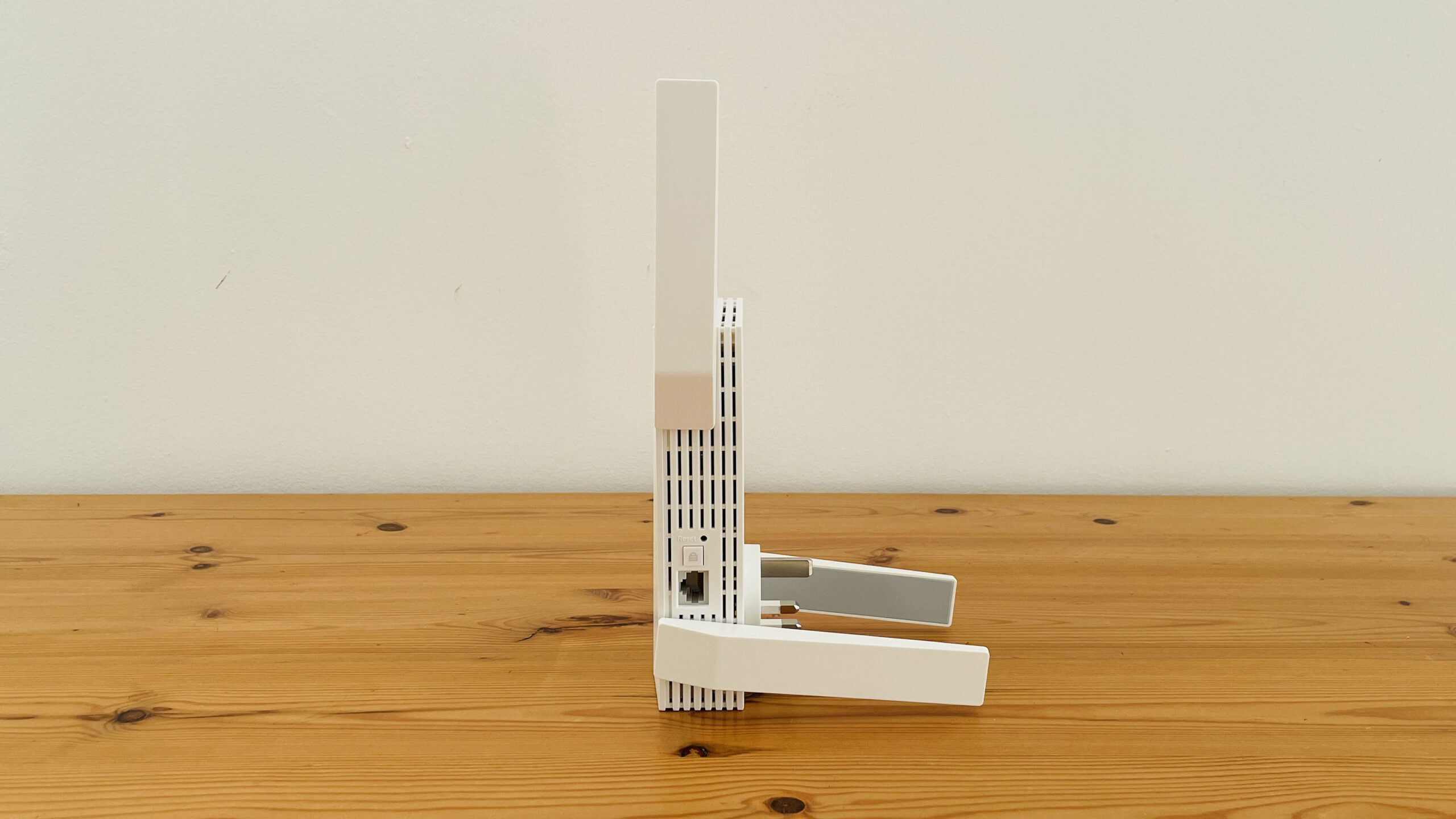
Make no mistake—this unit dominates any outlet. Fully extended antennae stretch it to a wall-eating 348x106x80mm, blocking adjacent sockets in office tests. Its aesthetic strays far from minimalist:
- Four outward-facing antennas configured for omnidirectional broadcast range
- Diagnostic lights requiring front-facing placement
- Over-plug design likely forcing socket compromises
Comparative Dimensions
| Model | Dimensions (mm) | Antenna Design
|—|—|—|
| AXE5400 | 348 x 106 x 80 | 4 external
| Asus RP-BE58 | 150 x 72 x 87 | 2 internal
| TP-Link RE700X | 149 x 78 x 36 | 2 internal
While visually jarring, those towering antennae serve a purpose: capturing faint router signals before rebroadcasting tri-band Wi-Fi across vast zones. The goal? Obliterate dead spots physics-defyingly—one Ethernet port ensures legacy device connections too.
Inside the Tech: Tri-Band Advantages Made Easy
Don’t mistake “last-gen” for underpowered. The AXE5400 packs optimized Wi-Fi 6E features prioritizing compatibility across all devices alongside bleeding-edge performance:
Triple-Band Synergy
Using three parallel bands eliminates congestion chaos:
- Legacy Support: 2.4GHz caters to smart-home/IoT sensors (analyzed as hitting 140Mbps Ookla speeds)
- Balanced Performance: 5GHz streaming/gaming hits max local-bandwidth—150Mbps benchmarked
- Cutting-Edge: Clean-air, ultra-fast 6GHz hitting 5.4Gbps saturates fiber connections
Against Wi-Fi 7 dual-band rivals maxing at 3.6Gbps, tri-band Wi-Fi 6E flexes greater bandwidth headroom here.
Adaptive Networking Intelligence
The AXE5400 incorporates “adaptive path selection”—typically marketed as roaming. Its antennas continually evaluate device proximity, shuffling connections between your router or extender dynamically.


