
Is Your CPU Cooler Keeping Secrets? Why Real-Time Temps Might Be Gaming’s Best Upgrade
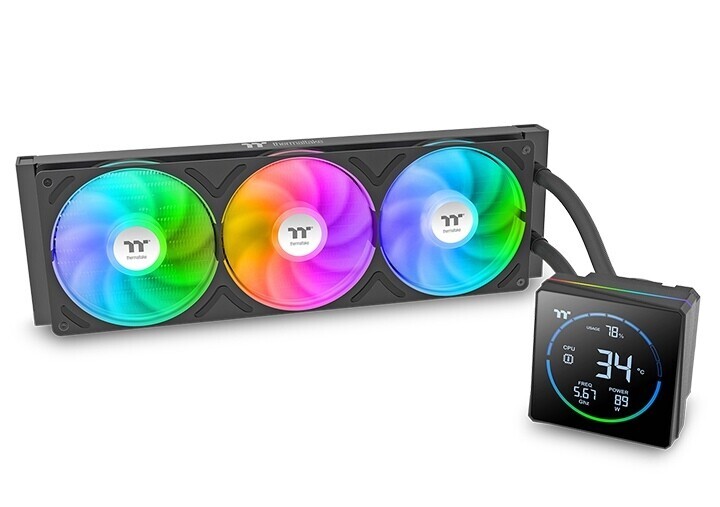
Have you ever finished an intense gaming session wondering just how hot your CPU actually got? Or glanced nervously at monitoring software while stressing your processor with demanding tasks? Traditional CPU coolers, even flashy Liquid Cooled All-In-Ones, often leave vital performance telemetry buried deep in software or BIOS menus. Thermaltake’s new TH-S V3 ARGB Sync series directly tackles this blind spot, injecting a novel dose of diagnostic clarity into the heart of your cooling system. Introduced in both 240mm and 360mm radiator sizes and stylish black or white trims, these mid-range liquid CPU coolers prioritize presenting real-time CPU vitals – temperature, usage, clock speed, and power draw – via a built-in LED segment display encircled by dazzling ARGB lighting. It promises integrated performance monitoring fused with high-performance cooling and customizable aesthetics, potentially setting a new standard for intuitive hardware interaction. Understanding how your liquid CPU cooler actively handles processor load is crucial for enthusiasts seeking peak performance and longevity.
Beyond the Bling: Unpacking the TH-S V3 ARGB Sync Display Tech
The standout feature demanding scrutiny is undoubtedly the CPU block’s integrated segment LED display. This isn’t merely decorative; it’s functional feedback central to Thermaltake’s vision. Unlike rival mid-tier coolers relying solely on companion software (or nothing at all), the TH-S V3 projects critical CPU parameters physically onto the cooler itself. How does it achieve this?
- Data Acquisition: The display pulls information directly from Advanced Configuration and Power Interface (ACPI) data tables – the foundational layer for system hardware communication within modern operating systems. This method ensures access to vital sensor readings directly from the CPU and motherboard.
- Software Interface: Thermaltake’s TT RGB Plus software serves as the communication hub. Installed on your system, it retrieves ACPI-derived data (CPU Temp, Usage Avg, Clock Speed, Power Draw) and transmits it back to the cooler block via a dedicated USB connection. This bypasses reliance on proprietary motherboard RGB or sensor headers, using a more universally supported pathway.
- Real-Time Monitoring: The simple segment display provides a continuously updated snapshot of your CPU’s condition. You instantly know the core temperature under load, whether all cores are firing correctly during rendering, if extreme overclocking is stable, or if CPU power consumption spikes unexpectedly. This integration eliminates the need for overlays or alt-tabbing during gameplay.
Complementing the functional display is the ARGB lighting ring surrounding it, illuminating the CPU socket area and creating a signature visual focal point within your chassis.
Engineering Under Pressure: Performance Specs Laid Bare
While aesthetics catch the eye, cooling efficacy determines survival under demanding workloads. Thermaltake has engineered the TH-S V3 ARGB Sync with specs targeting robust thermal management within its mid-range positioning:
- Pump Performance: The fluid loop relies on a pump-block unit operating at speeds ranging from 800 RPM (low-noise idle) up to a potent 2500 RPM at peak demand. Efficient pump design ensures rapid coolant flow to transfer heat from the CPU to the radiator efficiently. PWM control within the TT RGB Plus software allows customizable response curves balancing noise and cooling power.
- Fan Design & Capability: Bundled with 120mm Hydraulic Bearing fans, the cooler offers choices (240mm: 2 fans; 360mm: 3 fans). These fans boast a wide operational range:
- Speed: 500 – 2500 RPM (PWM Controlled)
- Airflow Capacity: Up to 85.29 CFM (Cubic Feet per Minute)
- Static Pressure: Up to 3.86 mm H₂O (Crucial for pushing air through dense radiator fins)
- Noise Output: Maximum 37.8 dBA at full speed.
- Power Draw: Requires voltage header headers for power and a connector(s) for control/synchronization.
This fan profile highlights a focus on high static pressure – essential for liquid cooling radiators where air needs to penetrate tightly packed fins – alongside respectable airflow volume. While not the absolute highest values on the market, they are competitive, especially considering the projected price bracket. Users prioritizing silence can configure fan curves favoring lower RPMs when performance demands are modest. Unlike some competitors bundling basic fans, Thermaltake equips these with integrated ARGB lighting, controllable via TT RGB Plus RGB Cooler Fan software.
Light Control Hub: Syncing the TT Ecosystem
Thermaltake recognizes modern builders crave cohesive aesthetics. The TH-S V3 leverages their existing TT RGB Plus software ecosystem for unified control, acting as a central hub:
- Single-Pane Control: Both the ARGB lighting ring encircling the display on the CPU block and the ARGB lighting integrated into all included fans are managed simultaneously within TT RGB Plus. This eliminates juggling multiple control utilities.
- Synchronicity: Users can synchronize lighting effects (static colors, breathing, spectrum cycling, effects tied to CPU usage/temperature, etc.) seamlessly across the cooler block and all radiator fans. This creates a visually uniform experience consistent with Thermaltake’s broader ARGB-compatible product lines.
- Data Transmission: Crucially, this same software is responsible for acquiring system sensor data via ACPI and piping that numerical data back to the segment display on the cooler block via USB. This integrated approach streamlines functionality but does require USB header connection on the motherboard and software installation.
This unified ARGB Sync Liquid Cooling approach enhances user convenience but ties functionality tightly to Thermaltake’s ecosystem compared to solutions using standards like Asus Aura Sync, Gigabyte RGB Fusion 2.0, Micro-Star Mystic Light Sync, or ASRock Polychrome SYNC motherboard integrations for lighting. For builders already invested in Thermaltake RGB components, this is seamless; others might find it an additional layer. Reliance on software can introduce potential points of failure (driver conflicts, software bugs) affecting both lighting and display functionality.
Situating the Contender: The Mid-Range Liquid Cooling Landscape
The TH-S V3 ARGB Sync enters a fiercely competitive segment dominated by established brands like Corsair (H100i, H150i series), NZXT (Kraken series), Arctic (Liquid Freezer II), Lian Li (Galahad series), and Deepcool (LS/LT series). How does its proposition stack up?
| Feature | Thermaltake TH-S V3 ARGB Sync | Competitor Typical Mid-Range | Thermaltake Distinguisher |
|---|---|---|---|
| Key Innovation | Segment LED Display on Block | Strong Focus on Pump/Block Lighting | Hardware-Level CPU Monitoring |
| Display Data Sources | Software via ACPI/USB | Primarily Software Dashboards | Direct Physical Readout |
| RGB Control | TT RGB Plus Ecosystem | Brand-Specific Software, Some Mobo Sync | Unified within TT |
| Fan Performance | High Static Pressure Focus | Varies Widely | Competitive CFM/Pressure |
| Max Noise | 37.8 dBA | Typically 35-42 dBA | Middle of Range |
| Software Reliance | Essential for Display/RGB | Essential for RGB/Customization | Block Display Requires SW |
| Price Position | Not Published (Target Mid-Range) | $90-$150+ (240mm), $120-$180+ (360mm) | TBD |
The segment LED display is Thermaltake’s strategic differentiator. While rivals like NZXT Kraken Z/L-series offer LCD displays, these are often prefixed by displays enabling customization (e.g., GIFs), reside in significantly higher price brackets, and prioritize aesthetic customization over straightforward telemetry (NZXT Kraken Z63 Overview). Corsair’s Elite LCD series similarly targets high-end buyers prioritizing aesthetics alongside data (Corsair iCUE Link LCD Overview). Thermaltake appears to be leveraging older segment technology specifically for utilitarian telemetry in the mid-range, avoiding flashy LCDs to manage costs. This positions the TH-S V3 as potentially offering unique functional insight without demanding a premium-tier investment.
Balancing Brilliance with Practicality: Potential Implications
The TH-S V3 ARGB Sync’s approach raises intriguing considerations:
- Functional Clarity: For users valuing rapid diagnostics without software clutter or overlays, the physical display offers genuine convenience. Quickly verifying safe temperatures during heavy CPU utilization becomes trivial.
- Software Reliance: The necessity of TT RGB Plus software running for the display to function is a dependency. Potential software conflicts or OS updates disrupting functionality remain inherent risks. Users preferring minimal software footprints might see this as a drawback.
- Mid-Range Viability: The crucial unanswered question is pricing. To succeed, Thermaltake needs to price the TH-S V3 competitively against feature-rich non-display rivals like the Arctic Liquid Freezer II (known for exceptional price/performance) or Corsair’s H Series. Adding the display tech without significantly inflating costs will be key.
- Performance Parity: While specs are promising, real-world thermal benchmarking against competitors like the Lian Li Galahad II or DeepCool LS/LT models will be the ultimate arbiter. High advertised fan specs don’t always equate to superior thermal dissipation (Understanding CPU Cooler Performance).
- Building Integration: The inclusion of fans with ARGB reduces the need for separate fan purchases but requires adequate fan and RGB headers on the motherboard. Sizing options cater flexibly to most cases, though clearance for the thicker CPU block assembly should be checked on compact motherboards.
When Seeing Heat Builds Better Systems
Thermaltake’s TH-S V3 ARGB Sync injects a welcome dose of practical monitoring into the crowded mid-range CPU cooler market. Its innovation lies not in revolutionary cooling mechanics, but in integrating real-time CPU diagnostics directly onto the hardware most responsible for managing CPU temperatures: the cooler


