
The Nose Goes Digital
In a quiet shop on Ginnekenstraat, a pedestrian street in the Dutch city of Breda, you can answer a short questionnaire about yourself and walk out less than an hour later holding a body spray that did not exist when you arrived.
The questions aren’t the ones a sales assistant asks. What color best represents you. Where would you go right now, if you could go anywhere at all. How would you describe your style.
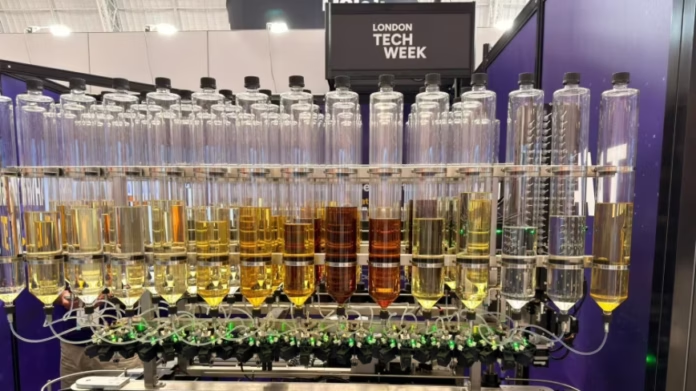
You answer, a set of algorithms reads your replies, and a machine in the room composes a scent to match, the bottle filled and labelled while you wait.
The Company Behind the Revolution
The company that built this room is called Scentronix, and for the better part of a decade it has argued that the way the world buys perfume is stranger than we admit. Its founders — Dutch artist and filmmaker Frederik Duerinck and scent designer Anahita Mekanik — frame the strangeness as a question: why should roughly 800 people decide how 8 billion people smell?
They’re referring to the small guild of master perfumers — the “noses” — who create virtually every scent on virtually every shelf. It’s a provocation, and like the best provocations, it carries a real insight inside it. For most of its history, perfume has been a closed art, elite and distant. Software is quietly prying it open.
AI in the Industry: From Philyra to Carto
The biggest names in the business reached the same conclusion years ago. In 2019, the German fragrance house Symrise paired its perfumers with an artificial intelligence system built alongside IBM Research, named Philyra. Trained on a vast archive of formulations and performance data, Philyra could suggest pairings no human would reach for — unburdened by habit or fashion.
Symrise perfumer David Apel composed two fragrances for the Brazilian brand O Boticário, released as the Egeo line. They were, by most accounts, the first AI-formulated perfumes to go on sale anywhere.
Givaudan, the largest fragrance house in the world, developed Carto — a touchscreen system that lays out a formula as a visual map and feeds it to a robot that blends a physical sample in seconds. Perfumers can test an idea virtually as fast as they can have it.
Not Everyone Is Convinced
Jean-Claude Ellena, the former in-house perfumer at Hermès and one of the most admired noses alive, has argued that a machine cannot read the intentions that guide a perfumer through a composition. He has said, with some sadness, that he pities the junior perfumer who will someday be handed a machine’s draft and asked to polish it.
Coming from someone who treats perfume as a form of literature, the objection lands. There is a real risk that automation flattens a craft into a workflow, that the strange, intuitive leaps get optimized away.
But the Fear Misses the Point
The fear assumes a contest — human against machine — and that is not what these tools are. Every single one of them keeps the perfumer in the room. Symrise calls Philyra an apprentice, not a replacement. Carto puts the formula on a screen, and a person still decides what’s beautiful. Even Scentronix, the most automated of the lot, routes roughly one customer in 50 to a human perfumer to fix whatever the algorithm has misjudged.
Beyond Perfume: Teaching Computers to Smell
Smell is the sense that has always resisted the machine. We taught computers to see and to hear decades ago, but odor — a chaos of molecules binding to receptors in ways we still only partly understand — stayed stubbornly analogue. That is changing. Researchers at Google have trained neural networks to predict how a molecule will smell from its structure alone. A European project called Odeuropa has used AI to recover the lost scents of historical Europe from centuries of text.
A $60 Billion Market Opens Up
The market for all this is large and quietly conservative. Industry estimates put global fragrance sales at around $60 billion a year, a business still shaped by a handful of houses, a rotation of celebrity licenses, and the same few hundred noses deciding what the rest of us wear. A system that lets a teenager in a pop-up store, or a small brand with no money for a laboratory, create something that smells like them and only them — that is not a threat. It’s an expansion.
Final Thoughts
What AI offers the perfume industry is not a verdict but an invitation — an opportunity to treat the oldest and most intimate of the senses as something you make rather than something you pick from a shelf. You walk in as a customer. You walk out, an hour later, holding a small bottle that smells like an answer to a question only you were asked, and that did not exist anywhere in the world when you woke that morning.


