
Navigating the Crowded Sky: Starlink’s Bold Orbit Shift for Space Safety
Imagine thousands of satellites zipping overhead. What happens if just two collide? Could a single mishap trigger a catastrophic chain reaction, littering Earth’s orbital highways with deadly debris? This “Kessler Syndrome” nightmare scenario isn’t sci-fi; it’s a growing concern as satellites rapidly proliferate. Against this backdrop, SpaceX’s Starlink network, the world’s largest satellite constellation, is executing a massive orbital maneuver reshaping cosmic infrastructure. Starlink isn’t just participating in space traffic management; it’s making an unprecedented move to proactively enhance safety on an industrial scale. The company announced plans to lower the orbits of approximately 4,400 satellites—the bulk of its operational fleet—from 550 kilometers down to 480 kilometers. This colossal shift, driven by escalating collision risks and celestial cycles, signals a pivotal moment in the commercialization of low-Earth orbit (LEO) and underscores the urgent importance of responsible space traffic management practices for preserving this vital domain.
The Great Descent: Starlink’s Constellation Reconfiguration Strategy
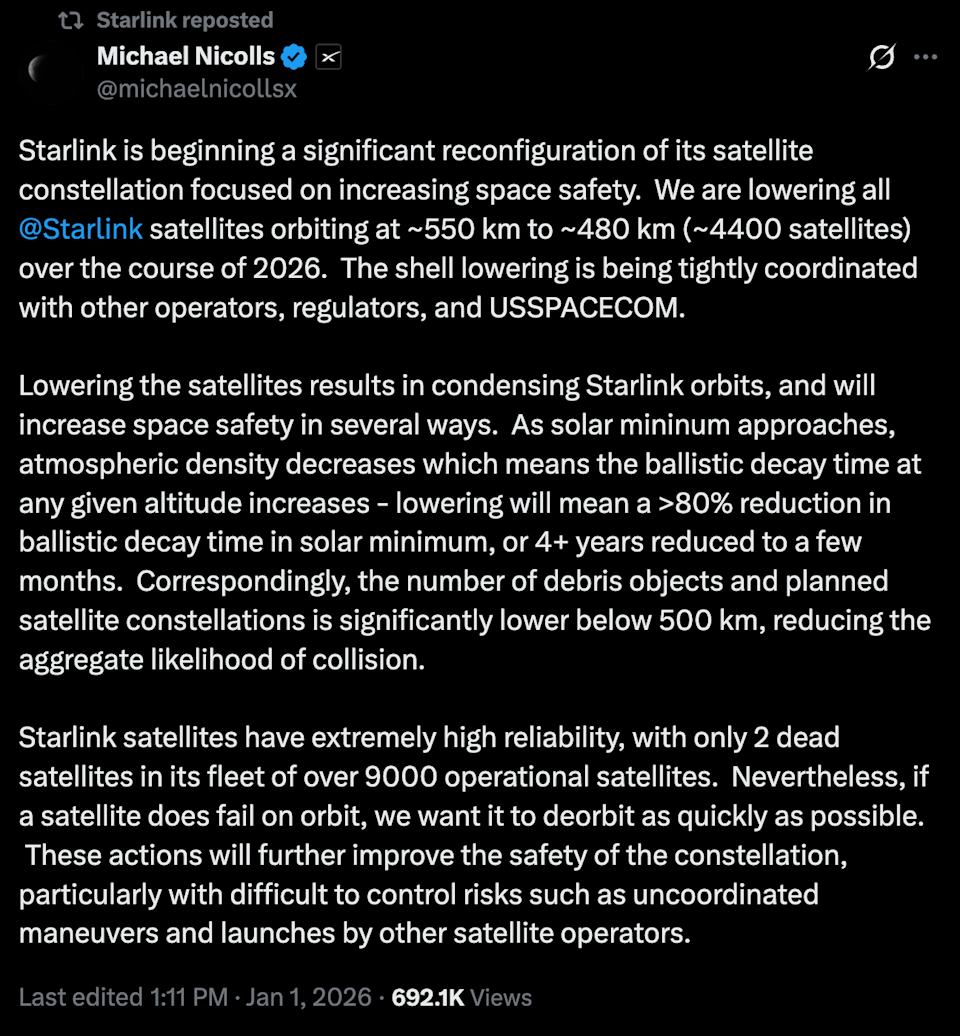
SpaceX’s Vice President of Engineering, Michael Nicolls, detailed this “significant reconfiguration” via a post on X (formerly Twitter). This isn’t a minor adjustment; it’s a fundamental transformation impacting nearly all satellites currently operating at the 550 km altitude level. So, why lower them? Nicolls articulated two primary motivations critical for space safety initiatives:
- Reducing Orbital Congestion: LEO is becoming increasingly crowded. Nicolls explicitly stated lowering the satellites moves them “into a region that’s less cluttered.” While 480 km isn’t uninhabited (existing satellites include Earth observation platforms, some CubeSats, and other operators are eyeing similar altitudes), it represents a strategic shift away from some denser operational zones and planned mega-constellation altitudes. Pulling the constellation tighter below traditional operational zones aims to diminish collision probabilities with both functioning satellites and potential debris fields in the slightly higher band.
- Accelerating Natural Deorbiting: This is perhaps the most scientifically significant aspect. Nicolls emphasized that the lower altitude places the satellites within a region where Earth’s atmosphere, though thin, exerts a stronger pull. Crucially, he linked the timing to the predicted solar minimum expected around the early 2030s. Solar activity significantly impacts the density of Earth’s upper atmosphere – the thermosphere expands during high solar activity (Solar Maximum), increasing drag on satellites, and contracts during Solar Minimum, drastically reducing drag. Nicolls calculated: “As solar minimum approaches, atmospheric density decreases which means the ballistic decay time at any given altitude increases – lowering will mean a >80% reduction in ballistic decay time in solar minimum, or 4+ years reduced to a few months.” This acceleration is vital for debris mitigation. If a satellite fails completely (becoming “space junk”), its natural decay time at 480 km, even in solar minimum, is drastically shorter than at 550 km. Failed satellites transforming into persistent debris pose the gravest collision threat. Faster decay automatically reduces that long-term risk window significantly.
Here’s a comparison of orbital decay characteristics:
| Altitude Factor | At 550 km Orbit | At 480 km Orbit | Impact |
|---|---|---|---|
| Atmospheric Drag | Lower | Higher | Increased drag leads to quicker orbit degradation |
| Ballistic Decay Time (Solar Min) | ~4+ years | Few months | Drastically reduced orbital lifetime |
| Collision Probability | Higher | Lower (targeted) | Moving to less congested space corridor |
| Deorbit Capability | Slower | Significantly Faster | Rapid removal if system failure occurs |
The Solar Link: Why Celestial Cycles Dictate Orbital Strategy
Nicolls’ reference to solar minimums highlights a sophisticated understanding of space weather dynamics often overlooked outside scientific circles. The sun’s activity cycles are governed by its magnetic field and sunspot frequency:
- Solar Maximum: Periods (approx. every 11 years) with intense solar activity characterized by sunspots, solar flares, and coronal mass ejections (CMEs). These events bombard Earth with energized particles and radiation, dramatically heating and expanding the thermosphere. This increased atmospheric density at orbital heights causes satellites to experience more drag, slowing them down and lowering their orbits faster. Missions require more frequent fuel-intensive maneuvers (“station keeping”) to maintain altitude. Crucially, drag-induced decay of debris happens faster. (Source: NASA Solar Cycle Science)
- Solar Minimum: The opposite phase, marked by reduced solar output and far fewer sunspots/CMEs. The thermosphere cools and contracts, minimizing atmospheric density at altitudes occupied by LEO satellites. Drag becomes significantly weaker. This drastically extends the lifetime of satellites and especially debris. An object that might decay naturally in 5 years during Solar Max could persist for decades in Solar Min. (Source: NOAA Space Weather Prediction Center)
Starlink’s move proactively counters the impending Solar Minimum’s adverse effect. By descending to 480 km before atmospheric density plummets, they ensure that even during the low-drag phase starting circa 2030, their satellites’ natural decay time remains very short (weeks to months) if propulsion fails. This preemptive action demonstrates foresight rarely seen on such a scale in the satellite industry.
Debris Mitigation and Recent Precipitating Events
The timing of Nicolls’ announcement is notable. It follows two troubling incidents involving Starlink satellites:
- Satellite Anomaly: Just weeks prior, Starlink acknowledged one of its satellites experienced an undisclosed “anomaly,” resulting in it shedding debris and becoming uncontrollable (“tumbling”). While Starlink stated there was “zero risk from the debris to the ISS or other critical space infrastructure,” it was a stark reminder that failures happen even in modern systems. Lowering orbits ensures any future failures result in quicker deorbits.
- Close Call with Chinese Satellites: Mere days before the orbit-lowering announcement, Nicolls posted about a serious near-miss. He described an incident involving satellites launched by China that appeared to maneuver without coordination with operators of satellites in the vicinity, leading to alarmingly close passes with Starlink satellites. Nicolls implicitly linked this unannounced, uncoordinated maneuvering in crowded space as a “difficult to control risk” that lowering altitudes could help mitigate.
These incidents underscore the volatile nature of LEO operations today. Space traffic management currently relies heavily on transparency, coordination, and voluntary conjunction assessments shared through organizations like the 18th Space Defense Squadron. Incidents like the Chinese satellites – dubbed “uncoordinated maneuvers and launches” – highlight gaps and vulnerabilities. This strategic orbital shift is Starlink’s tangible response; by opting for a lower, potentially less contested altitude band and ensuring ultra-fast decay post-failure, they are building in a significant safety buffer passively, mitigating risks even when coordination with other actors fails.
Setting a Precedent and Facing Challenges Beyond LEO
Starlink’s voluntary orbital descent sets a significant precedent. It actively demonstrates:
- Proactive Debris Mitigation: Moving beyond baseline regulatory requirements (like the 25-year deorbit guideline) to implement robust, physics-based risk reduction.
- Investment in Long-Term Space Sustainability: Fuel for maneuvers costs money, but Starlink prioritizes long-term operational health and orbital cleanliness.
- Acknowledgment of Systemic Risks: Recognizing that risks exist beyond their direct control (e.g., debris from old missions, uncoordinated launches/maneuvers).
However, significant challenges remain:
- The Zuma Problem: What happens when satellites from other operators lacking Starlink’s capability or commitment fail at higher altitudes? Lowering Starlink doesn’t solve debris generated elsewhere.
- Operational Complexity: Maintaining precise formations while simultaneously descending thousands of satellites requires immense precision. Collision avoidance coordination remains essential.
- Competition Congestion: Competitors like Amazon’s Project Kuiper and OneWeb plan constellations potentially operating in overlapping LEO regions. Coordination between mega-constellations is unprecedented and legally complex.
- Long-Term Liability & Policy: International space law regarding liability for collisions and debris mitigation enforcement remains tangled. Companies like Starlink navigating complex risks push the boundaries faster than regulations evolve. (Source: McGill University Space Law Resources).
Starlink’s orbit shift emphasizes the intricate interplay between orbital mechanics, solar activity, debris effects, and geopolitics. Success hinges on constant vigilance, international collaboration, and the adoption of forceful safety measures.
Charting a Course for Shared Orbital Real Estate
Starlink’s decision to orchestrate a descent of thousands its satellites is far from routine orbital maintenance. It’s an adaptable strategy reaching into the depths of celestial physics (anticipating solar minimums) while navigating the messy realities of an increasingly crowded and geopolitically contested frontier. The


