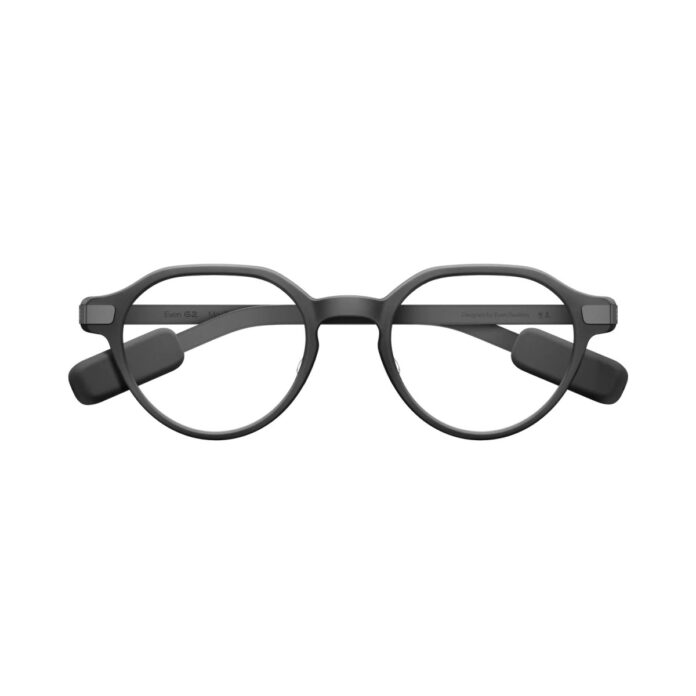

For the past few years, tech executives have been telling us that smart glasses will be the next big interface for consumer hardware. But today’s smart glasses still rely heavily on phones, even when they have great hardware. Even Realities’ G2 smart glasses are in that same boat — premium-looking glasses with a neon-style heads-up display you can see in any lighting, but functionality that depends on your phone.
A Different Approach to Smart Glasses
Even Realities takes a distinct approach from players like Meta. Their devices feature a monochrome heads-up display that shows text and information in green, giving it the look of a neon board. There are no cameras or speakers — and that’s by design. The company wants to focus on productivity rather than recording, so people around you don’t have to worry about being filmed.
G2 vs G1: What’s Improved
The G2 is the second-generation model and a significant upgrade over the G1. It features a brighter 1,200-nit display (up from 1,000 nits), four microphones (up from two), a 75% larger display area, and a smoother 60Hz refresh rate (up from 20Hz). All packed into a lightweight 35-gram magnesium alloy frame.
Real-World Use: The Good
The glasses are incredibly light at 35 grams, with a magnesium alloy frame and titanium alloy temples. They’re comfortable to wear all day. The battery claims up to two days of typical use, and the charging case can recharge them up to seven times before needing to be plugged in itself.
The features are genuinely useful for specific use cases: real-time translation during conversations (tested in Chinese, French, and Spanish), a teleprompter mode, turn-by-turn navigation, and meeting transcription with AI-powered context bubbles. The “Prep Notes” feature lets you add documents before a meeting and the AI surfaces relevant explanations in real-time — like defining “Green Hydrogen” during an energy briefing.
The Not-So-Good
Connectivity with the phone has been the biggest pain point. Early on, the glasses would disconnect from the app so frequently that some users nearly gave up. App updates have improved this significantly, but it’s still not flawless. The voice assistant (Even AI) often mishears commands in noisy environments, and the navigation feature doesn’t work with Google or Apple Maps — you have to route through the Even Realities app, which has address accuracy issues.
At $599, the G2 is a solid piece of hardware in a well-designed frame. But outside of jobs that require constant translation or teleprompting, it’s hard to find a clear daily use case. Even’s bet is that skipping the camera and speakers is the right move for a productivity-focused device — and we don’t disagree with that direction. But the company now needs to build more first-party software to make the glasses something people actually reach for every day.


