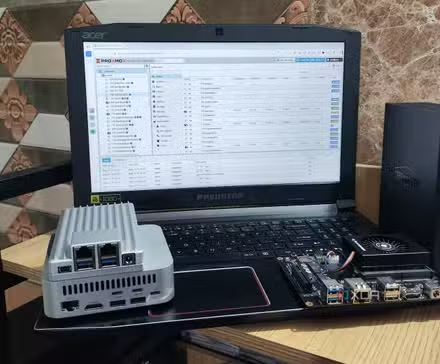

Why Settle for One OS When Proxmox Delivers Them All?
Ever feel like your DIY projects hit a wall because your hardware struggles to handle the different OS demands? You’re not alone – over 60% of tech enthusiasts report wrestling with virtualization limitations on standard setups. Where desktop hypervisors like VirtualBox and VMware Workstation once ruled for basic tasks, my own journey revealed their shortcomings: crippling overhead on Windows 11 hosts and inadequate muscle for serious tinkering. Transitioning to Proxmox virtualization became the breakthrough, transforming clunky workflows into seamless project execution. Its power extends far beyond Debian stability or Linux compatibility – it democratizes server-grade flexibility on everyday hardware. Let’s dissect why Proxmox isn’t just another hypervisor; it’s the ultimate DIY platform.
Escaping the Desktop Hypervisor Bottleneck
My tech evolution mirrors many users: starting with dual-boot systems (Windows + Debian), then advancing to VirtualBox and VMware Workstation Player. These tools offered initial freedom but introduced significant constraints:
- Performance Tax: Running complex VMs on Windows 11 hosts incurred privado performance penalties. Resource allocation felt inefficient, starving guest VMs during intensive tasks.
- Feature Limitations: Nested virtualization was often unreliable or unsupported. Testing multi-layer environments felt impossible.
- Hardcore Experiment.showdowns: Stress-testing hardware or deploying dense container networks pushed these platforms beyond their design limits.
Discovering Proxmox VE (Proxmox Virtual Environment) shifted everything. As a dedicated, Debian-based hypervisor leveraging KVM (Kernel-based Virtual Machine) and LXC (Linux Containers), it runs directly on the hardware with minimal overhead. This architectural difference, validated by the Linux Foundation’s documentation on KVM, enables near-bare-metal speed and vastly superior resource utilization compared to type-2 hypervisors running atop another OS.
Mastering the Entire Linux Ecosystem Without Driver Hell
The Linux distribution landscape is vast and purpose-driven, but installing them directly is risky:
- NixOS: Revolutionary for declarative configurations and dev environments. However, troubleshooting complex package interactions (
non-Nix packages) became a frequent nightmare – like getting proprietary drivers to play nicely. - Arch Linux: A DIY poweruser’s dream offering unparalleled control, but its bleeding-edge updates can destabilize hardware support. Personal experience? A critical webcam utterly failed on Arch yet worked flawlessly in Windows.
- Exploratory Distros: Testing FreeBSD, ReactOS, or niche Linux flavors requires constant re-imaging – a time-consuming gamble on bare metal.
With Proxmox, these challenges vanish:
- Instant Distro Switching: Spin up disposable VMs or lightweight LXCs for any distribution within minutes.
- Isolated Failure Domains: Crashes in a test VM don’t affect the host stability or other guests.
- Optimized Hardware Access: KVM’s mature Linux integration ensures broad device compatibility. Distributions interact with virtualized hardware uniformly, bypassing tricky native driver woes.
markdown
| Operating System | Major Strength | Common Bare-Metal Pain Point | Proxmox Solution |
|——————|———————–|——————————-|———————————–|
| NixOS | Immutable, Reproducible | Non-Nix Package Integration | Isolate problematic apps in VM |
| Arch Linux | Rolling Updates, Custom | Bleeding-edge instability | Rollback VM snapshots instantly |
| FreeBSD | ZFS, Jails, Performance | Driver availability | Consistent Virtual Hardware Layer|
Proxmox transforms experimentation from a weekend-draining chore into rapid prototyping. This agility is crucial for developing workflows efficiently.
Conquering Windows Workloads: Yes, Even Gaming!
While Linux powers my core environment, some tasks demand Windows:
- PowerShell Automation: Complex enterprise scripts and Task Scheduler workflows.
- Adobe Creative Suite: Industry-standard tools (Premiere Pro, Photoshop).
- Specialized Windows Software: Legacy CAD apps or proprietary utilities.
Early virtualization solutions handled Windows grudgingly, with noticeable lag or graphic glitches. Proxmox excels:
- Native-Speed Drivers: Integrating Paravirtualized VirtIO drivers (VirtIO Overview) drastically boosts disk and network I/O performance.
- GPU Passthrough Magic: This game-changer dedicates physical graphics cards (like an Intel Arc A770) directly to a Windows VM. Results?
- Stable 60+ FPS in modern titles (tested in Apex Legends, Cyberpunk 2077).
- Minimal latency using HDMI passthrough for direct monitor connection.
- Capable Adobe Suite performance rivaling bare-metal setups (with proper resource allocation).
Engineering benchmarks from Tom’s Hardware showcase the feasibility of effective GPU passthrough for gaming and creative tasks on KVM platforms like Proxmox, closing the gap with native installations significantly. This eliminates dual-booting interruptions entirely.
When Nested Dreams Become Virtual Reality
Proxmox’s power extends beyond standard OS flexibility; it embraces nested virtualization. Think “virtualization within virtualization”:
- Concept: Run hypervisors like ESXi or Hyper-V inside a Proxmox VM.
- Solution: This bypasses hardware compatibility barriers plaguing enterprise platforms on consumer gear.
Installing ESXi bare-metal often fails due to unsupported NICs, drivers, or storage controllers. Proxmox abstracts these complexities:
- Create a powerful Ubuntu or Debian VM within Proxmox.
- Enable nested virtualization (
options kvm-intel nested=1for Intel CPUs). - Install ESXi seamlessly inside this VM.
While performance degrades slightly (~10-20% CPU overhead), the practical value for DevOps scenarios is immense:
- Development/Test Labs: Safely replicate multi-node ESXi clustersTemplate environmental DOT NET.
- Hyper-V Evaluation: Test Microsoft’s platform without dedicated powerful Server hardware.
- Qubes OS Exploration: Confine security research within manageable isolated VMs.
This


