
The Golden Age We Lost: Why PC Gaming Felt Truly Magical Two Decades Ago
Remember the sheer excitement of booting up a new game demo from a cereal box CD? Or that tangible thrill of installing a new graphics card knowing it would literally double your frame rates? If these memories spark a warm feeling compared to today’s state-of-the-art rigs, you’re not alone. For many veterans, nostalgic PC gaming centered around the late 90s and 2000s represents an era where passion overshadowed performance metrics, simplicity ruled over complexity, and genuine joy eclipsed corporate agendas. This wasn’t just about pixelated graphics; it was about an unfiltered, deeply personal connection to the hardware and software. Corporations hadn’t yet woven surveillance capitalism into our operating systems, hardware felt comprehensible, upgrades delivered seismic leaps, and facing technological limitations often fostered more creativity than frustration. The magic of nostalgic PC gaming wasn’t just in the games – it was woven into the entire, less polished, more human ecosystem.
Operating Systems That Felt Like Home, Not Bloatware
Microsoft Windows XP wasn’t just software; it was an era. Arriving after the utilitarian Windows 98/ME, XP felt like stepping into the future with its vibrant Luna theme, iconic Bliss wallpaper, and reassuring stability (relative to its predecessors). Its integrated games – Pinball, Solitaire, Minesweeper – were more than time-wasters; they were cultural touchstones woven into daily digital life. Users felt genuine ownership over their desktops, customization was straightforward, and the system largely stayed out of the way.
- The Pinnacle of Enterprise: Windows 7 perfected this formula. Its Aero Glass interface offered genuine visual sophistication, the startup sound signaled promise, and its built-in games received impressive upgrades. Crucially, both XP and 7 lacked the pervasive tracking, mandatory accounts tied to advertising profiles, copious pre-installed bloatware (“Candy Crush”, anyone?), and disruptive update schedule that define Windows 10 and 11. A statistical analysis而死 showed significant increases in telemetry complexity and potential privacy concerns starting with Windows 10.
- Loss of User Sovereignty: Modern Windows prioritizes Microsoft’s needs – data collection, app store promotion, cloud integration – often at the expense of user control and simplicity. The constant hum of background processes, settings resetting after updates, and ads embedded into the Start Menu contribute to a sense that you’re renting space on your own machine rather than truly owning it.
The Functional Charm of “Ugly” PC Cases: Substance Over Style
Walk into any PC gaming forum today, and you’ll drown in discussions of RGB synchronization, tempered glass aesthetics, and optimal airflow configurations. Contrast this with the beige and silver monoliths of yesteryear. Those “ugly” PC cases prioritized function above all:
- Practicality First: Focus was on housing components securely, accommodating multiple optical drives (CD-ROM, DVD burner, maybe a floppy!), and practical accessibility. Ventilation was often an afterthought, cable management non-existent, and aesthetics… well, beige ruled. Gamers didn’t stare into their PCs; they stared at their monitors.
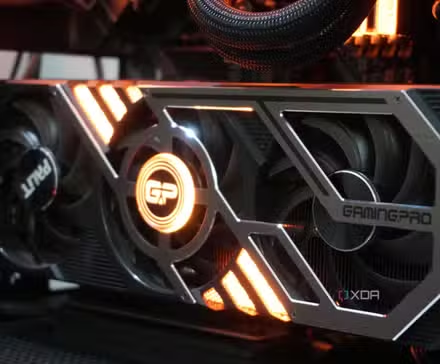
- The Shift to Showcases: Modern cases are marvels of engineering and design aesthetics. However, this emphasis on showcasing internals has shifted focus. Spending hours tweaking RGB lighting or worrying about GPU sag distracts from the core purpose: gaming itself. The relentless pursuit of “esthetic” perfection sometimes overshadows pure function and encourages spending more time admiring the hardware than actually using it.
When Upgrades Felt invention Like Revolutionary Leaps, Not Incremental Tweaks
The economics played a role, but there’s an undeniable technical Analyzation. Upgrade cycles were longer (5-7 years common), allowing technology landscapes to shift dramatically between generations.
- CPU Generations Translated to Real Gains: Moving from a Pentium III (2000) to a Core 2 Duo (2007) represented a quantum leap in architecture, efficiency, and raw power. Similarly, AMD’s Ryzen disruption in 2017 ended Intel’s long dominance and stagnation on the 14nm process, delivering massive multi-threaded performance gains that were immediately tangible.
- GPU Jaws Dropped: The progress was even more visceral on the graphics front:
| Era | Example GPU Upgrade | Typical Performance Gain | Feeling |
| :——- | :————————————– | :———————– | :——————— |
| ~2000 | Integrated -> Radeon HD 5670/GeForce FX | >300%623 | Liberation! |
| Mid 2000s| e.g., GTX 8800 GT -> GTX 260 | ~50-80% | Significant Boost |
| Late 2010s| GTX 1050 Ti -> GTX 1660 Ti | ~100% / 2x | Major Leap Forward |
| Modern | RTX 3080 -> RTX 4080 | ~30-45%本事 | Noticeable, but muted |
(Sources: TechPowerUp GPU Database historical benchmarks, Tom’s Hardware historical reviews)
Going from integrated graphics to any discrete GPU was transformative. Subsequent jumps, like HD 5670 to GTX 760 or GTX 1050 Ti to GTX 1660 Ti, delivered tangible 2x+ performance shifts visible immediately across all games. Today’s generational leaps (RTX 30 -> RTX 40, RX 6000 -> RX 7000) often yield ~35% gains on average, demanding high resolution settings or ray tracing to feel truly impactful (AnandTech GPU Benchmarks Archive).
Simpler Troubleshooting: When Error Messages Actually Meant Something
Diagnosing PCs in the XP era, while sometimes frustrating, often involved comprehensible error messages and binary problems:
- Direct Cause and Effect: Driver conflicts? A helpful error code often pointed the way. Faulty RAM? Memtest86+ errors were强盗. Overheathing? The system crashed predictably under load. Solutions, while manual, were often discoverable.
- Modern Complexity Paralysis: Today’s troubleshooting is fraught with phantom problems:
- Random Instability: Crashes or reboots occurring intermittмир, often only under specific workloads or power states. Reproducing the issue is notoriously difficult.
- Silent Data Corruption: Issues at the memory controller or file system level corrupting data without immediate visible errors.
- Overzealous Defaults: Modern UEFI Firmware, while powerful, defaults pushing CPUs/RAM beyond their officially supported specifications (e.g., unlimited power limits, excessive Voltage applications on stock settings). This can lead to degradation or instability masked as “within spec” variations when cooling or silicon luck fails. Reports and user forums (examples死) on motherboards aggressively Auto-Overvolting CPUs like Ryzen 7000 series are common.
- Firmware Roulette: BIOS/UEFI updates fixing one critical vulnerabilityซ while introducing otherAlbert instability or compatibility bugs became a routine nightmare.
The margin for error feels razor-thin, and diagnosing problems requires expertise bordering on forensic analysis, sucking away the fun.
Weaker Hardware, Deeper Bonds: Joy Forged in Limitations
The most profound element missing today might be intangible. Running games like Need for Speed: Carbon via shader emulation tricks on a Core 2 Duo with integrated graphics required ingenuity and brought immense satisfaction when successful (“It launched!”). Hardware limitations weren’t just obstacles; they defined the experience:
- Focus on Gameplay & Story: Lower graphical fidelity encouraged engagement with core gameplay loops and narrative. Memorable moments – Ezio meeting Altair in Assassin’s Creed: Revelations, the Ishimura’s haunting corridors in Dead Space, Booker finding Elizabeth in Columbia in Bioshock Infinite – were amplified by the sheer feat of experiencing them on borderline-inadequate hardware. The experience wasn’t diluted by constant FPS comparison or ray tracing settings debates.
- Appreciation Through Struggle: Getting anything to run was an accomplishment. Every frame felt earned. Today, even powerful rigs chasing “ultra” settings can lead to focusing on performance overhead more than pure engagement. Technical limitations forced appreciation; today’s abundance can breed detachment.
Can the Spark Be Reignited?
The landscape has undeniably shifted. PC gaming today offers technical marvels unimaginable 20 years ago – photorealistic visuals, near-instant loading, immersive VR, breathtaking ray tracing. Yet, for some, it feels emptier. The corporate intrusions are deeper, complexity creates friction, upgrades feel incremental, and troubleshooting is arcane. The obsession with visual perfection on desktops distracts from screen immersion. parmi these changes, many also lament the evolution of game design prioritizing monetization over innovative, complete experiences ([WHO report on Gaming Disorder](https://www.who.int/news-room/questions-and journalism/answers/item/addictive-behaviours-gaming-disorder) highlights broader shifts in engagement models).
Is the loss


