
Mastering Minecraft’s Magic: The Ultimate Guide to Enchanting with Books
Ever spent hours mining precious diamonds only to lose your coveted gear moments later? Or felt the frustration of needing Silk Touch for a critical project, but your enchantment table stubbornly refuses to offer it? Enchanted books in Minecraft are the versatile solution, transforming this core game mechanic from a gamble into a strategic powerhouse. Unlike directly enchanting items at the table, enchanted books provide portability, flexibility, and the potential for god-tier tools you simply can’t achieve otherwise. They decouple the enchantment process from the table itself, allowing you to apply crucial buffs like Unbreaking III or Sharpness V anywhere there’s an anvil. Understanding how to use enchanted books in Minecraft is fundamental for progressing beyond basic survival, empowering players to curate their ideal gear loadout for conquering the Nether, the End, or simply building magnificent structures. This guide delves deep into crafting, using, mastering, and troubleshooting enchanted books as documented in Minecraft’s core mechanics.
Demystifying the Source: Enchanted Book Fundamentals
Enchanted books are not found (in routine gameplay); they are meticulously crafted and harnessed through specific in-game mechanics. Mastering them relies entirely on two workstations: the Enchantment Table for creation and the Anvil for application. Their key advantage is portability: once enchanted, the book’s magic can be applied away from the table, making it perfect for remote bases, exploration, or applying precise buffs immediately after acquiring valuable resources.
Crafting the Vessel: Step-by-Step Book Creation
Before magic comes the mundane. Creating the books themselves is the essential first step:
- Crafting Table Construction: Start by converting logs into planks. Place 4 planks (same wood type) in your 2×2 personal crafting grid to create your indispensable Crafting Table. Place it down.
- Paper Production: Locate Sugar Cane growing near water. Place 3 Sugar Cane horizontally in the middle row of your Crafting Table to yield 3 sheets of Paper.
- Leather Gathering: Obtain Hide by defeating Cows, Horses, Mooshrooms, or Llamas. Place 4 Hides in your personal crafting grid (any arrangement) to create Leather.
- Book Crafting: Open the Crafting Table. In the top row, place 1 Paper in the first box and 1 Paper in the second box. In the middle row, place 1 Paper in the second box. In the bottom row, place 1 Leather in the second box. This crafts 1 Book.
Analysis: This chain emphasizes Minecraft’s core resource loop, requiring players to engage with farming, animal husbandry, and basic crafting. Strategic Tip: Establish a Sugar Cane farm early for a steady paper supply.
Forging the Font of Power: Building the Enchantment Table
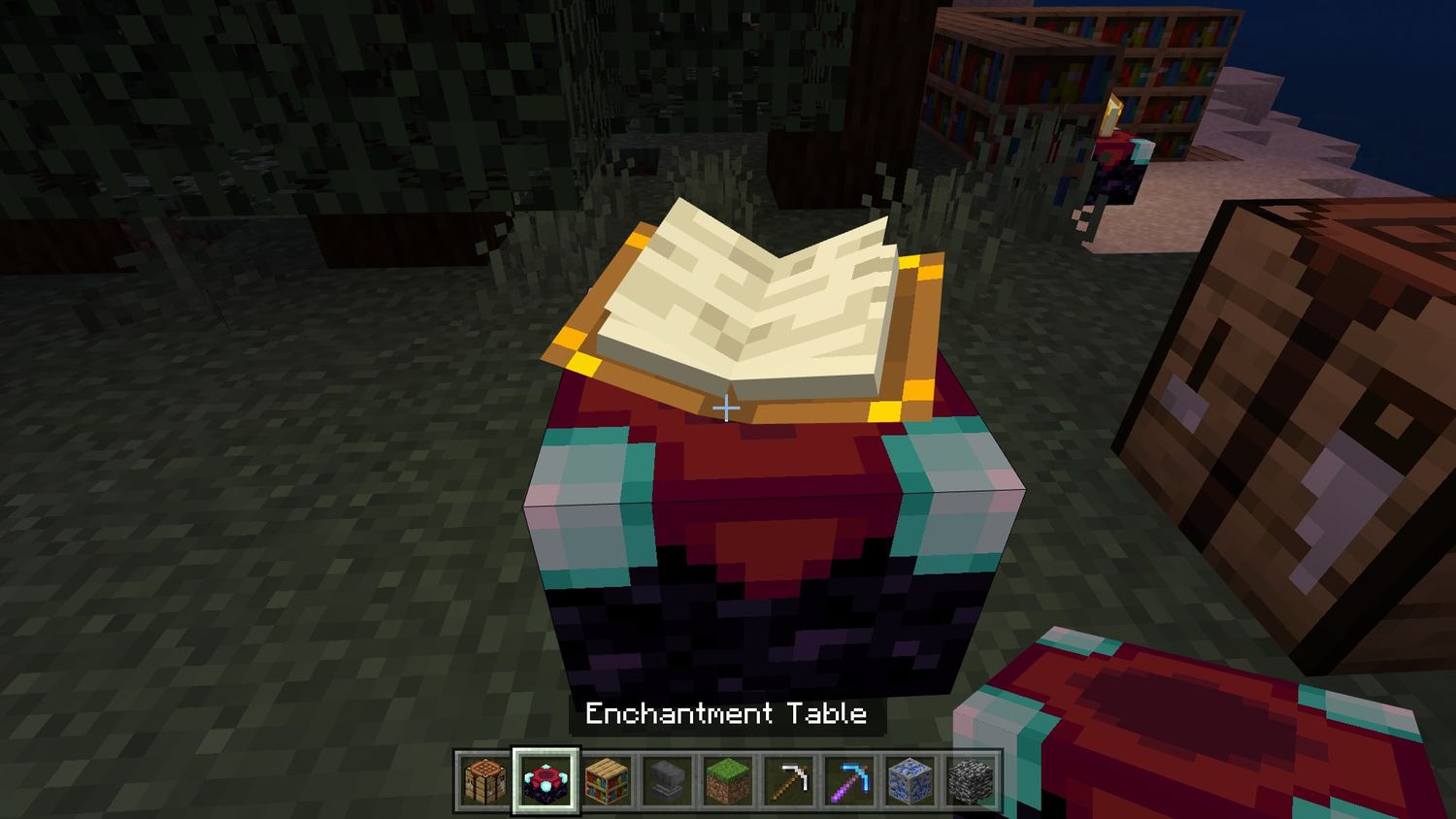
The Enchantment Table is the gateway to imbuing books with magic. Its crafting recipe demands rarer resources, marking a significant game progression point:
- Diamond Acquisition: Mine deep underground (typically between Y=-58 to Y=-64) using an Iron Pickaxe or better. You need 2 Diamonds.
- Obsidian Harvesting: Either find lava pools (use water bucket carefully to turn lava source blocks to obsidian) or mine existing veins. Requires at least a Diamond Pickaxe. You need 4 Obsidian blocks.
- Table Construction: In your Crafting Table:
- Top Row: Empty | Book | Empty
- Middle Row: Diamond | Obsidian | Diamond
- Bottom Row: Obsidian | Obsidian | Obsidian
Yields 1 Enchantment Table.
The Heart of Enchantment: Creating the Magical Tomes
With Book and Table ready, it’s time to enchant:
- Lapis Lazuli: Mine deep beneath the surface (similar layer to Diamonds, Y-levels -32 to -64) using a Stone Pickaxe or better. This vibrant blue ore provides the ‘fuel’ for enchantments (1 Lapis per attempt).
- Placing the Table: Set the Enchantment Table on a solid surface. Interact with it to open its interface.
- Enchanting Process:
- Place a standard Book (not a book and quill!) into the left input slot.
- Place 1 Lapis Lazuli into the Lapis slot.
- Three potential enchantment options appear on the right, each with a level requirement and displaying its associated XP cost.
- Select one enchantment. The book vanishes from the left slot and the enchanted version appears in the result slot, shimmering magically. Move it to your inventory.
- Crucially, the enchantments offered are random and depend partially on your player level but primarily on how the table is upgraded with bookshelves (discussed later).
Strategic Tip & Analysis: Rerolling Enchantments: If the offered options are undesirable, don’t take the book out. Simply place a different, “sacrificial” item (like a stick or stone tool) into the book slot. The options will refresh. Replace the sacrificial item with another Book to see a fresh set of three enchantments. This rerolling technique is vital for targeting specific enchantments (Original Analysis).
| Enchantment Rerolling Strategy |
|---|
| Target Action |
| :———————– |
| See New Options |
| Attempt Better Rolls |
| Preserve Target Book |
Unleashing the Magic: Applying Books with the Anvil
The Anvil is where the enchanted book meets your gear. It’s also resource-intensive, cementing it as mid-to-late game crafting:
- Crafting the Anvil: Requires significant iron.
- Smelt Iron Ore -> Iron Ingots (9 ingots = 1 Iron Block).
- Crafting Recipe:
- Top Row: Iron Block | Iron Block | Iron Block
- Middle Row: Empty | Iron Ingot | Empty
- Bottom Row: Iron Ingot | Iron Ingot | Iron Ingot
- Anvil Function: Place the Anvil and interact.
- Application Process:
- Place the item you wish to enchant (sword, pickaxe, bow, armor, etc.) into the far left slot.
- Place the Enchanted Book into the middle slot.
- The resulting enchanted item appears in the result slot on the right, displaying the enchantment cost in levels (1-39+). If compatible, the cost displays in green or white; red means you lack sufficient XP. Pick up your enchanted item.
Key Compatibility Rule: “Sharpness IV” won’t go on a bow; “Power V” won’t go on a sword. Each enchantment type is restricted to specific item categories as defined in-game (Minecraft Enchantments).
Amplifying Your Potential: Crafting God-Tier Gear
The true power of enchanted books lies in combination and amplification, only possible via the anvil:
- Combining Enchanted Books: Want Efficiency IV but only have two Efficiency III books?
- Place one Efficiency III book in the left anvil slot.
- Place the second Efficiency III book in the middle slot.
- The result slot will show an Efficiency IV book (costing levels). This only works for combining two books of the same enchantment type to reach the next level.
- Combining Multiple Enchantments onto One Item: The anvil allows layering different, compatible enchantments onto a single item. Place a Diamond Sword in the left slot. Place a Sharpness IV book in the middle slot. The sword gains Sharpness IV. Now, place this enchanted sword back in the left slot. Add a Looting III book to the middle slot. The resulting sword now has both Sharpness IV and Looting III (the cost accumulates, including penalties for prior work).
Critical Caveat: Anvil Costs & Prior Work Penalty: Every use of an anvil on an item increases a hidden “Prior Work Penalty.” This penalty exponentially increases the XP cost of future anvil operations on that item (including renaming). Eventually, the cost becomes prohibitive (“Too Expensive!”), limiting how many times you can modify an item. Plan your combination sequence! (Original Analysis)
Troubleshooting Common Enchanted Book Issues
“Why is it red?!” Solve enchantment blockers:
- Red Experience Cost: This means your current XP level (the green number on your HUD) is lower than the required cost displayed. Grind XP: mine oires (especially Nether Quartz), defeat mobs, breed animals, trade with villagers, cook food in furnaces.
- Red X / “Too Expensive!”:
- Incompatibility: Trying to apply “Infinity” to a crossbow? Impossible. Ensure the enchantment can legally be applied to that item type. Consult the wiki for valid enchantments per item.
- “Too Expensive”: The combined cumulative cost of enchantments and prior work penalties exceeds the anvil’s cap (approx level 39). Your only options: start over with a new base item, or use a slightly enchanted item (slightly lower penalty) and combine strategically earlier. This is a core balance mechanic.
- Conflict: Some enchantments cannot coexist. You generally cannot have both “Sharpness” and “Smite/Bane of Arthropods” on the same sword (they conflict). The anvil will refuse the combination.
Maximizing Your Enchantments: Power Through Bookshelves
While enchanted books add flexibility, the strength of enchantments available initially at the table depends on tableside bookshelves:
- Crafting Bookshelves: Requires Leather and Books.
- Craft 3 Books (see Book creation earlier).
- Crafting Recipe:
- Top Row: Wood Plank | Wood Plank | Wood Plank
- Middle Row: Book | Book | Book
- Bottom Row: Wood Plank | Wood Plank | Wood Plank
- Optimal Placement: Bookshelves must be placed exactly one block away from the Enchantment Table on the same level or one block above, with no solid blocks in between. Torches, carpets, or other transparent blocks are allowed between them.
- Power Levels:
- Maximum Enchantment Level: Requires 15 Bookshelves correctly placed. Enables level 30 enchantments.
- Zero Bookshelves: Max level 8 enchantments (very basic/weak).
- Incremental Placement: Every correctly placed bookshelf increases the potential level of enchantments offered (not the frequency of good ones). Minecraft Wiki Bookshelves
- Achieving Level 30: Arrange 15 bookshelves in a 5×5 square (corners missing) centered on the table, one block away, forming a perfect hollow cube boundary around it. Platforms or steps may be needed for second layers.
Analysis: Bookshelves represent progression investment. Prioritize getting at least 10-12 early to enable mid-tier enchants, then build to 15 when seeking end-game power (Protection IV, Efficiency V, Unbreaking III, etc.).
Conclusion: From Survivalist to Sorcerer
Enchanted books fundamentally elevate Minecraft gameplay, transforming enchantment from a static gamble into a dynamic, portable, and strategic system. By mastering the creation of the Enchantment Table and Books, understanding the randomized enchantment process (and rerolling!), and wielding the Anvil’s immense power to combine and apply effects with precision, players can create legendary gear tailored for any challenge. Remember: collect that Lapis Lazuli, build those bookshelves to maximize your enchanting table, and manage your anvil costs wisely to avoid the dreaded “Too Expensive!” message. Whether you’re seeking Unbreaking III for long-lasting tools, Silk Touch for pristine resource gathering, or Sharpness V to dominate combat, enchanted books provide the pathway. Now go forth and enchant! What’s the most impressive combination of enchantments you’ve ever crafted in Minecraft? Share your triumphs (or frustrations!) in the comments below!
Sources & Further Reading:
Original article at www.lifewire.com


