
The AI Race Heats Up: Microsoft Azure Unveils Supercomputing Powerhouse for OpenAI
Are we on the cusp of a new era of artificial intelligence? Microsoft Azure has just upped the ante, announcing the NDv6 GB300 VM series, a groundbreaking deployment of NVIDIA GB300 NVL72 systems designed for the most demanding AI workloads. This supercomputing-scale cluster, tailor-made for OpenAI, signifies a major leap forward in AI infrastructure. This is not just about faster chips; it’s a holistic system-level innovation pushing the boundaries of what’s possible in AI inference and training. Let’s delve into the details of this game-changing technology.
Unveiling the NDv6 GB300 VM Series: A Deep Dive
Microsoft’s announcement of the NDv6 GB300 VM series isn’t just about adding more hardware; it represents a fundamental shift in how AI infrastructure is designed and deployed. This collaboration between Microsoft and NVIDIA aims to provide the raw power and sophisticated architecture needed to fuel the next generation of AI models.
Powering AI with NVIDIA GB300 NVL72: Inside the Beast
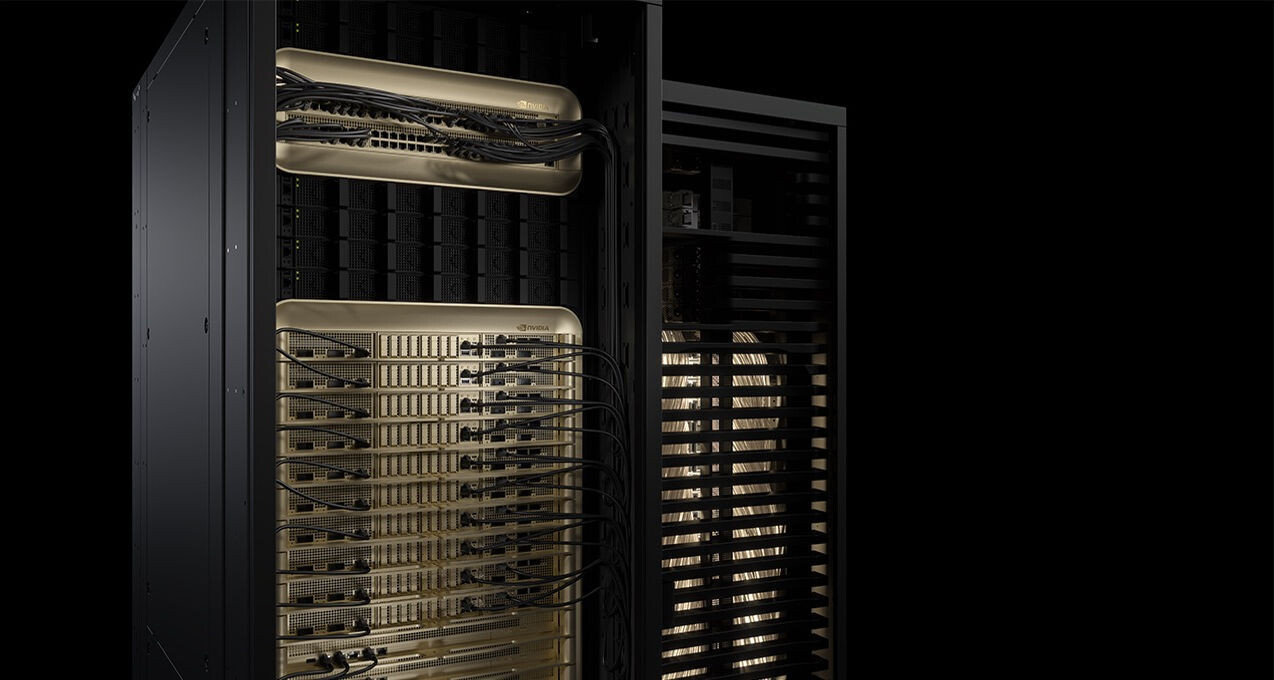
The heart of this new Azure offering is the NVIDIA GB300 NVL72 system. This isn’t a collection of individual GPUs thrown together; it’s a carefully integrated, liquid-cooled, rack-scale unit.
- What’s Inside? Each rack packs a serious punch, boasting 72 NVIDIA Blackwell Ultra GPUs and 36 NVIDIA Grace CPUs. The integration of both GPUs and CPUs within the same system is crucial for optimized AI workflows, allowing for rapid data transfer and efficient processing of complex tasks.
- Massive Memory Capacity: A staggering 37 terabytes of fast memory provides the massive, unified memory space critical for advanced AI applications like reasoning models, agentic AI systems, and complex multimodal generative AI.
- Unparalleled Performance: With 1.44 exaflops of FP4 Tensor Core performance per VM, the NDv6 GB300 VM series offers unprecedented computational power. This translates to faster training times, more complex models, and ultimately, more intelligent AI systems.
- FP4 Tensor Cores: According to NVIDIA, FP4, or Floating Point 4-bit precision, is a new data format allowing for increased throughput and reduced memory footprint. (See more: https://developer.nvidia.com/blog/nvidia-hopper-architecture-in-depth/)
Why is all this power necessary? The increasing complexity of AI models, particularly Large Language Models (LLMs) like GPT-4 and its successors, demands exponentially more computational resources. These models are trained on vast datasets and require immense processing power to perform inference – the process of generating responses to user prompts.
Benchmarking Blackwell Ultra: A Performance Leap
The NVIDIA Blackwell Ultra platform isn’t just theoretically powerful; it’s been proven in real-world benchmarks. The MLPerf Inference v5.1 benchmarks demonstrated the platform’s exceptional capabilities, particularly when using the NVFP4 data format.
- Key Results:
- Up to 5x higher throughput per GPU on the 671-billion-parameter DeepSeek-R1 reasoning model compared to the previous generation NVIDIA Hopper architecture.
- Leadership performance on newly introduced benchmarks like the Llama 3.1 405B model.
What do these numbers mean? They demonstrate a significant increase in efficiency and speed, allowing researchers and developers to work with larger, more complex models without being bottlenecked by hardware limitations. This translates to faster innovation and the ability to tackle previously intractable AI challenges.
The Network is the Computer: NVLink and Quantum-X800 InfiniBand
Raw processing power is only one piece of the puzzle. The ability to efficiently connect and coordinate thousands of GPUs is equally critical for achieving supercomputing-scale AI. Microsoft Azure addresses this challenge with a sophisticated two-tiered networking architecture.
-
NVLink Switch Fabric: Within each GB300 NVL72 rack, the fifth-generation NVIDIA NVLink Switch fabric provides a staggering 130 TB/s of direct, all-to-all bandwidth between the 72 Blackwell Ultra GPUs. This essentially transforms each rack into a single, unified accelerator with a shared memory pool. This is crucial for memory-intensive models that require rapid access to large datasets.
-
Quantum-X800 InfiniBand: To scale beyond the confines of a single rack, the cluster leverages the NVIDIA Quantum-X800 InfiniBand platform. Designed specifically for trillion-parameter-scale AI, this platform offers 800 Gb/s of bandwidth per GPU, ensuring seamless communication across all 4,608 GPUs.
Why is high-bandwidth networking so important? Imagine trying to build a house with thousands of workers, but only a narrow path for them to move materials. The construction would be severely delayed. Similarly, in AI, GPUs need to communicate with each other constantly to share data and coordinate calculations. High-bandwidth networking ensures that this communication happens quickly and efficiently, preventing bottlenecks and maximizing overall performance.
- Advanced Features of Quantum-X800:
- Adaptive routing: Dynamically adjusts data paths to avoid congestion.
- Telemetry-based congestion control: Monitors network performance and proactively addresses potential bottlenecks.
- Performance isolation: Prevents one user’s workload from negatively impacting the performance of others.
- SHARP v4: Accelerates operations, significantly boosting the efficiency of large-scale training and inference.
Implications for OpenAI and the Future of AI
Microsoft’s investment in this cutting-edge infrastructure is directly tied to its partnership with OpenAI. By providing access to this supercomputing-scale cluster, Microsoft is empowering OpenAI to push the boundaries of AI research and development.
- Benefits for OpenAI:
- Faster training times for increasingly complex AI models.
- Ability to experiment with larger and more sophisticated architectures.
- Improved performance in AI inference tasks, leading to more accurate and responsive AI systems.
Beyond OpenAI: While OpenAI is the initial beneficiary, this infrastructure will eventually be available to other Azure customers. This will democratize access to supercomputing-scale AI, enabling a wider range of organizations to innovate and develop cutting-edge AI solutions.
Reimagining the Data Center: Cooling, Power, and Software
Deploying the world’s first production NVIDIA GB300 NVL72 cluster at this scale required a complete rethinking of the data center infrastructure. Microsoft had to address several critical challenges.
- Custom Liquid Cooling: The immense heat generated by thousands of high-performance GPUs necessitates advanced cooling solutions. Liquid cooling is far more efficient than traditional air cooling and allows for higher densities of computing power.
- Power Distribution: Providing enough power to thousands of GPUs requires a robust and efficient power distribution system. Microsoft had to design a custom power infrastructure to meet the demands of this supercomputing cluster.
- Reengineered Software Stack: Orchestrating and managing thousands of GPUs requires a sophisticated software stack. Microsoft reengineered its software stack to optimize performance, reliability, and scalability.
These behind-the-scenes innovations are just as important as the hardware itself. Without a properly designed data center infrastructure, even the most powerful GPUs would be unable to deliver their full potential.
The Road Ahead: More Innovations on the Horizon
The launch of the NDv6 GB300 VM series is just the beginning. As Azure scales to its goal of deploying hundreds of thousands of NVIDIA Blackwell Ultra GPUs, even more innovations are expected to emerge. This will unlock new possibilities in AI, leading to breakthroughs in areas such as:
- Reasoning AI: AI systems that can understand and reason about the world in a more human-like way.
- Agentic AI: AI agents that can autonomously perform complex tasks and interact with their environment.
- Multimodal AI: AI models that can process and understand information from multiple sources, such as text, images, and audio.
Conclusion: A Turning Point for AI
The Microsoft Azure NDv6 GB300 VM series represents a significant milestone in the evolution of AI infrastructure. By combining the raw power of NVIDIA Blackwell Ultra GPUs with innovative networking and data center technologies, Microsoft is enabling a new era of AI innovation. This collaboration with NVIDIA, and its dedication to OpenAI, demonstrates a serious commitment to pushing the boundaries of what’s possible with artificial intelligence.
The implications are far-reaching, with the potential to transform industries and solve some of the world’s most pressing challenges. What do you think about this significant investment in AI infrastructure? Will it lead to a new wave of AI breakthroughs? Share your thoughts in the comments below!
Sources & Further Reading:
Original article at www.techpowerup.com


