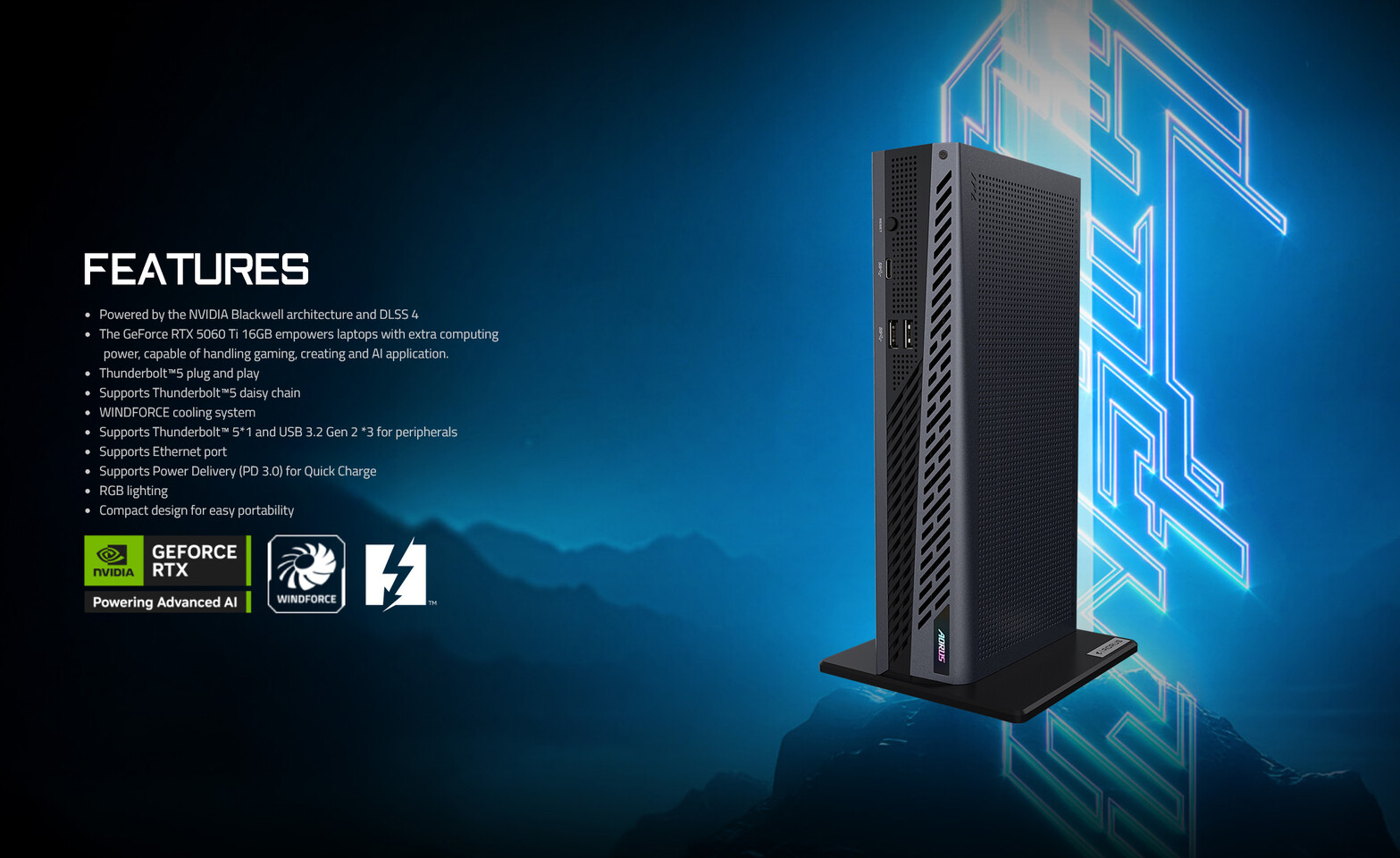

Is This the Future of Laptop Gaming? GIGABYTE AORUS RTX 5060 Ti AI BOX eGPU Revealed
Imagine significantly boosting your laptop’s graphics capabilities with a single, sleek device. GIGABYTE has just unveiled the AORUS RTX 5060 Ti AI BOX eGPU, an external graphics processing unit that promises to deliver desktop-level performance to laptops. This compact powerhouse packs a punch, featuring a desktop-grade NVIDIA GeForce RTX 5060 Ti and acting as a full-fledged docking station. Let’s dive into the details and explore what makes this eGPU a potential game-changer, especially for gamers, content creators, and AI enthusiasts who demand performance on the go.
The GIGABYTE AORUS RTX 5060 Ti AI BOX eGPU: A Deep Dive
GIGABYTE’s announcement of the AORUS RTX 5060 Ti AI BOX eGPU has generated considerable buzz in the tech community. This isn’t just another eGPU; it’s a meticulously designed piece of hardware that aims to bridge the gap between the portability of laptops and the raw power of desktop PCs. Here’s a detailed breakdown of its key features and their implications:
Desktop-Grade GPU Performance in a Portable Package
The core of the AORUS RTX 5060 Ti AI BOX is the NVIDIA GeForce RTX 5060 Ti, a desktop-grade GPU. This is a critical distinction. Most eGPUs on the market utilize mobile versions of GPUs, which are often underclocked and have reduced memory bandwidth to conserve power and manage heat. GIGABYTE’s decision to go with the full desktop chip means users can expect significantly higher performance.
This decision is further emphasized by the inclusion of 16GB of VRAM (Video RAM). This is double the typical 8GB found in many competing eGPUs and even some desktop cards. The extra VRAM is crucial for handling large textures, complex scenes in games, and demanding AI workloads. This means smoother gameplay at higher resolutions, faster rendering times for creative professionals, and increased efficiency for AI model training.
Advanced Cooling with WINDFORCE Technology
To accommodate the power and heat generated by a desktop GPU in such a small enclosure (117 x 243 x 45 mm), GIGABYTE has integrated its acclaimed WINDFORCE cooling system. This advanced cooling solution ensures the GPU remains stable and performs optimally even under sustained heavy loads. While specific details of the WINDFORCE implementation in the AI BOX haven’t been fully disclosed, WINDFORCE typically involves custom-designed fans, heat pipes, and heatsinks optimized for efficient heat dissipation. This prevents thermal throttling, a common issue in undercooled GPUs, which significantly impacts performance.
Thunderbolt 5 Connectivity: The Future of Bandwidth
One of the most forward-looking aspects of the AORUS RTX 5060 Ti AI BOX is its Thunderbolt 5 connectivity. This next-generation interface offers significantly increased bandwidth compared to Thunderbolt 4 or USB4. While the AI BOX utilizes PCIe 4.0 x4 bandwidth over Thunderbolt 5, it’s reported to perform only 5% slower than a desktop PCIe 4.0 x16 slot. This near-native performance is a substantial improvement over previous generations of eGPUs that were often bottlenecked by the limited bandwidth of older interfaces.
However, it’s crucial to acknowledge that Thunderbolt 5 adoption is currently limited. Only high-end laptops and mini PCs are beginning to incorporate this technology. Fortunately, the AI BOX maintains USB4 backward compatibility, ensuring it can be used with a wider range of devices, albeit with reduced bandwidth. In USB4 mode, GIGABYTE promotes its Project G-Assist, which suggests the eGPU could work alongside the laptop’s integrated graphics to balance workloads. This functionality will likely require specific drivers and software support.
More Than Just a GPU: A Full-Featured Docking Station
The AORUS RTX 5060 Ti AI BOX is more than just an eGPU; it’s a comprehensive docking station. It features:
- Three USB 3.2 Gen 2 ports with Power Delivery 3.0: Allows for fast data transfer and quick charging of connected devices.
- Ethernet connectivity: Provides a stable and reliable wired internet connection.
- Thunderbolt 5 daisy-chaining: Enables connecting multiple Thunderbolt devices in a chain, simplifying cable management and expanding connectivity options.
These features transform the AI BOX into a central hub for all your peripherals, making it a convenient and efficient solution for both home and office use.
Aesthetic Appeal: RGB Lighting and Compact Design
GIGABYTE hasn’t overlooked the aesthetic appeal of the AORUS RTX 5060 Ti AI BOX. The AORUS logo and interior feature RGB lighting, allowing users to customize the look and feel of the device. The compact design further enhances its portability, making it easy to transport between different locations.
Addressing Potential Concerns and Market Implications
While the AORUS RTX 5060 Ti AI BOX offers numerous advantages, several potential concerns need to be addressed:
- Pricing: The use of a desktop-grade GPU and advanced features will likely result in a premium price tag. GIGABYTE has yet to announce pricing, but it’s expected to be above the $460 MSRP of the desktop RTX 5060 Ti card. The final price will be a critical factor in its market success.
- Thunderbolt 5 Adoption: The limited availability of Thunderbolt 5 devices could restrict the AI BOX’s potential in the short term. However, as Thunderbolt 5 becomes more widespread, the AI BOX will become increasingly attractive.
- Software Compatibility: Ensuring seamless compatibility with various laptops and operating systems will be crucial. GIGABYTE will need to provide robust drivers and software updates to address potential issues.
Despite these potential challenges, the AORUS RTX 5060 Ti AI BOX has the potential to significantly impact the market for eGPUs. Its combination of desktop-grade performance, advanced cooling, Thunderbolt 5 connectivity, and docking station functionality sets it apart from the competition. It targets a growing market of users who demand high performance from their laptops without sacrificing portability.
Comparing the AORUS RTX 5060 Ti AI BOX to Existing eGPU Solutions
To better understand the significance of the AORUS RTX 5060 Ti AI BOX, let’s compare it to existing eGPU solutions:
| Feature | AORUS RTX 5060 Ti AI BOX | Typical eGPUs with Mobile GPUs |
|---|---|---|
| GPU Type | Desktop-grade RTX 5060 Ti | Mobile GPUs (e.g., RX 7600M XT) |
| VRAM | 16GB | 8GB |
| Cooling System | WINDFORCE | Basic cooling solutions |
| Connectivity | Thunderbolt 5/USB4 | Thunderbolt 3/4 |
| Docking Station | Yes | Sometimes |
| Performance | Significantly higher | Moderate improvement |
| Price | Higher (expected) | Lower |
This comparison highlights the key advantages of the AORUS RTX 5060 Ti AI BOX: superior performance due to the desktop GPU, increased VRAM, and advanced cooling. While it may come at a higher price point, the added performance and features could justify the investment for demanding users.
The Future of eGPUs and the Role of AI
The AORUS RTX 5060 Ti AI BOX represents a significant step forward in the evolution of eGPUs. As technology continues to advance, we can expect to see even more powerful and versatile eGPU solutions emerge. The increasing demand for AI processing power is also driving innovation in this field. eGPUs can provide a cost-effective way to add AI capabilities to existing laptops and desktops, enabling users to run demanding AI applications without having to purchase entirely new systems.
Conclusion: A Promising Development for Performance-Hungry Users
The GIGABYTE AORUS RTX 5060 Ti AI BOX eGPU is a promising development for gamers, content creators, and AI enthusiasts who need a significant performance boost for their laptops. Its desktop-grade GPU, advanced cooling, Thunderbolt 5 connectivity, and docking station functionality make it a compelling solution. While pricing and Thunderbolt 5 adoption remain potential hurdles, the AI BOX has the potential to redefine the eGPU market.
What do you think about this innovative eGPU? Is it something you would consider adding to your setup? Share your thoughts in the comments below!
Sources & Further Reading:
Original article at www.techpowerup.com


