
The Coaxial Comeback: Your Secret Weapon for Rock-Solid Home Internet
Did you know the cable line snaking into your living room – often written off as just a relic of cable TV past – might be delivering your Netflix binges, Zoom calls, and gaming sessions right now? While fiber internet grabs headlines with flashy speed claims, millions of households reliably power their entire digital lives over the humble coaxial cable, often without realizing its true potential or widespread use. Far from being obsolete, modern coax delivers surprisingly fast, stable internet over coax, making it a compelling and practical option many overlook. Forgoing the fiber hype train might be smarter than you think.
Deconstructing the Coax Connection: Not Magic, Just Clever Engineering
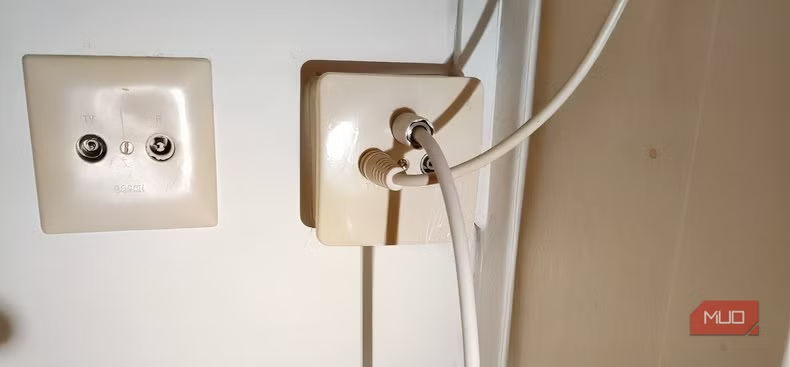
That thick, stubborn cable connecting to your wall isn’t just for passively receiving TV signals anymore. Inside its shielding lies a copper core uniquely adept at transporting high-frequency data signals over short distances with minimal interference – crucial for preserving data integrity.
- The DOCSIS Difference: The transformation happens thanks to the DOCSIS standard (Data Over Cable Service Interface Specification). This technology allows bidirectional communication over the same cable traditionally used for one-way TV broadcasts. When you stream, browse, or upload a photo, data travels as radio signals embedded within the coaxial cable.
- Your Hardware Hub: A crucial piece of equipment sits between this cable and your devices: the cable modem. This device acts as the translator:
- It receives radio frequency signals from the coax.
- Decodes them into digital data packets.
- Sends these packetsтиемney by connecting цифровой сигнал to your.
- When you send data (like an email), it reverses the process, encoding your digital data into radio signals sent back up the cable.
- The Hybrid Advantage: Contrary to popular belief, internet over coax isn’t just coax. Providers utilize a Hybrid Fiber-Coaxial (HFC) network architecture. Fiber optic cables handle the massive data loads across vast distances from the provider’s core network to a local neighborhood node. This leverages fiber’s incredible speed and capacity. The coax cable then takes over for the critical “last mile” connection directly into your home. This blend yields both high speed and cost-effective deployment, inheriting the existing coaxial infrastructure already embedded in countless residences.


