
The Memory Maze: Claude AI Recalls Your Chats But Only When Asked – A Privacy Revolution or a Step Backward?
What happens when artificial intelligence remembers everything you’ve ever told it? In an era where AI assistants increasingly track our preferences, conversations, and habits, Anthropic’s Claude AI has introduced a polarizing twist: the ability to recall past chats—but only when explicitly asked, and exclusively for paying subscribers. This feature arrives amidst fierce competition from ChatGPT, Gemini, and Copilot, all offering persistent memory capabilities. However, Claude’s “on-demand only” approach sparks critical questions: Is this a privacy-preserving masterstroke that puts users in control, or does it undermine the convenience AI memory promises? Let’s dissect how Claude’s new feature redefines AI personalization while navigating the minefield of privacy and practicality.
Claude’s Recall: Unpacking the On-Demand Memory Model
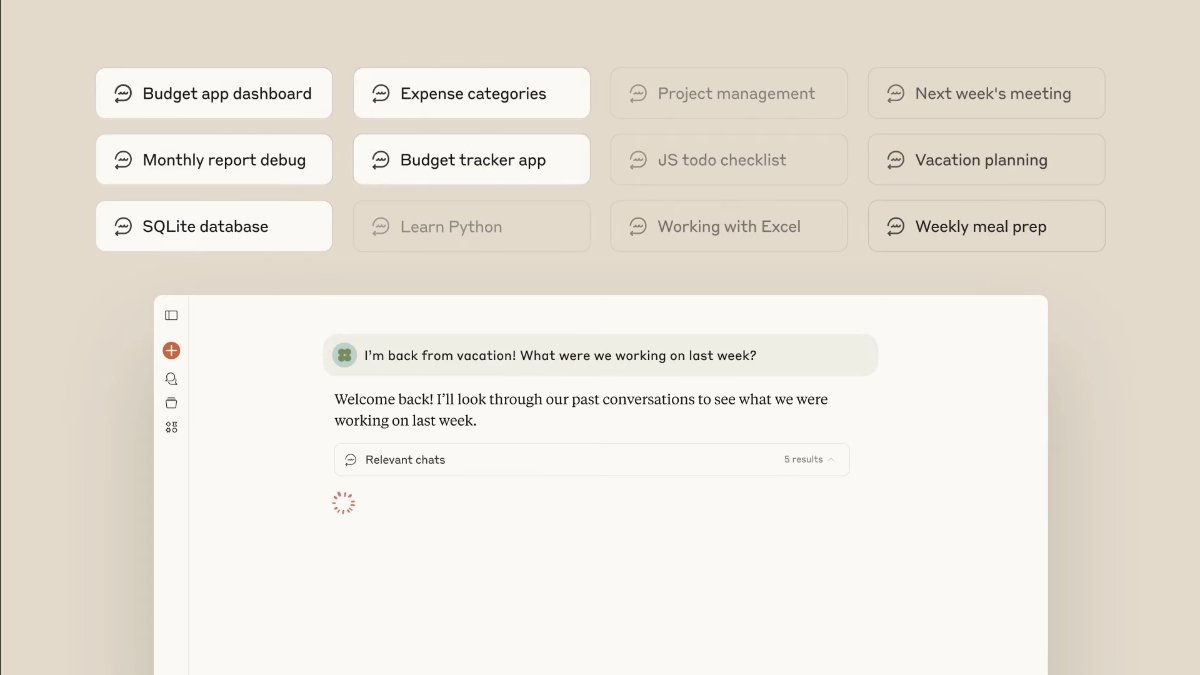
Anthropic demonstrated this new capability in a 34-second YouTube video, showcasing Claude retrieving details from previous interactions with startling ease. For instance, if a user previously mentioned loving sci-fi novels, Claude can now reference that preference when recommending books in a new session. Crucially, this isn’t automatic—users must trigger recalls like “What genres did I say I enjoy?” or “Find our chat about project deadlines.” Unlike rivals that silently build user profiles, Anthropic spokesperson Ryan Donegan clarified: “Users will need to ask Claude to retrieve information […] it is not building a user profile.” This positions Claude as a discreet librarian rather than an overeager eavesdropper.
Availability and Activation Discrepancies
The rollout targets premium tiers first: Claude Pro ($20/month), Team, and Enterprise users, with free access excluded. Intriguingly, a factual clash exists between Anthropic’s support page and external reporting:
- Anthropic claims: “Search and reference chats” is enabled by default.
- The Verge reports: Users must manually activate the feature.
This contradiction suggests potential tier-specific implementations, with Enterprise users possibly needing manual opt-in. To disable altogether, navigate:
Settings → Profile → Preferences → Toggle off “Search and reference chats”.
(If missing, the feature isn’t available for your account yet.)
Memory Wars: Claude vs. ChatGPT, Gemini & Copilot
Claude enters a battlefield dominated by AI giants with fundamentally different memory philosophies. Here’s a critical comparison:
| Feature | Claude | ChatGPT | Gemini | Copilot |
|---|---|---|---|---|
| Memory Type | On-demand recall | Persistent | Persistent | Persistent |
| User Trigger Required? | Yes | No (automatic) | No (automatic) | No (automatic) |
| Default State | Enabled (per Anthropic) | Configurable | Configurable | Configurable |
| Profile Building | None | Yes | Yes | Yes |
| Free Access | ❌ | Limited (GPT-3.5) | ✅ | ✅ |
| Privacy Focus | High (no passive storage) | Medium | Medium | Medium |
- ChatGPT: OpenAI’s “Memory” feature retains personal details across chats (e.g., meeting preferences) for tailored interactions, controllable via settings.
- Gemini: Google’s AI logs context like calendar events and personal tastes unless paused.
- Copilot: Microsoft’s system leverages past chats via Bing integration for continuity.
Claude’s model diverges sharply by requiring explicit commands. While rivals risk “context window pollution” (irrelevant memories diluting responses), Anthropic minimizes this by isolating recalls to user-initiated searches.
Why On-Demand? The Privacy Argument
Anthropic’s restraint aligns with its Constitutional AI principles, emphasizing user consent and minimizing data footprints. Unlike persistent memory, which operates like an “always-on” recorder, Claude’s recall functions more like a password-protected vault. This addresses key vulnerabilities:
- Privacy Regulation Compliance: Falls in line with GDPR/CCPA by limiting data retention scope.
- Security Risks: Hackers can’t exfiltrate a rich profile if it doesn’t exist.
- User Trust: 74% of consumers fear AI misusing personal data (Pew Research, 2023). Claude’s opt-in model fosters transparency.
Use Cases: Power and Limitations
- Pro:
- A writer asks Claude: “Find past brainstorming ideas for my novel.”
- A chef queries: “What vegan ingredients did I discuss last week?”
- No need to re-explain preferences: “Recall my allergy restrictions.”
- Con:
- Requires remembering what to ask—undermining convenience.
- Lacks anticipatory suggestions (e.g., “Since you liked Dune, try Foundation“).
The Controversy: Defaults, Control, and Confusion
The Anthropic-Verge discrepancy on default activation highlights implementation opacity. Enterprise clients may prefer manual enablements for audit trails, while consumers benefit from automation. Notably, Claude avoids the “creep factor” plaguing rivals—like ChatGPT suggesting anniversary gifts unprompted—but risks feeling “less smart.”
The Future of AI Memory: Where Does Claude Fit?
As models evolve, memory could leverage Retrieval-Augmented Generation (RAG architectures) to pull from local files or databases. Hybrid approaches may emerge, blending Claude’s privacy-centric recall with opt-in persistence. However, Anthropic’s stance challenges the industry: Should personalization come at the cost of autonomy?
Conclusion: Control Over Convenience?
Claude AI’s memory feature brilliantly balances utility and ethics by recalling past chats only when summoned. It’s a defiant counter to rivals’ automatic logging, sacrificing some fluidity to prioritize privacy. While its tiered rollout and activation ambiguities need clarity, Claude empowers users to dictate AI boundaries—making it a trailblazer in responsible personalization. In a world of intrusive algorithms, shouldn’t you decide what’s remembered?
Do you trust AI with your conversational history? Share your take on Claude’s approach—or disclose your memory preferences—in the comments!
Sources & Further Reading:
Original article at www.ghacks.net


