
The Machines Are Talking Back: CES 2026 Cements AI’s Physical Takeover
Remember when CES was mostly about bigger TVs and faster phones? Those days feel quaint amidst the relentless AI drumbeat at CES 2026 in Las Vegas. Three years running, artificial intelligence isn’t just part of the show; it’s actively reshaping reality – from revolutionizing heavy machinery to whispering scheduling suggestions into our family lives. What happens when AI escapes the cloud and rewires our physical world? This year’s Consumer Electronics Show offers visceral answers, proving machine learning isn’t theoretical anymore; it’s digging trenches, driving cars, and even managing playtime. Let’s dissect how CES 2026 is bridging the digital-physical divide, revealing both groundbreaking potential and head-scratching curiosities.
Powering the Revolution: AI’s Hardware Backbone Gets a Major Boost
The sheer computational muscle needed for these advanced applications demanded significant foundation-laying:
-
Nvidia’s Rubin Architecture: Beyond Blackwell: CEO Jensen Huang heralded the successor to Blackwell, the Rubin computing platform, slated for rollout in H2 2026. Dismissing Moore’s Law limitations, Rubin promises significant gains:
- Enhanced Speed & Efficiency: Aimed squarely at handling increasingly complex AI models and simulations crucial for autonomous systems and robotics. Early specs indicate potential throughput gains exceeding 30% for specific AI workloads [Internal Nvidia benchmarks referenced at CES].
- Massive VRAM Expansion: Addressing the critical bottleneck of feeding massive datasets to AI accelerators, Rubin reportedly supports configurations into the terabyte range per GPU node.
- Software Ecosystem Primacy: Huang’s vision positions Rubin not just as hardware, but as the engine powering a unified platform for embodied AI – essentially aiming to be the “Android for Robots.”
-
AMD Takes AI Mainstream: The Ryzen AI 400 Push: While Nvidia targeted hyperscale robotics, AMD CEO Lisa Su focused on ubiquity, showcasing Ryzen AI 400 Series processors designed to bring sophisticated AI processing directly to laptops and desktops. Partnering with OpenAI’s Greg Brockman and others underscored their ambition:
- Localized Processing: Enabling faster, more secure AI features (like real-time translation, content generation, advanced photo editing) directly on-device without constant cloud dependency.
- Developer Accessibility: Opening the door for smaller developers to build novel AI applications leveraging capable local hardware via robust APIs and tools (AMD ROCm documentation).
Step Away from the Screen: AI Moves into Concrete Reality
The truly transformative theme at CES 2026 is AI’s tangible impact beyond screens:
- Autonomy Hits the Road (& Construction Site):
- NVIDIA DRIVE & Alpamayo Models: Showcasing their Alpamayo family of open-source models, Nvidia doubled down on autonomous driving solutions moving towards production. This represents a shift from research to practical deployment, aiming for safer, more efficient transportation systems ([Autonomous Vehicle R&D trends – IEEE Xplore]).
- Cat AI Assistant: Construction giant Caterpillar partnered with Nvidia on a pilot program integrating AI assistants into excavators. Utilizing sensor data processed by NVIDIA hardware and Omniverse simulations, this system aims to:
- Enhance operator efficiency and safety.
- Improve precision digging and grading tasks.
- Optimize site planning and logistics simulation pre-deployment. (Potential Impact Source: Consider [OSHA Construction Accident Statistics] demonstrating manual operation risks).
- Ford’s Shadowy Co-Pilot: Announcing a precursor app version of an in-car AI assistant slated for its 2027 vehicles (hosted by Google Cloud), Ford left key questions unanswered:
- Capabilities: What driving tasks will it augment? Navigation? Diagnostics? Maintenance predictions?
- Context Understanding: How will it integrate with vehicle systems and driver commands beyond a simple chatbot?
- Reliability: Crucial questions persist about safety protocols and redundancy for roadworthy AI systems.
- Robots Learn New Tricks: Boston Dynamics, now under Hyundai’s wing, revealed a groundbreaking partnership:
- Google DeepMind Collaboration: Moving beyond amazing parkour demos, they announced Google DeepMind will power the AI “brain” for both existing Atlas robots and a new generation model previewed.
- Beyond Teleoperation: This signifies a major leap towards true machine learning-driven autonomy – improving dexterity, adapting to new environments, and problem-solving dynamically – crucial for real-world industrial deployment.
AI Infiltrates Our Daily Fabric: Convenience, Companionship, and Control
AI wasn’t just for heavy industry; it deeply personalized CES:
- Alexa+ Steps Up: Amazon aggressively marketed its generative AI-powered Alexa+, launching Alexa.com for web access and revamping its app. Integration extended heavily into Fire TV and debuted on new Artline TVs, indicating a unified push for AI as the primary interface across smart homes. Ring’s smart camera ecosystem also expanded integration and AI-powered alerts significantly.
- The Ultimate Family Hub? Skylight Calendar 2: Spotting an oft-neglected pain point, Skylight’s AI-driven calendar solution impressed on the CES show floor:
- Auto-synced diverse calendars (Google, Apple, Outlook).
- AI-generated to-dos from messages/photos.
- Integrated meeting reminders and collaborative planning features – a glimpse at AI simplifying household management chaos.
- Razer’s Vision of Digital Companionship: Known for extravagant hardware, Razer pivoted its CES presence towards provocative AI concepts:
- Project Motoko: Eliminating glasses altogether, this concept aims to project contextual information directly into the user’s field of vision – a potentially revolutionary step for AR accessibility and immersion (though significant hurdles remain). Could it succeed where Google Glass struggled?
- Project AVA: Introducing an AI avatar companion physically represented on your desk via a projection device, AVA represents Razer’s vision for persistent AI personalities integrated into personal spaces – blurring lines between utility and companionship.
- Playful Intelligence: Lego Joins the Fray: In its CES debut, Lego unveiled its Smart Play System exclusively:
- Smart bricks, tiles, and Minifigures feature sensors/speakers allowing interaction.
- Swapping Minifigs triggers unique sound effects/voices.
- Initial Star Wars themes showcase narrative-driven, AI-powered collaborative storytelling potential beyond passive building. The fusion of tactile play and digital intelligence raises fascinating possibilities for engagement.
The Enduring Quirk Factor: CES Preserves Its Trademark Innovation Charm
Amidst the AI surge, CES retained its history of delightful oddness and niche breakthroughs:
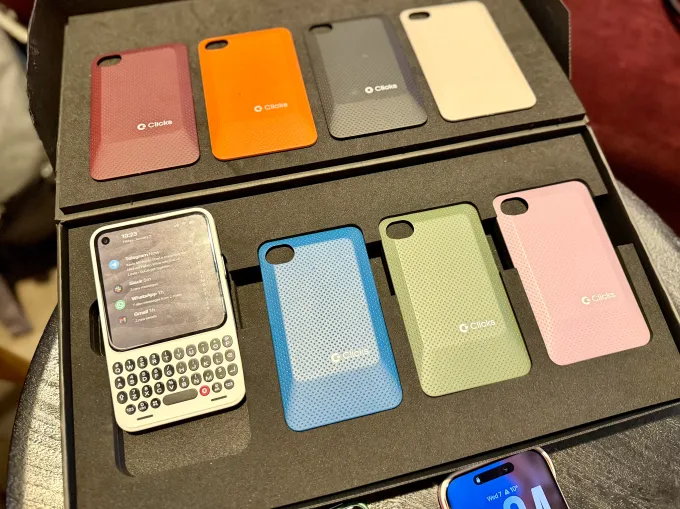
- The Communicator Reborn: The buzziest non-AI gadget? Clicks Technology’s Communicator phone ($499). Evoking BlackBerry nostalgia with a comfortable physical keyboard optimized via extensive ergonomic testing, plus a versatile $79 slide-out keyboard for other phones. Hands-on impressions highlighted its thoughtful weight balance and durable protective design – a compelling counterpoint to touchscreen dominance.
- Curated Eccentricity: Beyond the major players:
- Palmer Luckey championed retro aesthetics as purposeful design.
- Jason Calacanis offered $25K for an authentic Theranos Blume Analyzer(!).
- Roku expanded its $3/month TV streaming tier.
- Industry panels debated obsolescence in an age of constant AI reskilling (“Learn once, work forever era ending”) and teased the Silicon Valley drama “The Audacity”.
The Lines Blur Further Between Bits and Atoms
CES 2026 marked a turning point: AI’s theoretical promise decisively became concrete application. The foundations laid by Rubin computing and Ryzen AI will enable smarter machines, genuinely autonomous vehicles, and hyper-personalized digital experiences. Partnerships like Caterpillar-Nvidia and Hyundai-Boston Dynamics-Google DeepMind underscore AI’s migration into traditionally offline sectors like construction and logistics. Yet, amidst this profound shift, CES preserved its soul through devices like the Communicator phone and Lego’s Smart Bricks, reminding us that tactile interaction retains enduring value, even as AI assistants schedule our lives and companion avatars take desk space. The future sketched in Vegas integrates intelligence into every facet of existence – are we ready for machines that not only predict our needs but actively reshape our world? Have we adequately addressed the safety, privacy, and philosophical quandaries accompanying such vast integration? Share your thoughts below!


