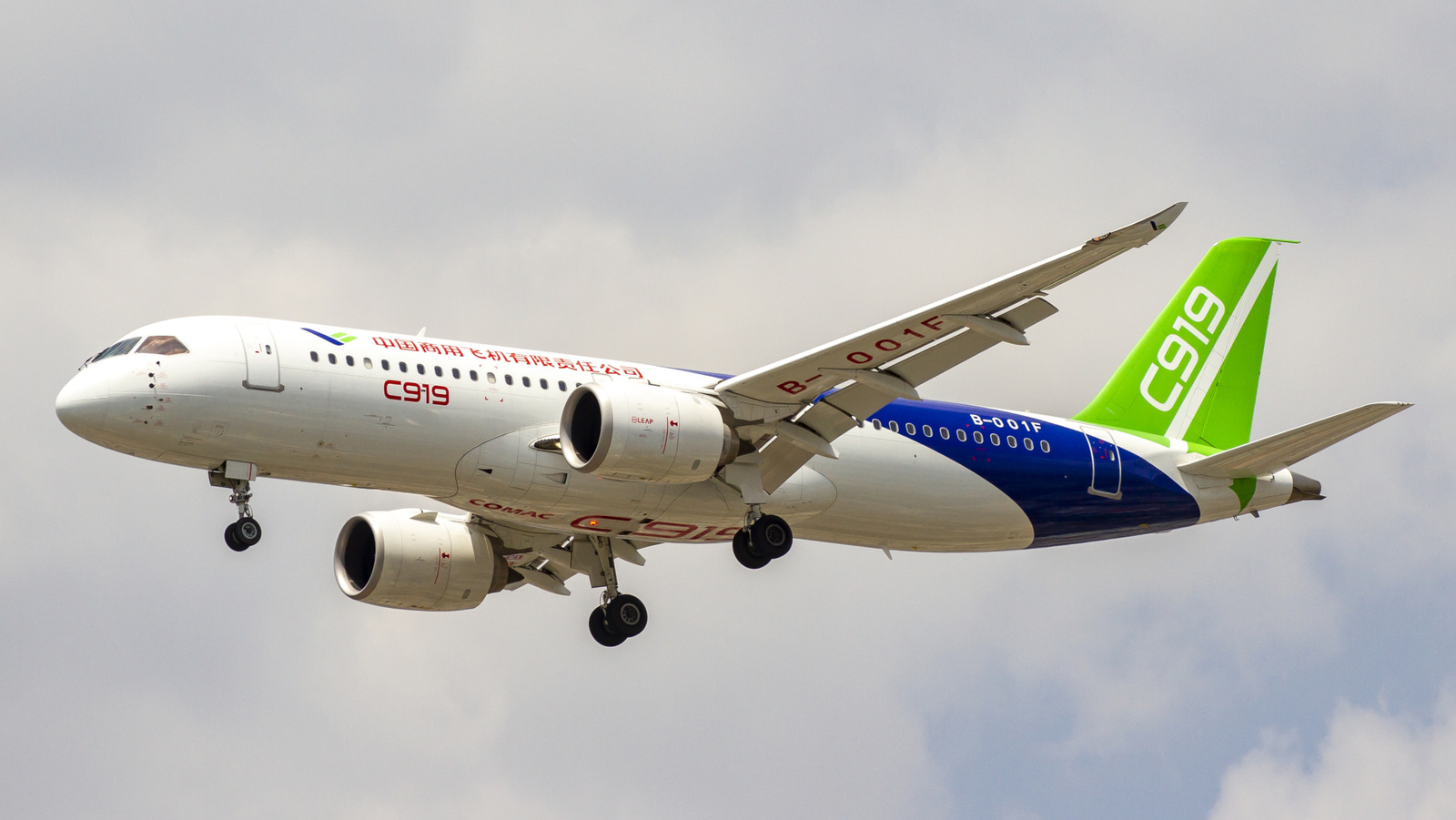

Will China’s COMAC C919 Disrupt the Boeing-Airbus Duopoly?
For decades, Boeing and Airbus have reigned supreme in the commercial aviation industry. But could a new contender be poised to challenge their dominance? The Commercial Aircraft Corporation of China (COMAC) has been developing the C919 narrow-body airliner, a direct competitor to the Airbus A320 and Boeing 737 families. While currently confined to Chinese airspace and Hong Kong, the C919 represents a significant ambition to break into the global market and reduce China’s reliance on foreign technology. Let’s delve into the details of this aircraft and examine its potential impact on the future of commercial aviation.
COMAC C919: A Contender Emerges
The COMAC C919 represents China’s boldest attempt yet to enter the highly competitive commercial aircraft market. Designed to rival the Airbus A320 and Boeing 737, the C919 aims to capture a significant share of the lucrative narrow-body market. Its development and entry into service mark a strategic move by China to become a major player in the global aerospace industry.
The Development Timeline of the C919
The journey of the C919 from conception to commercial operation has been a long and complex one.
- 2009: COMAC officially announces the C919 project, initially projecting a 2016 rollout.
- May 2017: The C919 successfully completes its maiden flight, a major milestone.
- May 2023: China Eastern Airlines operates the inaugural commercial flight from Shanghai to Beijing.
- January 2025: Approximately 16 C919s are in service, with plans to deliver 27 more throughout the year.
This timeline reveals the challenges and delays inherent in developing a complex aircraft from the ground up. Despite the initial setbacks, COMAC has persevered and is now actively ramping up production.
Production Capacity: Can COMAC Compete?
A key factor in the C919’s potential success is COMAC’s ability to scale up production. The current plan is to reach a production rate of 150 aircraft per year within five years. While ambitious, this figure still lags behind the production capabilities of Airbus and Boeing.
To illustrate the production gap, consider the following comparison:
| Manufacturer | Aircraft Model | Estimated Monthly Production | Target Monthly Production |
|---|---|---|---|
| Airbus | A320 | 50 | 75 (by 2027) |
| Boeing | 737 | 38 | 42 (target for this year) |
| COMAC | C919 | ~2 (annual goal of 150) | ~12.5 (annual goal of 150) |
While COMAC’s planned production increase is significant, bridging the gap with established manufacturers will be a considerable challenge. Successfully scaling up production will be crucial for COMAC to meet demand and compete effectively in the market.
C919 and the Narrow-Body Market
The narrow-body aircraft market, dominated by the Airbus A320 and Boeing 737 families, is the workhorse of commercial aviation. These aircraft are primarily used for short to medium-range flights and are essential for airlines operating domestic and regional routes. The C919 is specifically designed to compete in this segment, offering airlines an alternative to the established players.
Technical Specifications and Design
The COMAC C919 is a narrow-body, twin-engine jet designed for short to medium-range flights. It has a seating capacity of 158 to 174 passengers in a typical two-class configuration, or up to 192 in a high-density configuration. It has a range of about 4,075 to 5,555 km (2,200 to 3,000 nm). Key competitors are the Boeing 737 MAX and the Airbus A320neo families.
Western Components and Technologies
While the C919 is intended to reduce China’s dependence on foreign technology, it still relies on several Western-built components and systems.
- Engines: The C919 is currently powered by CFM International LEAP-1C engines. These engines are a product of a joint venture between Safran (France) and General Electric (USA) and are also used on the Boeing 737 MAX and Airbus A320neo families.
- Avionics: The aircraft’s avionics are supplied by Aviage Systems, a joint venture between GE and AVIC (Aviation Industry Corporation of China).
This reliance on Western technology highlights the challenges of developing a completely indigenous commercial aircraft. However, China is actively pursuing the development of domestic alternatives, including a homegrown engine for the C919.
Certification Challenges and International Expansion
A significant hurdle for the C919 is obtaining certification from international aviation authorities. Currently, the aircraft is certified only by the Civil Aviation Administration of China (CAAC), limiting its operations to Chinese airspace and Hong Kong.
The EASA and FAA Conundrum
- European Union Aviation Safety Agency (EASA): COMAC is seeking EASA certification, which is expected to take 3-6 years.
- Federal Aviation Administration (FAA): COMAC is not currently pursuing FAA certification.
The lack of FAA certification effectively bars the C919 from operating in the United States, a major aviation market. However, COMAC is actively seeking certification from other regulatory bodies within the 193 member states of the International Civil Aviation Organization (ICAO). Gaining these certifications is crucial for the C919 to expand its international reach and compete effectively with Airbus and Boeing.
The Road Ahead: Lessons from Airbus
COMAC can draw inspiration from the early struggles of Airbus. When Airbus first entered the market, it faced significant challenges in gaining acceptance and competing with established American manufacturers. It took years for Airbus to secure its first US order, and even then, the aircraft were initially loaned to Eastern Air Lines to generate interest.
Despite these initial hurdles, Airbus eventually grew to become a dominant force in the commercial aviation industry. COMAC can learn from Airbus’s perseverance and strategic approach to overcoming obstacles and establishing itself in a competitive market. The focus should be on product quality and innovation.
The Potential Impact on the Aviation Industry
The entry of the C919 into the commercial aviation market has the potential to reshape the industry landscape.
- Increased Competition: The C919 provides airlines with an alternative to Airbus and Boeing, potentially leading to increased competition and lower prices.
- Shifting Market Dynamics: The rise of COMAC could shift the balance of power in the aviation industry, challenging the dominance of established manufacturers.
- Technological Innovation: The development of the C919 could spur technological innovation in the aviation industry, as manufacturers compete to offer more efficient and advanced aircraft.
However, the C919’s success is not guaranteed. It faces significant challenges, including certification hurdles, production limitations, and reliance on Western technology. Only time will tell if the C919 can truly disrupt the Boeing-Airbus duopoly.
Conclusion: A Promising Start, But a Long Way to Go
The COMAC C919 represents a significant step for China’s aviation industry and a potential challenge to the established dominance of Boeing and Airbus. While the aircraft faces numerous hurdles, including certification and production scaling, its successful entry into service marks a pivotal moment. The C919 provides airlines with a new option in the narrow-body market, potentially driving competition and innovation. Whether it can truly rival the established giants remains to be seen, but the C919 has certainly introduced a new dynamic into the global aviation landscape.
What do you think? Will the C919 succeed in breaking the Boeing-Airbus duopoly? Share your thoughts in the comments below!
Sources & Further Reading:
Original article at www.slashgear.com


