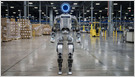

The Dawn of the Machine Co-Worker: Why Hyundai Betting Big on Atlas Changes Everything
What if the grimy, physically demanding work on automotive assembly lines could be handled seamlessly by agile, tireless machines shaped like us? Billion-pound presses, intricate wiring harnesses, awkward pallets of parts – tasks humans perform daily, often with risk and fatigue, might soon see a radical new workforce arrive. Hyundai Motor Group ignited just this future when its Boston Dynamics unit unveiled the next-generation Atlas humanoid robot. Designed specifically for Hyundai’s manufacturing environment, this upgraded bot isn’t a lab showcase; it’s targeting deployment on factory floors – starting as early as 2025, with Hyundai’s Savannah, Georgia U.S. EV Metaplant earmarked as a proving ground. This move signals far more than a cool tech demo; it represents a profound strategic bet on humanoid robots as viable solutions for complex real-world industrial tasks, fundamentally reshaping the future of manufacturing work.
The Evolution Beyond Parkour: Atlas Grows Up
Boston Dynamics’ Atlas captured global imagination with its dazzling, sometimes unsettling, parkour routines. Yet, those displays were proof-of-concept gymnastics, demonstrating advanced mobility, agility, and balance – essential foundations, but not an end goal. The Hyundai-focused iteration marks a distinct evolutionary pivot:
- From Acrobat to Artisan: The core focus shifts dramatically. Dazzling flips and rolls take a backseat to practicality. This Atlas prioritizes reliability, efficiency, and safety in performing structured, repetitive manufacturing tasks requiring dexterity. Think levers pulled, components positioned, bolts secured – the unglamorous but essential building blocks of production.
- Perception for Precision: Factory floors are dynamic environments. The new Atlas requires advanced sensing capabilities far beyond navigating obstacle courses. It needs vision systems that can identify specific parts (often in suboptimal lighting), differentiate components amidst clutter (like discarded packaging), understand spatial relationships (ensuring a part fits accurately), and react safely to unexpected human proximity or moving machinery.
- Industrial-Grade Interfaces: Where the old Atlas might need a clear pathway, the new one needs plinths, shelves, levers, control panels, and material carts designed or adapted for interaction. Its grippers must handle tools and components previously intended for human hands – automotive parts ranging from fragile electronic modules to heavy metal castings.
- Hyundai-First Mentality: Crucially, this isn’t a general-purpose robot searching for problems. It’s engineered by Hyundai engineers for Hyundai processes using Boston Dynamics’ biomechanical prowess. Atlas is being molded directly by the challenges and workflows it will face on Hyundai’s production lines.
Why a Human Form? The Niche Hyundai Sees Filling
Car manufacturing already crawls with robots – massive arms welding chassis, painting bodies, or installing windshields with millimeter precision. Why introduce fragile-looking humanoids? Hyundai’s gamble hinges on the unique advantages bipedal, anthropomorphic machines offer:
- Built for Existing Infrastructure: Factories evolved around humans. Stairs, catwalks, narrow aisles between machinery, workstations designed for our reach and posture – these are endemic. A wheeled or tracked robot often requires costly modifications. A humanoid designed specifically for manufacturing environments can navigate Hyundai’s existing plants immediately, leveraging walkways, stairs, and operator stations built decades earlier. This drastically reduces retooling costs and speeds deployment.
- Versatility Beyond Programming: Much factory work involves sequences of diverse tasks (“pick this, carry it there, lift it into that fixture”). Traditional industrial robots excel at repetitive single motions. Reprogramming them for a new step is complex and halts production. Humanoids, with advanced AI/ML architectures driving adaptable manipulation powered by dynamic balancing, promise the ability to learn or be taught sequences more fluidly, switching between tasks with potentially minimal downtime. This targets complex workflows less suited to single-arm automation.
- Handling the Unpredictable (Sort Of): Slight variations in part presentation, changes in bin location, minor spills – these realities disrupt rigid automation. While not yet capable of handling truly novel chaos, humanoids equipped with sophisticated machine vision and manipulation algorithms hold more promise for adapting to minor workflow perturbations within constrained factory settings compared to fixed robots.
- Collaboration Potential: Designed as factory partners, these Atlas models likely incorporate sophisticated sensors for safe interaction zones around humans, allowing closer collaboration than the safety cages mandatory for heavy-duty industrial arms handling 200-pound welding guns.
Beyond Grunt Work: Potential Tasks for the Robotic Co-Worker
Hyundai’s initial rollout in Savannah will undoubtedly focus on well-defined, somewhat isolated tasks proving reliability and ROI. Target areas likely include:
- Logistics & Material Handling: Moving parts kits to assembly stations, transporting components between production islands, loading/unloading carts and conveyor staging areas requiring navigation between fixed equipment.
- Component Installation: Placing heavy battery packs into chassis frames (with precision guided lifting), inserting wiring harnesses, securing interior trim panels – tasks demanding fine motor control within confined spaces designed for humans.
- Quality Control Assistance: Using vision systems to perform visual inspections in awkward locations for cameras or humans, potentially flagging defects for human review.
- Machine Tending: Loading/unloading parts into stamping presses or CNC machines, pressing buttons and levers on equipment interfaces – replacing potentially hazardous, monotonous roles.
- Post-Process Tasks: Deburring, polishing, applying sealants in tasks requiring handling tools manually while navigating fixtures.
Table: Atlas vs. Traditional Industrial Robots – The Perfect Fit?
| Feature | Traditional Industrial Robot Arm | Boston Dynamics Atlas (Hyundai Gen) | Advantage |
|---|---|---|---|
| Mobility | Fixed base or limited track/cart movement. | Bipedal/Quadruped – Navigates stairs, uneven terrain. | Atlas (For environments built for humans) |
| Flexibility/Task Switching | Reprogramming/retooling complex & time-consuming. | Potentially faster AI-driven task adaptation. | Atlas (For multi-step workflows) |
| Infrastructure Cost | Often requires major modifications (cages, dedicated paths) | Designed for existing human-centric infrastructure. | Atlas (Lower retrofit cost) |
| Payload Capacity | Significantly higher (Many tons possible). | Limited compared to massive dedicated arms. | Industrial Arm (For heavy lifting) |
| Precision/Speed | Extremely high (Micro-meter, rapid cycles). | Variable, dependent on control systems – likely slower. | Industrial Arm (For high-speed repetition) |
| Human Collaboration | Requires strict guarding/separation. | Potential for safer closer cooperation. | Atlas (For tasks needing intermittent human interaction) |
| Initial Cost | High, but established ROI models. | Likely extremely high, new/unproven long-term ROI. | Industrial Arm (For now) |
Hyundai’s Strategic Imperative: More Than Just Efficiency
The Hyundai investment isn’t just about automating tasks; it’s a multi-layered strategic play:
- Solving the Labor Challenge: Manufacturing faces persistent skilled labor shortages globally (source). Tasks requiring strength, stamina, or performed in uncomfortable environments are uniquely difficult to fill. Atlas targets automating these undesirable jobs, potentially freeing humans for more skilled, safer roles.
- Gaining Automation Supremacy: Hyundai aims to be seen as the most advanced auto manufacturer. Deploying cutting-edge humanoids provides a powerful marketing edge, signaling technological leadership and attracting investment. It positions Hyundai as defining the future of the factory, not just participating in it.
- Integrating Boston Dynamics: Acquiring Boston Dynamics (Wikipedia) wasn’t a philanthropic move. Hyundai needs tangible ROI. Integrating Atlas directly into core automotive operations justifies the acquisition cost and embeds BD’s AI/robotics expertise directly into Hyundai’s production DNA.
- Perfecting for Wider Industry: Mastering humanoids within the demanding environment of auto manufacturing creates a transferable product/service. Success at Hyundai paves the way for Hyundai Robotics (a distinct unit) to sell Atlas-derived solutions to logistics, warehousing, aerospace, and beyond, opening vast new markets.
- US Manufacturing Acceleration: Targeting the Savannah EV plant leverages US government incentives for domestic manufacturing and clean energy. Demonstrating cutting-edge automation bolsters Hyundai’s standing in this critical growth market.
The Human Factor: Displacement, Transformation, and Safety
Introducing robots inevitably sparks concern about job losses. Hyundai stresses Atlas will tackle


