
Forget Everything You Knew About Ultraportables?
What if a laptop could shatter the performance ceiling without bulking up? That audacious question hovers around Acer’s Swift Go 16 AI, poised for release in mid-2026. Beneath a deceptively familiar chassis throbs Intel’s revolutionary “Panther Lake” CPU—a silicon beast promising Apple-level efficiency and gaming-grade power. This isn’t just iterative; it’s Intel’s generational leap, packaged in a MacBook Air-rivaling frame starting at just 2.9 pounds. Amid industry-wide “RAMageddon” fears inflating prices, Acer’s gamble hinges on balancing cutting-edge specs with accessibility. Can a Windows laptop truly claim the ultraportable throne? Early impressions suggest it’s so much more than hype.
A Design Masterclass: Portability Meets Practicality
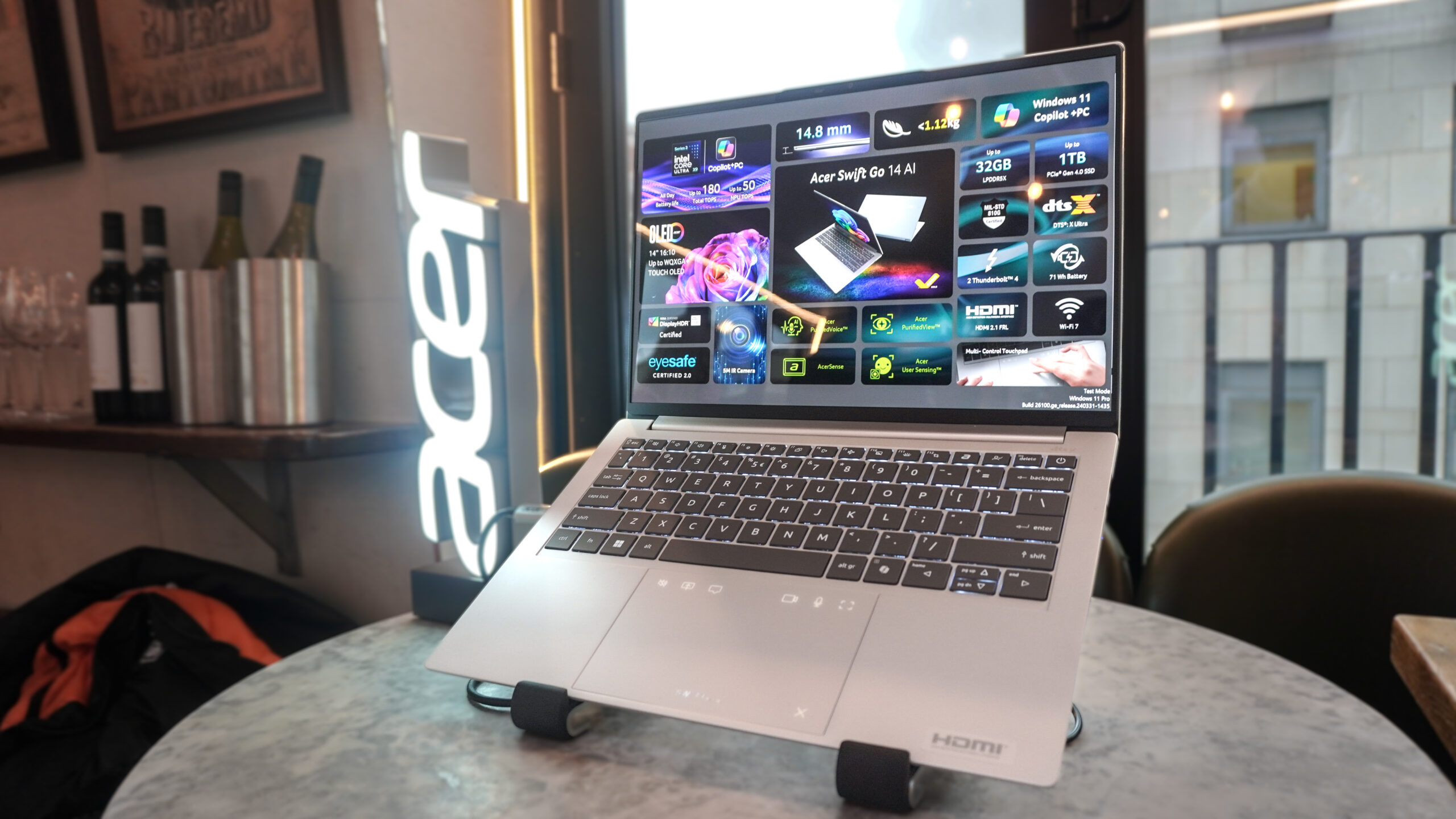
Holding the Swift Go 14 AI prototype elicited an involuntary “whoa.” At 2.4 pounds, it undercuts Apple’s current 13-inch MacBook Air (2.7 lbs) despite its larger footprint. The 16-inch model stretches the scales to a still-featherweight 2.9 lbs—a triumph of engineering achieved via laser-etched aluminum. This isn’t flimsy minimalism; the chassis feels sturdy, even sporting a 180-degree hinge for flexible presentations. Yet, it’s the port selection that drops jaws:
- Thunderbolt 4 x 2 (40Gbps data/Power Delivery)
- USB-A ports x 2 (legacy devices)
- HDMI 2.1 (8K/60Hz video output)
- 3.5mm audio jack
Few ultraportables avoid the dongle life. Acer’s commitment to versatility echoes business traveler frustrations—imagine connecting a projector, external drive, and mouse simultaneously without adapters. This thoughtful layout targets professionals needing seamless transitions between office, travel, and home workflows.
Breaking Down the Hardware DNA
Both 14-inch and 16-inch variants share near-identical internals tailored to productivity warriors. Below, a technical dissection:
| Feature | Swift Go 14 AI (2026) | Swift Go 16 AI (2026) |
|---|---|---|
| Display | 14″ OLED, up to 2880×1800 | 16″ OLED, up to 2880×1800 |
| Processor | Intel Core Ultra X9 388H | Intel Core Ultra X9 388H |
| Graphics | Intel Arc B390 | Intel Arc B390 |
| Memory (RAM) | Up to 32GB LPDDR5x | Up to 32GB LPDDR5x |
| Storage | Up to 1TB NVMe SSD | Up to 1TB NVMe SSD |
| Weight | 2.4 lbs | 2.9 lbs |
Source: Acer CES 2026 Showcase Specifications
The highlight? Unified LPDDR5x RAM—signaling a shift toward integrated high-bandwidth memory. This enables quicker data access for intensive tasks while conserving energy. However, 32GB non-upgradable RAM might bottleneck long-term ambitions in heavy AI modeling, hinting at a premium configuration necessity. Storage limits also warrant scrutiny; content creators juggling raw media will crave higher capacities.
Visuals That Pull You In
OLED technology dominates premium laptops, and the Swift Go leverages Samsung-tier panels that prioritize punch over compromise. Offering resolutions up to 2880×1800 (“3K” in Acer-speak), both models flaunt touch-enabled OLED displays. Brief demonstrations revealed striking strengths:
- True blacks enabling near-infinite contrast ratios.
- DCI-P3 color gamut coverage for photo/video editing.
- Extreme brightness adaptations for outdoor use.
Industry testing (DisplayMate benchmarks) will validate whether it meets professional calibration standards. Still, early visuals cue cinematic escapism—a YouTube deep dive or Netflix binge demand this vibrancy. Paired with HDMI 2.1, creators can effortlessly drive external HDR monitors despite evaporating ports elsewhere.
Panther Lake: Intel’s Silent Revolution
Performance whispers center on Panther Lake—Intel’s rumored CPU nicknamed the “jungle cat.” This isn’t Lunar Lake warmed over; leaked specifics from Intel roadmap briefings outline staggering leaps:
- 25% faster CPU throughput versus Intel Core Ultra 2.
- 38% energy efficiency gains—bordering MacBook Pro endurance.
- AI Processing: NPU-peak surges from 120 TOPS to 180 TOPS (Trillion Operations/Second), rivaling Qualcomm


