
The Compact Powerhouse: Why ASUS’s New Motherboard Blurs Workstation and Server Lines
Have you ever wished for server-grade reliability and management features in a desktop-sized workstation – without the exorbitant price tag? This precise gap in the market is what ASUS is aggressively targeting with its newly unveiled Pro WS B850M-ACE SE. This intriguing platform packs enterprise-inspired capabilities into a microATX footprint, specifically catering to users who demand more than a standard desktop PC can offer: high-density storage, remote manageability, robust networking, and unwavering stability. Whether you’re a creative professional handling massive datasets, a small business deploying a lightweight server, or a tech enthusiast building a compact yet potent unRAID/NAS solution, this motherboard demands attention. Its blend of prosumer pricing and enterprise-grade features represents a fascinating evolution in the workstation motherboard landscape.
Terminal Strength: Decoding the Core Capabilities
Underpinning the Pro WS B850M-ACE SE is the versatile AMD Socket AM5 platform. While Ryzen 7000 and upcoming Ryzen 9000 series desktop processors are naturally the primary focus, ASUS throws a tantalizing curveball: official support for the AMD EPYC 4005 series CPUs. These server-grade AM5 processors offer significantly higher core counts specifically engineered for entry-level servers and intensive workloads. This flexibility caters perfectly to its target audience. Need blazing fast cores for rendering? Grab a Ryzen 9 7950X. Building a compact NAS or VM host craving higher core density? An EPYC 4564P becomes a compelling option – a level of processor freedom rarely seen in this form factor or price segment.
Processing Power Options:
| Processor Series | Target Use Case | Core Count Range | Key Advantage |
——————-|——————|——————-|—————|
| AMD Ryzen 7000/9000 | High-Performance Workstations, Rendering | Up to 16 Cores | High Clock Speeds, Gaming |
| AMD Ryzen PRO 7000/9000 | Commercial Workstations | Up to 16 Cores | Security Features, Manageability |
| AMD EPYC 4005 Series | Entry-Level Servers, High-Core VM Hosts | Up to 16 Cores | Core Density, Efficiency |
Memory Stability Fit for Professional Duty
Data integrity is paramount in professional environments. Recognizing this, the Pro WS B850M-ACE SE embraces ECC (Error-Correcting Code) unbuffered DDR5 memory. ECC actively detects and corrects single-bit memory errors before they can corrupt files or crash applications – a critical safeguard for scientific computing, database servers, or long-running renders where silent data corruption could be disastrous. Supporting up to 256GB across four DIMM slots (leveraging DDR5’s dual-channel architecture effectively creating four sub-channels), it offers impressive capacity. While DDR5-5600 support represents a solid baseline today, its compatibility lays a foundation for higher-specced ECC modules as they become more prevalent.
Server Heritage Baked In
This board distinctly borrows DNA from ASUS’s enterprise server pedigree:
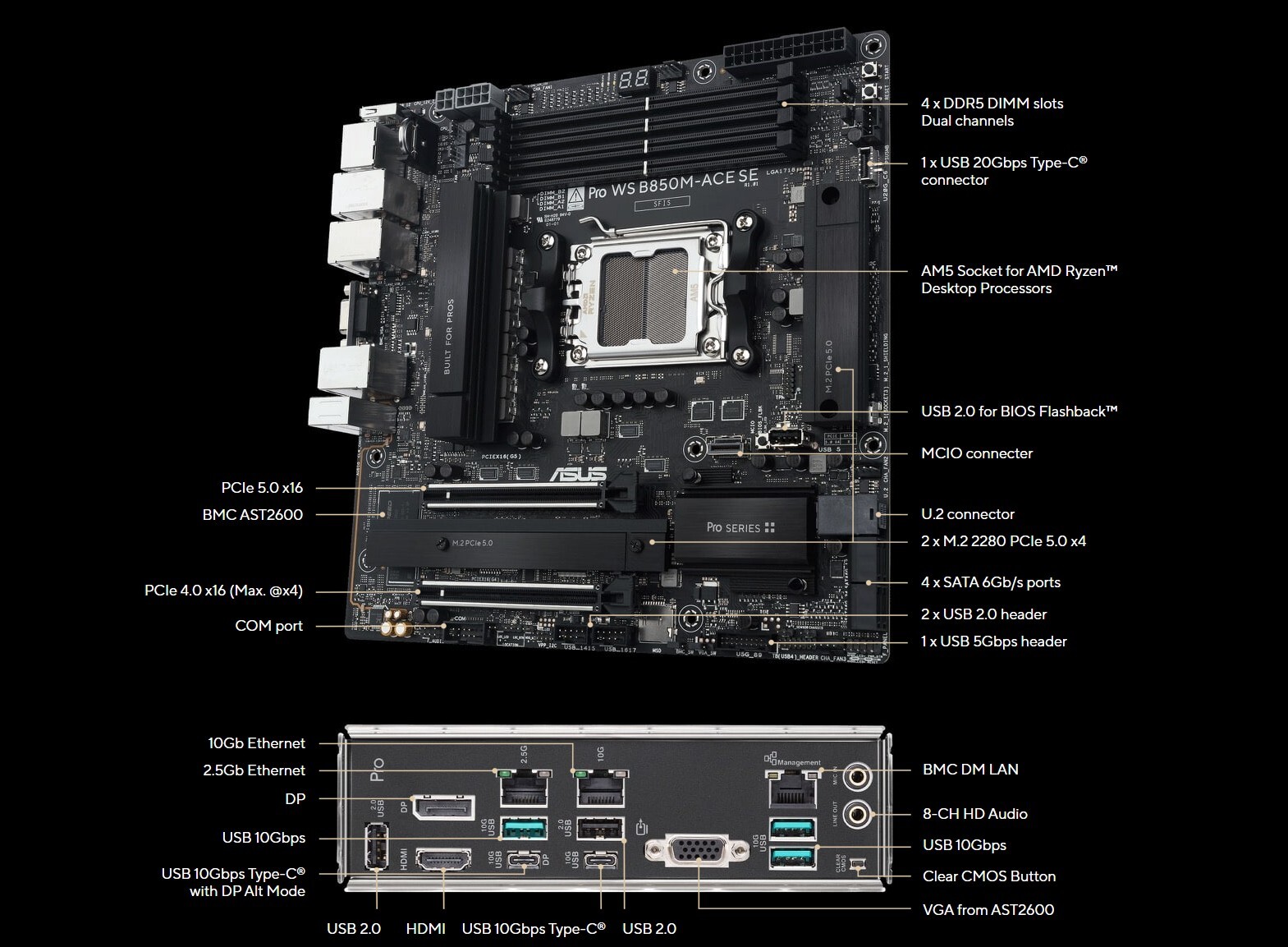
- Intelligent Platform Management Interface (IPMI): Driven by the dedicated ASPEED AST2600 controller chip with a dedicated 1GbE port and VGA-out (D-Sub), IPMI is a game-changer. Acquiring ASUS Control Center Express IT management software unlocks remote power control (on/off/reset), real-time sensor monitoring (temps, fan speeds, voltages), virtual media mounting (install OS remotely!), and SOL (Serial-over-LAN) console access. Imagine troubleshooting a crashed workstation headless server blade mounted in a closet without needing a keyboard/monitor plugged in – that’s pure admin bliss. For small IT teams or remote workers, this drastically reduces downtime and simplifies maintenance.
- Storage Versatility: Storage not an afterthought. Dual PCIe 5.0 x4 M.2 slots offer blistering SSD speeds for your OS and active projects. But the truly compelling features for storage-heavy use cases are the U.2 (SFF-8639) Gen 3 and PCIe Gen 4 MCIO (Multi-Cloud Input/Output) interfaces. U.2 allows direct connection of enterprise-grade, high-capacity 2.5-inch NVMe SSDs known for endurance and often cooler operation. MCIO is a newer interface designed for flexibility, supporting NVMe storage devices and potentially other expansion cards via compatible cables. Combined with four SATA ports (+ the U.2 drive), building a workstation with diverse storage tiers becomes effortless. The internal
microSDslot provides secure storage for encryption keys or licenses. Learn more about RAID configurations and storage interfaces on Wikipedia. - Triple-LAN Fortress: Networking isn’t an afterthought either. A blazing-fast 10 GbE port (using Realtek RTL8127) handles transferring massive media files or supporting high-bandwidth applications locally. A redundant 2.5 GbE port (Intel i225 controller) offers a high-speed fallback or separates management traffic. And the dedicated 1 GbE for IPMI ensures remote management remains accessible independently, irrespective of traffic on the other ports. This robust connectivity makes the board equally suitable for a primary NAS/file server or a workstation requiring rapid access to network resources.
Connectivity and Expansion Nuances
While microATX imposes constraints, ASUS maximizes utility:
- USB: Generous speeds abound: Two rear USB-C 10 Gbps/10Gbps ports, a front-panel USB-C 20 Gbps header (‘USB 3.2 Gen 2×2’) for premium storage docks/external SSDs, three rear USB-A 10 Gbps ports, an internal USB-A port, plus numerous 5 Gbps headers. This covers expansive peripheral setups.
- Expansion Slots: Leveraging PCIe lanes strategically is key on mATX. While details beyond the MCIO are vital, expect PCIe slot configurations prioritizing generality while maximizing connectivity. This necessitates careful planning if using multiple high-bandwidth add-in cards and populating all M.2/U.2 slots.
- Video Output: Relies on processor integrated graphics (Ryzen desktop/Ryzen PRO/EPYC 4005 with iGPU) via HDMI and DisplayPort. The IPMI’s VGA port provides a basic out-of-band video solution.
Balancing Act: Practicality Meets Power
Pushing the boundaries within a microATX frame presents inherent compromises, primarily in expansion. Can you install multiple double-wide GPUs? Likely not without severe limitations elsewhere. How many PCIe slots run at full speed simultaneously? This requires scrutiny. However, ASUS clearly prioritizes core workstation and entry-server functions: maximum CPU power, ECC memory stability, vast efficient storage connectivity, unparalleled remote management (IPMI), and cutting-edge networking.
The anticipated $400 price point is crucial context. Compare this to competitors: Standard ATX workstation boards with basic features (lacking ECC/IPMI/U.2/10GbE) start lower, but adding these enterprise features often pushes prices significantly higher. Entry-level server motherboards require specific expensive chassis/power supplies and easily exceed this cost. This positions the Pro WS B850M-ACE SE uniquely – offering similar core enterprise functionality at near-mainstream desktop motherboard pricing.
Forging a New Path in Compact Computing
The ASUS Pro WS B850M-ACE SE isn’t trying to be everything; it carves out a distinct niche exceptionally well. By baking enterprise-level staples – ECC memory support, IPMI-based remote management, U.2/MCIO storage flexibility, and multi-Gigabit networking – into an affordable microATX design, it empowers a specific audience. Home labs gain professional-grade stability and management previously inaccessible. Small businesses defer investing in bulky servers. Workstation users boost capacity without sacrificing desk space. The EPYC 4005 compatibility throws open doors to higher-core-density workloads usually reserved for larger systems. While compromises exist in expansion potential, the concentrated focus on storage, network, management, and core CPU power delivers tangible value. If your needs lean towards demanding computational tasks, high data integrity, massive storage arrays, or remote accessibility within a compact, cost-effective build, this board warrants serious consideration. It’s more than just silicon; it’s a blueprint for a potent, manageable micro-powerhouse. Where would you leverage such hybrid capability? Drop a comment below!


