
Is ASRock’s New Radeon RX 9060 XT the Right Choice for You?
In the ever-evolving landscape of PC gaming, staying ahead of the curve means understanding the latest hardware. Are you struggling to choose the perfect graphics card to boost your gaming experience? ASRock has recently introduced the Radeon RX 9060 XT 16 GB Challenger Standard Edition, a custom-design card that aims to strike a balance between performance and value. This article will delve into the specifications, design, and target audience of this new graphics card to help you determine if it’s the right fit for your needs.
Diving Deep into the ASRock Radeon RX 9060 XT 16 GB Challenger Standard Edition
ASRock’s new offering, the Radeon RX 9060 XT 16 GB Challenger Standard Edition, joins the ranks of custom-designed graphics cards, specifically tailored to provide a unique blend of performance and features. While it shares similarities with its “OC Edition” counterpart, several key distinctions set it apart, making it a potential option for a specific niche of gamers and PC enthusiasts. Let’s explore what makes this card tick.
Clock Speeds: A Balanced Approach
One of the most notable differences between the Standard Edition and the OC Edition lies in their clock speeds. The Standard Edition sits comfortably between the AMD reference specs and the higher clock speeds of the Challenger OC.
- Game Clock: The ASRock RX 9060 XT 16 GB Challenger Standard Edition boasts a Game clock of 2620 MHz. This is a step up from the AMD reference specification of 2530 MHz, yet slightly lower than the Challenger OC’s 2700 MHz.
- Boost Clock: The Boost frequency follows a similar pattern, reaching up to 3230 MHz on the Standard Edition. This compares to 3130 MHz for the AMD reference and 3290 MHz for the Challenger OC.
These differences, while seemingly minor, can impact real-world gaming performance. The higher clock speeds of the OC Edition will generally translate to slightly higher frame rates, but at the potential cost of increased power consumption and heat generation. The Standard Edition aims to provide a sweet spot, offering a noticeable improvement over the reference card without pushing the limits quite as far.
Memory Configuration: Staying Consistent
The memory configuration remains unchanged across the ASRock RX 9060 XT 16 GB Challenger models. The Standard Edition, like its OC sibling, features 16 GB of GDDR6 memory operating at an effective speed of 20 Gbps. This ensures ample memory bandwidth for demanding games and applications, especially at higher resolutions like 1440p and 4K. The 16 GB of VRAM is essential for modern games with high-resolution textures.
Cooling and Design: Familiar Territory
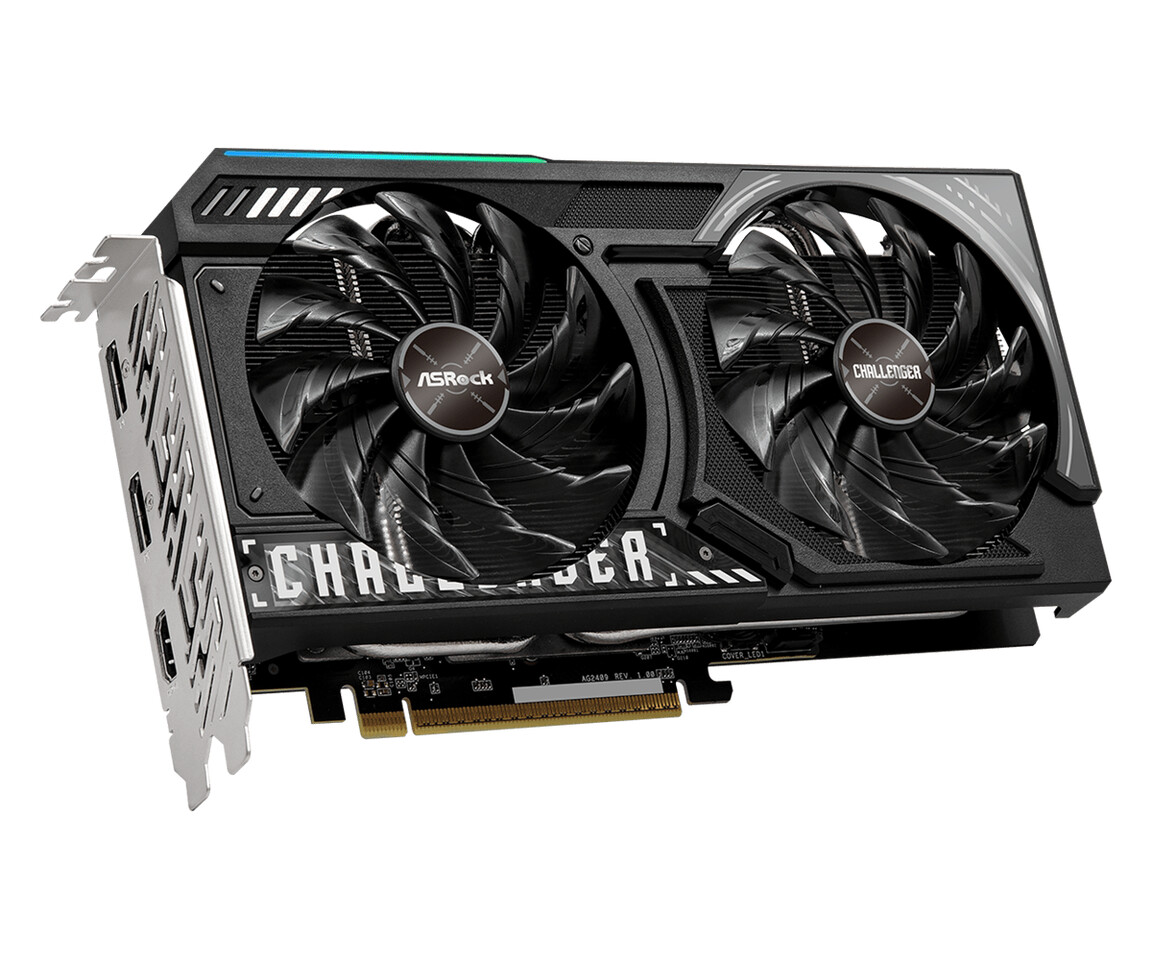
ASRock has opted to maintain the same board design and cooling solution for the Standard Edition as the Challenger OC. This means users can expect the same tall, 2-slot, dual-fan cooling system, which utilizes an aluminum fin-stack heatsink to dissipate heat effectively. This is a crucial aspect, as efficient cooling is essential for maintaining stable performance and preventing thermal throttling, especially during prolonged gaming sessions. The dual-fan design is a common and effective method for cooling graphics cards, and the 2-slot thickness ensures compatibility with a wide range of PC cases.
Power and Connectivity: Standard Affair
The power requirements of the ASRock RX 9060 XT 16 GB Challenger Standard Edition are fairly standard for a card in this performance bracket. It draws power from a single 8-pin PCIe power connector, making it compatible with most modern power supplies. In terms of display outputs, the card offers a modern selection, including two DisplayPort 2.1a ports and one HDMI 2.1b port. This allows for connectivity to the latest monitors and displays, supporting high refresh rates and resolutions. DisplayPort 2.1a and HDMI 2.1b are crucial for future-proofing your setup, as they support higher bandwidths and resolutions than previous generations.
Under the Hood: Navi 44 and RDNA 4 Architecture
At the heart of the ASRock RX 9060 XT 16 GB Challenger Standard Edition lies the “Navi 44” silicon, based on AMD’s latest RDNA 4 graphics architecture. The Navi 44 silicon die contains:
- 2,048 stream processors: These are the workhorses of the GPU, responsible for executing the complex calculations required for rendering graphics.
- 32 RT (Ray Tracing) accelerators: These dedicated hardware units accelerate ray tracing tasks, enabling more realistic lighting and reflections in supported games.
- 64 AI accelerators: These units are designed for accelerating AI-related tasks, such as upscaling technologies like AMD FidelityFX Super Resolution (FSR).
- 128 TMUs (Texture Mapping Units): TMUs handle the application of textures to 3D models, adding detail and realism to the rendered scene.
- 64 ROPs (Raster Operation Units): ROPs perform the final stages of rendering, including blending and outputting the image to the display.
The 16 GB of memory is connected via a 128-bit wide memory interface, providing ample bandwidth for data transfer between the GPU and memory. The card also features a full-width PCI-Express 5.0 x16 host interface, ensuring maximum bandwidth for communication with the CPU and other system components. PCI-Express 5.0 x16 ensures compatibility with the latest motherboards and allows for future upgrades as technology advances.
Distinguishing the “Standard Edition”: More Than Just a Label
ASRock has made it a point to explicitly badge this card as the “Standard Edition,” rather than simply omitting the “OC Edition” label. This suggests that the Standard Edition is intended as a distinct product, catering to a specific market segment. It’s likely that ASRock is targeting users who are looking for a reliable, well-performing graphics card without the added cost and potential complexities of an overclocked model.
Who is the Target Audience?
The ASRock Radeon RX 9060 XT 16 GB Challenger Standard Edition appears to be designed for gamers and PC enthusiasts who prioritize a balance of performance, price, and stability. It is well-suited for:
- Gamers playing at 1080p and 1440p: The card’s specifications are well-suited for achieving high frame rates in most modern games at these resolutions.
- Users who prefer a “plug-and-play” experience: The Standard Edition’s clock speeds are pre-configured by ASRock, eliminating the need for manual overclocking and ensuring a stable and reliable experience out of the box.
- Budget-conscious buyers: The Standard Edition is likely to be priced lower than the OC Edition, making it an attractive option for those looking to maximize performance without breaking the bank.
- Builders with standard-sized cases: The two slot design ensures this card will fit into the majority of standard computer cases.
ASRock Radeon RX 9060 XT: Key Specifications Compared
| Feature | ASRock RX 9060 XT 16GB Challenger Standard Edition | ASRock RX 9060 XT 16GB Challenger OC | AMD Reference RX 9060 XT |
|---|---|---|---|
| Game Clock | 2620 MHz | 2700 MHz | 2530 MHz |
| Boost Clock | 3230 MHz | 3290 MHz | 3130 MHz |
| Memory Speed | 20 Gbps | 20 Gbps | 20 Gbps |
| Cooling Solution | Dual-Fan, Aluminum Fin-Stack | Dual-Fan, Aluminum Fin-Stack | (Likely Reference Design) |
| Power Connector | 8-pin PCIe | 8-pin PCIe | 8-pin PCIe |
| Display Outputs | 2x DisplayPort 2.1a, 1x HDMI 2.1b | 2x DisplayPort 2.1a, 1x HDMI 2.1b | 2x DisplayPort 2.1a, 1x HDMI 2.1b |
Potential Drawbacks and Considerations
While the ASRock Radeon RX 9060 XT 16 GB Challenger Standard Edition offers a compelling package, there are a few potential drawbacks to consider:
- Slightly Lower Performance Than OC Edition: Users seeking the absolute highest frame rates may prefer the OC Edition, which offers slightly higher clock speeds.
- Memory Bandwidth Limitations: The 128-bit memory interface might be a bottleneck in certain memory-intensive games or applications, especially at 4K resolution. This is something to consider when comparing to GPUs with wider memory buses.
- Unconfirmed Pricing: The ultimate value proposition of the Standard Edition will depend on its pricing relative to the OC Edition and competing graphics cards.
Conclusion: A Solid Choice for Balanced Performance
The ASRock Radeon RX 9060 XT 16 GB Challenger Standard Edition appears to be a well-rounded graphics card that strikes a good balance between performance, features, and price. Its slightly higher clock speeds than the reference card, combined with its robust cooling solution, make it a suitable choice for gamers looking to upgrade their gaming experience without breaking the bank or delving into the complexities of overclocking. While it may not offer the absolute highest performance, its stability, features and value makes it an attractive option for a wide range of users. Ultimately, whether this card is the right choice for you will depend on your individual needs and budget. What do you think about the new ASRock RX 9060 XT? Comment below!
Sources & Further Reading:
Original article at www.techpowerup.com


