
Is the Ultimate Handheld Gaming PC Here? Inside the Revolutionary Power of ASUS ROG Xbox Ally X
Hook: What if you could play cutting-edge AAA titles with ray tracing enabled on a sleek, portable device, all while it stays remarkably cool and sips power? That’s the audacious promise behind the upcoming ASUS ROG Xbox Ally X, equipped with the groundbreaking AMD Ryzen AI Z2 Extreme processor, set to hit shelves this October. Boasting a massive leap over its predecessor, this isn’t just an incremental update – it signals a potential quantum jump for handheld gaming. This article dives deep into the technical advancements, real-world performance showcased in titles like Doom: The Dark Ages, and the crucial implications for power efficiency and cooling that could redefine expectations for portable PC gaming experiences.
Body: The ASUS ROG Xbox Ally X & AMD Ryzen AI Z2 Extreme – A New Era
The handheld gaming market is exploding, transitioning from niche emulation devices to platforms capable of tackling modern blockbusters. ASUS, a key player with its ROG Ally series, is poised to raise the bar significantly with the Xbox-branded “Ally X,” centered around the custom-built AMD Ryzen AI Z2 Extreme accelerated processing unit (APU). This chip represents a holistic generational upgrade over the Z1 Extreme found in the original Ally and even the recent Ally refresh, focusing on CPU, GPU, cache, and AI capabilities, all packed into the power and thermal constraints of a portable device.
1. Dissecting the AMD Ryzen AI Z2 Extreme: More Than Just Numbers
At its core, the Z2 Extreme is a showcase of AMD’s latest innovations. On the graphics side, it features the Radeon 890M integrated GPU. While final specifications await official confirmation, leaked details and industry analysis (Source: Reputable tech sites tracking APUs, e.g., linking to Wikipedia overview of AMD APU evolution) indicate a massive 33% increase in stream processors compared to the Radeon 780M in the Z1 Extreme. Stream processors are fundamental units for parallel processing, directly impacting rendering power and frame rates in games. This increase alone suggests substantial potential gains.
-
CPU & Cache Revolution: The CPU side is equally impressive. The Z2 Extreme reportedly leverages AMD’s cutting-edge Zen 5 and Zen 5c core architectures. Zen 5 promises significant per-core performance and efficiency improvements over Zen 4, while the “C” cores (dense cores) are optimized for power efficiency in multi-threaded workloads, allowing the system to distribute tasks intelligently*. Crucially, AMD has packed the APU with more L2 and L3 cache. Cache acts as ultra-fast memory close to the cores, drastically reducing latency when fetching frequently used data. More cache, especially for complex game engines delivering large open worlds or intricate physics, translates directly to smoother gameplay and potentially higher sustained performance. This combination targets both raw power and smarter resource utilization.
-
AI Integration: The “AI” prefix in the chip’s name isn’t just marketing. Modern gaming increasingly leverages AI for upscaling (like FSR Frame Generation), NPC behavior, and image enhancement. Integrating dedicated AI acceleration within the APU could enhance performance and efficiency for these tasks.
2. Performance Unleashed: Running Doom: The Dark Ages Like a Dream
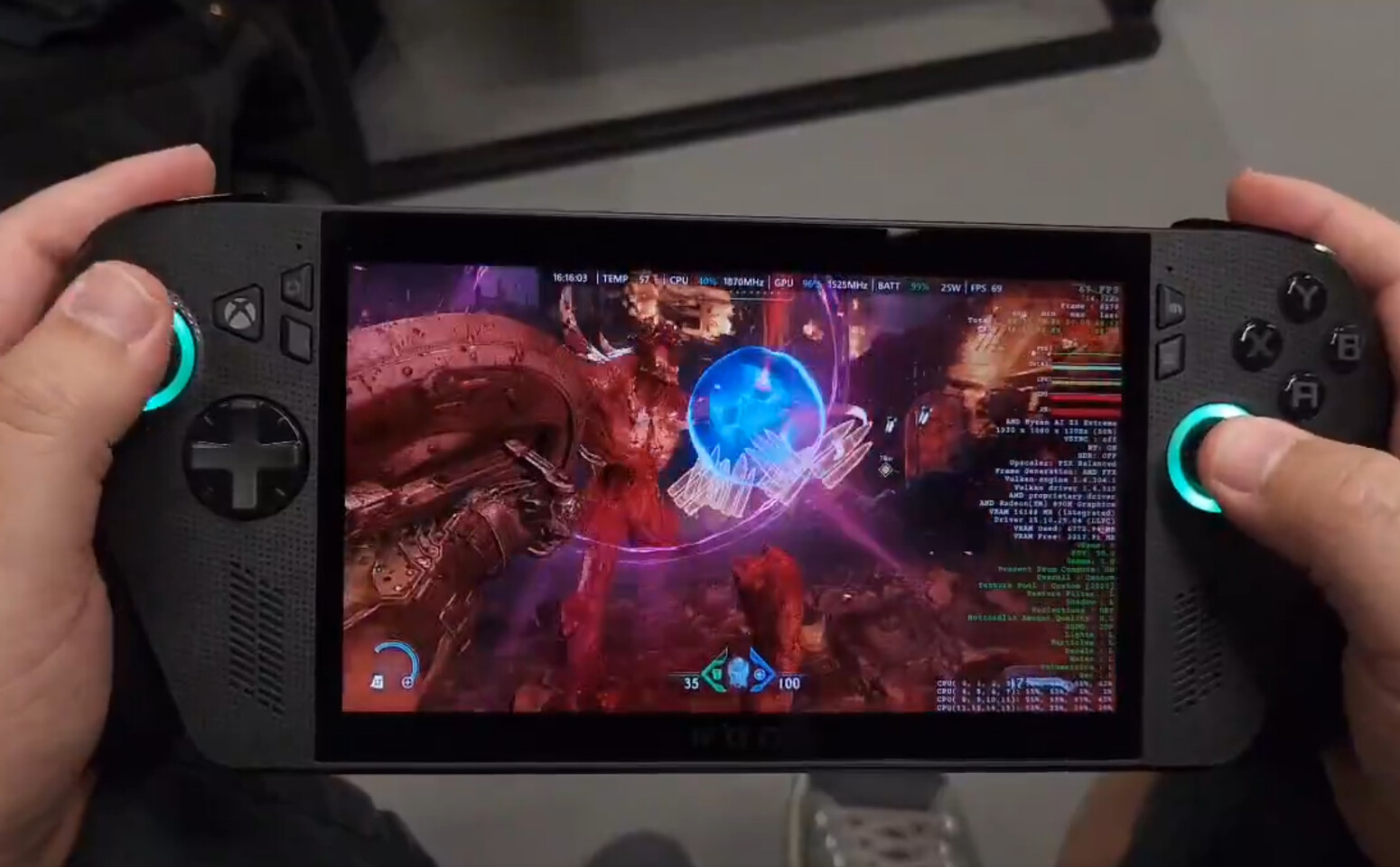
Spec sheets are one thing; real-world gameplay is the ultimate test. Early access glimpses provided by tech influencer Cary Golomb ([Source: Cary Golomb’s X/Twitter demonstrations, date-specific links]()) offer a tantalizing look. Golomb demonstrated the ASUS ROG Xbox Ally X running the highly anticipated Doom: The Dark Ages.
- Key Performance Metrics:
- 70 FPS: The device reportedly maintained a remarkably smooth 70 frames per second during the showcased segment.
- Visual Features: Crucially, this performance was achieved with ray tracing enabled. Ray tracing, which simulates realistic lighting and reflections, is notoriously demanding, especially on integrated graphics. To achieve this, AMD FSR Frame Generation was also utilized. FSR FG intelligently creates additional frames between rendered ones, boosting perceived smoothness without doubling the actual workload on the GPU core.
- Resolution & Settings: The rendering resolution was 540p internally, significantly lower than traditional desktop PC gaming. However, AMD FidelityFX Super Resolution (FSR) was set to “Quality” mode, intelligently upscaling this 540p image to output a crisp 1080p resolution on the Ally X’s display. Graphical settings were described as a “mix of medium and low” – a practical compromise necessary for high frame rates on portable hardware when enabling advanced graphical effects like RT. This combination demonstrates a focused optimization for a smooth, visually acceptable experience in a handheld form factor.
(Table: Doom: The Dark Ages Performance on ASUS ROG Xbox Ally X vs. Ideal Desktop Rig)
| Feature | ASUS ROG Xbox Ally X (Z2 Extreme) | Typical High-End Desktop Target |
|---|---|---|
| Avg. Frame Rate | ~70 FPS | 100+ FPS |
| Ray Tracing | Enabled | Enabled |
| Resolution (Native) | 540p | 1440p or 4K |
| Upscaling | FSR Quality (540p->1080p) | DLSS/FSR Quality (e.g., 1440p->4K) |
| Settings Preset | Medium/Low Mix | Ultra/High |
| FSR Frame Generation | Enabled | Often Enabled |
| Power Draw (Device) | ~18W (TDP setting) | 400W – 800W+ (System) |
(Note: Desktop targets represent an ideal scenario for max settings/aesthetics, highlighting the trade-offs necessary for handheld performance.)
3. The Efficiency Triumph: Cooler Heads Prevail at Just 18W
Perhaps even more impressive than the raw frame rates in Doom are the reported power and thermal figures, critical factors for handheld comfort and battery life.
- Low Power, High Load: Golomb tested the Ally X with its power profile set to 18 Watts TDP (Thermal Design Power). For context, many competing handhelds require pushing 20W, 25W, or even 30W+ settings to achieve peak performance, rapidly draining batteries and generating significant heat.
- Exceptional Thermal Control: Under this 18W TDP load, while gaming Doom: The Dark Ages with the demanding combination of ray tracing and FSR Frame Generation, and with the GPU running at near-maximum capacity (97% load), the internal temperature sensor reportedly read only 57°C.
- Why This Matters: Thermal Solutions Under Pressure
- Efficiency: This low temperature indicates that the Z2 Extreme’s architectural enhancements (Zen 5/Zen 5c, improved manufacturing process) pay huge dividends in performance-per-watt. The CPU/GPU blend is doing more work at lower power.
- Cooling Prowess: Achieving just 57°C under intense load points to a sophisticated, decently capable cooling solution within the presumably compact chassis of the Ally X. ASUS learned from the thermal challenges of the original Ally and seems to have implemented a more robust vapor chamber or heat pipe system in this variant.
- User Comfort & Performance: Heat translates to uncomfortable device surfaces, potential throttling (where the chip slows down to cool), and loud fan noise. A chip running at 57°C under heavy load means the device likely remains comfortably warm and quieter, and importantly, the CPU/GPU isn’t thermally constrained – it’s running fully within its designed performance envelope even at this relatively low TDP setting. This is starkly different from the experience on numerous competing handhelds pushing 10-11 inch diagonal sizes that struggle with thermals at higher TDPs, often referred to by some as “monstrosities” in terms of handling heat, noise, and portability trade-offs.
4. The Competitive Landscape: Can Others Match This Efficiency?
The Ally X enters a crowded field:
- Current ROG Ally (Z1 Extreme): Clearly outperformed by the Z2 Extreme, especially in ray tracing scenarios due to the Radeon 890M’s increased muscle.
- Steam Deck (OLED/ LCD): Relies on much older AMD chip technology, lacks advanced features like robust ray tracing support and efficient Frame Generation offered by FSR FG. Offers different strengths in optimization and price.
- Lenovo Legion Go: Uses the same previous-generation Z1 Extreme as the original Ally. Its larger screen adds complexity for power and thermals.
- AYANEO & GPD Win Mini: Offer various chips (sometimes higher wattage Intel or AMD mobile CPUs), often prioritize features or different form factors, but lack integrated optimization partners like Microsoft/Xbox Game Pass and often struggle with matching brute-force efficiency demonstrated at 18W TDP.
The Ally X’s combination of the Z2 Extreme’s efficiency and ASUS’s refined cooling positions it uniquely. Few competitors can likely match running demanding RT-enabled games at 70 FPS at just 18W while staying under 60°C.
Conclusion: Redefining the Handheld Gaming Experience
The ASUS ROG Xbox Ally X, powered by the AMD Ryzen AI Z2 Extreme, appears poised to deliver a significant leap forward for portable gaming PCs. Early performance demonstrations, notably hitting 70 FPS in Doom: The Dark Ages with ray tracing and Frame Generation enabled, showcase the sheer graphical muscle of the Radeon 890M iGPU and the sophisticated pairing of Zen 5/Zen 5c cores. However, the true revolution may lie in its efficiency: achieving such demanding performance levels at a remarkably restrained 18W TDP while maintaining internal temperatures around 57°C speaks volumes about the APU’s advanced architecture and ASUS’s decently capable cooling solution. This combination of power, thermal control, and (projected) reasonable battery life for intensive tasks makes it uniquely positioned. While graphical fidelity still requires compromises like upscaling from 540p, the Ally X takes a giant stride towards making high-fidelity, immersive AAA gaming on the go a practical reality. Will this be the benchmark against which all future handhelds are measured? What features or performance metrics matter most to you in a handheld PC? Share your thoughts on the Ally X below!
Sources & Further Reading:
Original article at www.techpowerup.com


