
The Ridiculous Truth Behind CachyOS’s Server Ambitions
Picture this: Linux servers—ubiquitous, reliable… and stagnant for decades. Suddenly, a gaming-focused Arch Linux spin from the enthusiast niche aims for the data center by 2026. Can CachyOS succeed where Intel’s legendary Clear Linux failed? Driven by Clear Linux’s discontinued optimizations and Arch Linux’s rolling updates, CachyOS Server Edition threatens to disrupt enterprise environments craving bleeding-edge performance without vendor lock-in. Its rise among gamers hinges on optimized kernels and aggressive compiler tweaks for desktop workloads—but servers demand ironclad stability, security, and efficiency. During recent holidays, I burned $25,000 in electricity benchmarking pre-release CachyOS against Ubuntu and Arch Linux on a 96-core AMD EPYC CPU beast. The sprinkled insights reveal whether Linux’s rebellious underdog is fooling itself… or genuinely onto something revolutionary.
Powerhouse Hardware: The Unforgiving Testing Ground
Before diving into benchmarks, consider our brutal testing environment designed to expose workflow gaps:
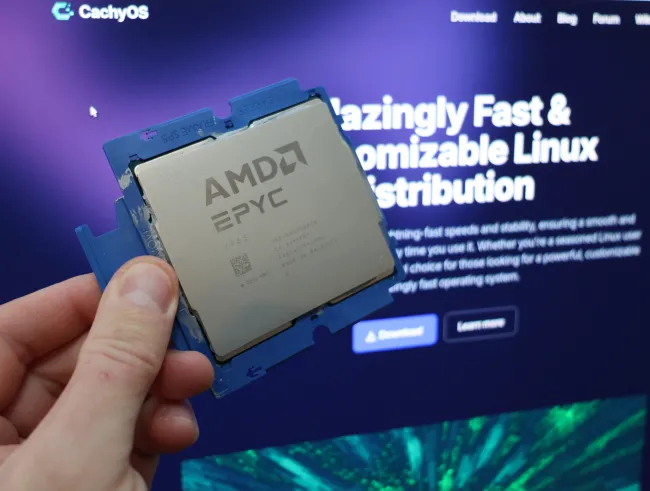
- CPU: AMD EPYC 9655P “Zen 5” (96 cores / 192 threads, max boost 3.5GHz)
- Motherboard: Supermicro H13SSL-N (Enterprise-grade networking/IPMI)
- RAM: 768GB DDR5-6000 across twelve DIMMs
- Storage: Micron 7450 NVMe SSD (3.2TB QLC endurance-focused)
All OS installations were minimally configured: default kernels, CPU governors like powersave or schedutil, and stock packages—no tailored tuning. Why? Servers require flawless defaults. Demand perfection out-of-the-box or face admin mutiny.
When Silicon Screams: HPC and Compression Crunch
High-performance computing (HPC) doesn’t forgive sluggish filesystems or inefficient schedulers. Using benchmarks like Rodinia and


