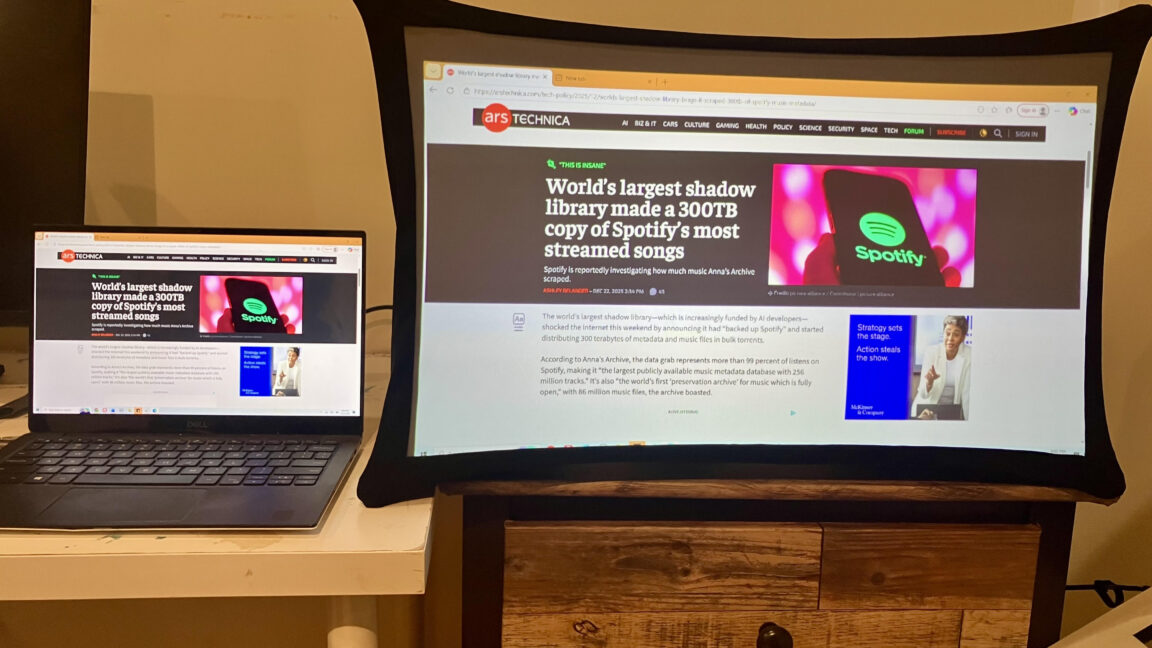

The Collapsible Screen Revolution: Can This Hybrid Device Solve Projector Problems?
Is it possible that decades of projector frustration – dim images, darkened rooms, demanding setups – finally have a compelling answer? For many display enthusiasts, especially those in compact or vibrant living spaces, traditional projectors have been a tough sell. Their need for dedicated dark environments and large, blank projection surfaces often clashes with everyday reality. Yet, the allure of a massive cinematic image or a space-saving large screen alternative remains potent. Enter the collapsible projector, attempting to bridge this gap by integrating the screen into the device itself. Pioneered by Arovia’s Splay, crowdfunded in 2021 and hailed as the “first fully collapsible monitor and projector,” this hybrid aims to offer unprecedented flexibility. Understanding its unique approach reveals whether it lives up to the promise of simplifying big-screen experiences anytime, anywhere.
Deconstructing the Splay: Beyond a Standard Projector
At its core, the Splay leverages projection technology. However, its defining innovation lies in the integrated, transformable form factor that addresses common projector pain points:
- The Collapsible Screen Technology: This is Splay’s magic trick. According to Arovia’s patented design, the system relies on:
- A housing with a sliding mechanism.
- A critical “collapsible screen” made of flexible, wrinkle-resistant silicone or rubber sheets embedded with “optical enhancing components.”
- Collapsible structural members that connect to this screen, allowing deployment and retraction.
This patented assembly enables the Splay’s core dual-mode operation, moving beyond traditional projection constraints by providing its own optimized projection surface when needed.
Mode 1: The Portable Integrated Monitor
When the fabric shroud is deployed:
- Self-Contained Display: Creates a large, built-in screen measuring either 24.5 inches or 34.5 inches diagonally (dependent on model).
- Purpose Built: The specialized screen material is designed for clarity and consistency, eliminating the hunt for a suitable wall or needing a separate portable screen.
- Space Efficient & Protected: The screen retracts into the main housing unit for transport or storage, offering significant protection.
- Ideal Use Cases: On-the-go presentations, mobile workstations in RVs or small apartments, bedside viewing, gaming sessions away from a dedicated setup, collaborative huddles.
Mode 2: Ultra-Short-Throw Projection Powerhouse
Removing the fabric shroud unlocks projection capability:
- Ultra-Short-Throw Lens: Allows projection of images up to 80 inches diagonally while positioned extremely close to a wall surface – often mere inches away. Projector throw ratio explains this capability.
- Traditional Projector Flexibility: Leverages existing walls (preferably light-colored and smooth), suitable for living rooms, outdoor setups (post-sunset), or temporary screening events.
- The Trade-off: Reverts to requiring a suitable external surface and benefits from ambient light control, unlike the integrated screen mode.
Comparing Visual Fidelity: Setting Realistic Expectations
Honesty is crucial regarding image quality. As Arovia emphasizes, the Splay remains fundamentally a projector. Its $1,300 price point positions it competitively within the projector market, especially considering the integrated screen innovation, but necessitates managing expectations against modern flat-panels:
- Vs. High-End TVs/Monitors: High-brightness HDR LCD-LED panels (See LCD Technology) and especially OLED displays (See OLED Technology) offer superior:
- Peak brightness and HDR performance
- Contrast ratios (especially OLED’s infinite contrast)
- Color accuracy and vibrancy
- Viewing angles
- Resolution clarity at typical viewing distances (Pixel density).
- Splay’s Limitations: As a projector projecting light onto a surface (even its own specialized one), the Splay inherently faces challenges matching emissive displays. Peak brightness, deep blacks, and pixel-level precision will likely fall short of high-end TVs. The collapsible screen, while innovative, introduces a surface that must diffract light, unlike glass panels.
- Context is Key: Its value isn’t in dethroning OLEDs for cinephile home theaters, but offering unparalleled portability and adaptability for large-screen viewing where traditional solutions fail. It solves a different problem.
Visual Performance Comparison Snapshot
| Feature | Splay (Collapsible Screen Mode) | Splay (Projection Mode on Wall) | High-End OLED TV (65″) |
|---|---|---|---|
| Screen Size (typ.) | 24.5″ or 34.5″ | Up to 80″ | 55″-77″ |
| Technology | LED Projection on Collapsible Screen | LED Projection on Wall | Emissive OLED |
| Native Contrast | Moderate | Moderate (Dependent on Wall) | Very High (Infinite) |
| Peak Brightness | Moderate | Moderate | Very High |
| Best Ambient Light | Moderate/Dark Room | Dark Room Optimal | Bright Room Okay (High Brightness Models) |
| Setup Portability | High (Integrated Screen) | Moderate (Requires Suitable Wall) | Low |
Expanding Horizons: Where the Collapsible Projector Excels
Splay’s versatility, backed by Arovia’s emphasis on mobile workspaces, gaming, and enterprise use, highlights scenarios where its unique format truly shines:
- Truly Mobile Productivity: Imagine a laptop-independent 34-inch monitor that folds into barely larger than a laptop bag. Sales teams giving uniform presentations anywhere; consultants with expansive data views in hotel rooms; hybrid workers maximizing small apartment spaces without a permanent big monitor setup.
- Social & Casual Gaming: Leveraging the integrated monitor mode provides a large, stable screen for gaming consoles (Nintendo Switch!), laptops, or mobile mirroring in locations without a suitable TV or where wall projection is impractical (dense decorations, small rooms). Low-input-lag performance specs would enhance usability here.
- Dynamic Enterprise Environments: Trade show booths needing instant large-screen demos, pop-up retail displays requiring quick setup/teardown, temporary training rooms – eliminating bulky monitors or complex projector/screen setups cuts costs and logistics headaches.
- Adaptive Home Entertainment: Spontaneous slideshows during gatherings, movies projected outdoors onto a garage door (using projection mode), streaming bedside without requiring a TV mount in the bedroom, or easily shifting viewing setups between rooms. Traditional TVs offer permanence; Splay offers adaptability.
- Unique Educational Applications: Teachers in flexible learning spaces deploying large screens instantly for presentations or group video calls without dedicated tech setups; students collaborating around a large projected image from a single device.
Weighing the Investment: Cost, Availability, and Future Potential
Priced at $1,300 (currently sold out, restock imminent), the Splay occupies a premium niche:
- Value Proposition: The integration of a specialized collapsible screen built-in represents tangible engineering R&D value. Buying a comparable portable monitor plus a quality Ultra-Short Throw projector would likely exceed this cost. You pay for convenience and integration.
- Sold-Out Status: Market validation? High demand fueled by accessible crowdfunding campaigns coupled with genuine novelty factor clearly exists. Restocking indicates ongoing commercial interest.
- Future Evolution: Will subsequent iterations focus on boosting brightness (critical for projection mode)? Integrating higher resolution? Refining screen materials for sharper clarity? The core concept – a self-contained portable big screen – holds significant promise for iterative improvement. Could future models blend micro-LED or laser projection for better contrast? (Explorations here).
Projection Reimagined?
The Arovia Splay fundamentally challenges the traditional projector paradigm. While it won’t satisfy the discerning eye seeking reference-grade home theater quality from an OLED or premium LCD, it brilliantly addresses specific, pervasive limitations that have hindered projector adoption in many contexts. By seamlessly integrating its own purpose-designed projection surface, the collapsible projector eliminates the dependency on finding a perfect wall or struggling with cumbersome external screens. Its dual-mode nature – transforming instantly from an all-in-one portable monitor to an ultra-short-throw projector – offers remarkable flexibility unmatched by conventional devices. It empowers users to create large-screen experiences instantly whether cramped in a studio apartment, presenting at a client site, gaming with friends outdoors, or optimizing a temporary workspace. For those seeking adaptable big-screen solutions prioritizing convenience and space-saving above absolute peak fidelity, the collapsible projector concept, demonstrated vividly by the Splay, represents a fascinating and highly practical evolution in display technology. Will this hybrid approach redefine how we think about portable large screens? Tell us your thoughts – could a collapsible projector solve your screen setup headaches?


