
The Unseen Blueprint: How Ant Colonies Master Collective Efficiency
Ever watched ants marching in endless streams and wondered how such seemingly fragile insects dominate ecosystems? The secret lies not in powerful individuals, but in a radical evolutionary bargain: ant colonies deliberately build millions of cheap, replaceable workers honed purely for collective success. Recent research published in Science Advances exposes a shocking truth: ants systematically underinvest in each worker’s biological “hardware” to elevate the colony’s survival. This finding challenges our understanding of complex societies everywhere—and forces us to ask: Is this sacrifice-driven model truly why ants rule the planet?
The Mandible Paradox: Dissecting the Ants’ Bargain Strategy
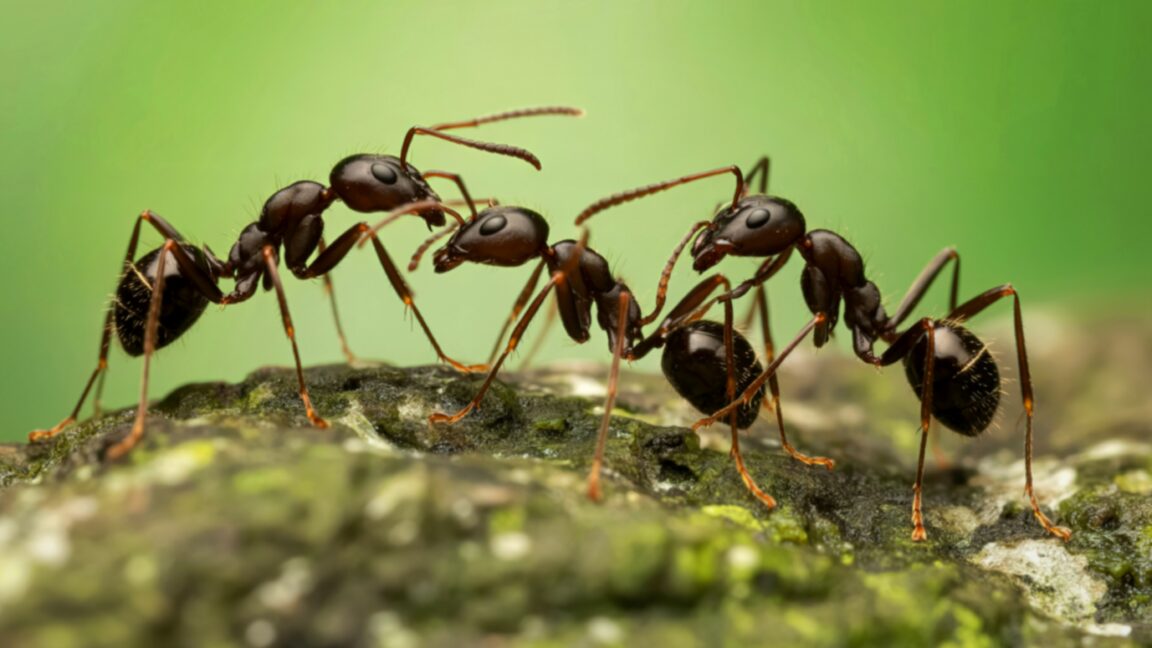
Remarkably, ants achieve efficiency by degrading investments in their most costly physical components. Focused on species with strict reproductive divisions (queens vs. sterile workers), scientists discovered colonies save vital nutrients by thinning worker exoskeletons—the insect equivalent of skyscrapers. Chitin, the primary exoskeleton component, demands immense energy to produce. Consider these nutritional economics:
- Exoskeleton Costs: Synthesizing chitin requires scarce nitrogen compounds and complex sugars. A fortified armor could starve colony growth.
- Energy Allocation: Resources saved from lighter bodies fuel larva production and colony expansion.
- Worker Specialization: Thin-shelled workers must rely on group support (food sharing, defense) to survive, cementing interdependence.
As researcher Matte states, this represents a fundamental “shift from self-investment toward a distributed workforce.” It’s biology’s supply-chain optimization—built over 100 million years.
Echoes of Multi-Scale Life: From Single Cells to Superorganisms
This ant strategy mirrors one of evolution’s landmark leaps: multicellularity. Just as solitary cells fused into specialized collectives, ants abandoned individualism for hyper-cooperation. Imagine amoebas vs. sharks:
| Solitary Organism | Superorganism Colony | |
|---|---|---|
| Unit Role | Jack-of-all-trades | Ultra-specialized cog |
| Self-sufficiency | Total independence | None—requires collective |
| Cost Efficiency | High per-unit investment | Low per-unit, high-group |
| Example | Lone beetle | Weaver ant colony (500k+) |
Critically, simplicity enables vast complexity. A neuron—less versatile than a bacterium—combines with millions of peers to create consciousness. Likewise, a fragile ant worker merges into architectures rivaling human cities. This pattern reveals collective life’s core trade-off: individual downgrade enables systemic supremacy. Yet its effectiveness hinges on a brutal precondition…
The Fertility Lock: Why Humans Could Never Embrace Ant Economics
Reproductive rights expose the flaw in applying ant logic to mammals. Ant workers sacrifice not just strength—but genetic legacy. Sterility transforms them into disposable proxies for the queen’s DNA. Compare societal paradigms:
-
Ant Colonies:
- Workers are non-reproductive extensions of the queen.
- Zero incentive for selfish survival—genes flow only via collective prosperity.
- Individual vulnerability enhances efficiency (Example: leafcutter ants replacing daily casualties).
-
Mammalian Societies (Wolves/Humans):
- All adults compete for mating chances (source: Animal Social Structures).
- High self-investment ensures personal reproductive success.
- Wolves fight rivals; humans pursue education/resources—both optimize individual fitness.
This explains why bee colonies thrive with sacrificial guards… but a “cheapened” human soldier retains family ambitions. As Matte notes: “It isn’t nutritional economics—it’s about sex.” Ants evolved beyond Darwin’s selfish gene; mammals remain enslaved by it.
Cutting the Costs Further: Brain, Muscle, and Genetic Secrets
Intriguingly, exoskeletons may be just the start. Researchers now probe neural and muscular systems—are ant brains pared down too? Consider:
- Metabolic Savings: Brains burn 20% human energy and require potassium/phosphorus. Ant colonies might shrink worker brains when task-specialization reduces decision load.
- Genetic Culprits: Which mutations enabled shifting investments? Comparing genomes could reveal altered nutrient sensors (example in honeybees).
Future robotics? Swarm drones may mimic these trade-offs—simple drones optimizing group computation over individual chips. First, we must dissect nature’s textbook…
Rethinking Complexity Through Six-Legged Lenses
Ant colonies demonstrate that society-scale power can emerge from microscale compromises. They thrive via a testament to austerity: sacrifice biological extravagance (expendable workers, diluted bodies) to conquer scarcity and fuel expansion. Yet this model’s viability hinges on reproductive centralization—queen-controlled genetics rewrite evolutionary rules. Mammals—driven by mating contests and genetic diversity—require costly individual autonomy. The implications shake ecology and AI: What makes a society resilient? Prioritizing collective survival via cheap units—or empowering error-prone individuals who drive innovation? As Matte concludes: understanding ants “needs more work.” But their lesson challenges our assumptions: excellence isn’t forged alone. It’s a group project sculpted by ruthless efficiency.
What do you think—could human societies borrow ant-like resource strategies? Or would sacrificing individual value doom us? Share your perspectives below!
Citation: Matte et al., “Resource allocation trade-offs drive the evolution of inexpensive workers in eusocial insects” Science Advances (2025). DOI: 10.1126/sciadv.adx8068


