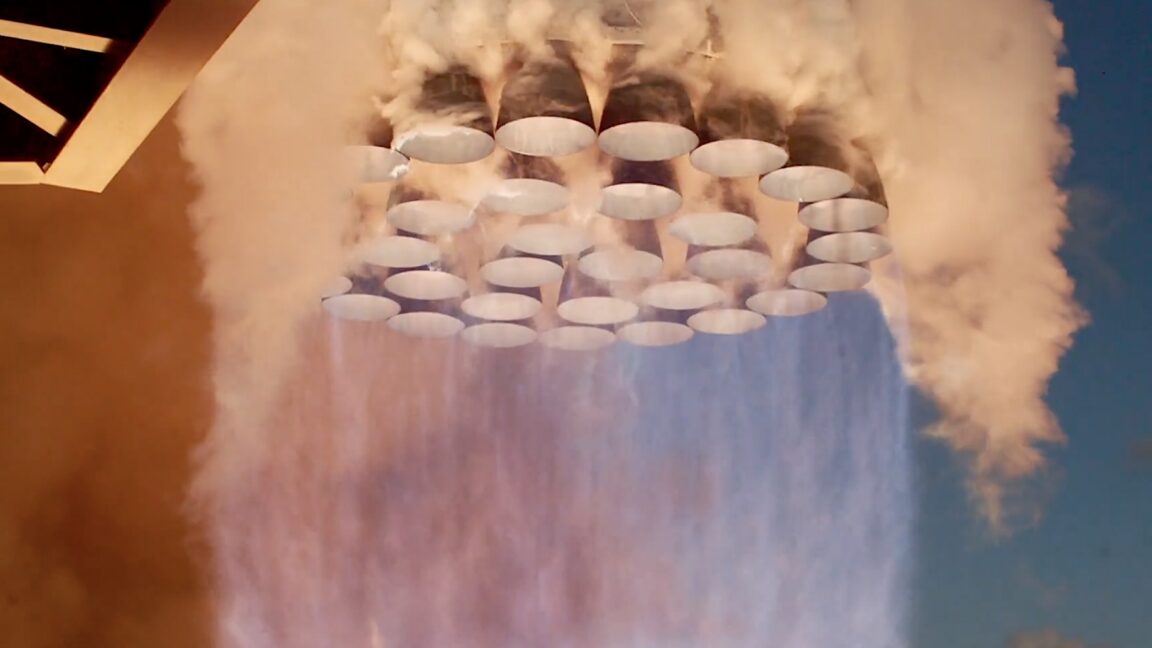

Has SpaceX Finally Cracked Reusability? Starship’s Latest Test Flight Signals Progress
Imagine a future where space travel is as commonplace as air travel. This vision hinges on a crucial element: reusable spacecraft. SpaceX is relentlessly pursuing this goal with its Starship program, and recent developments suggest they may be closer than ever. The latest test flight of Starship has yielded promising results, marking a significant step towards achieving full reusability. This breakthrough is not just about lowering costs; it’s about unlocking unprecedented access to space, enabling ambitious missions to the Moon, Mars, and beyond.
Starship’s Reentry: A Promising Sign of Heat Shield Durability
One of the most challenging aspects of space travel is the reentry process. As a spacecraft plunges back into Earth’s atmosphere, it encounters immense friction, generating scorching temperatures that can destroy the vehicle. SpaceX has been grappling with this issue for years, but the recent Starship test flight offered a glimmer of hope.
Surviving the Fiery Gauntlet: Starship’s Heat Shield Performance
During the latest reentry, live video streams from onboard cameras provided a captivating view of the event. The Starship was enveloped in the familiar orange and purple plasma, a consequence of the extreme heat generated by atmospheric friction. However, what was notably different this time was the apparent lack of significant damage to the heat shield and flaps.
In previous tests, damage to the heat shield was a common occurrence. Ablative heat shields protect the spacecraft by gradually burning away, dissipating heat. However, this process requires refurbishment or replacement after each flight, adding to the cost and complexity of reusability. The recent test suggests that Starship’s heat shield design may be significantly more robust than earlier versions. This could mean less frequent refurbishment, a crucial step towards achieving true reusability.
Elon Musk’s “Acid Test”: Reusability as the Key to Starship’s Success
Elon Musk, the CEO of SpaceX, has emphasized that full reusability is the “acid test” for Starship’s overall success. In other words, unless the spacecraft can be reused repeatedly without extensive repairs, the program will not achieve its ambitious goals. The fact that Starship emerged from reentry relatively unscathed is a major milestone in this regard.
Dynamic Banking and Splashdown: Simulating Future Landing Maneuvers
Beyond the heat shield performance, the recent Starship test flight also demonstrated advanced maneuverability during the final descent.
- Dynamic Banking Maneuver: The Starship executed a “dynamic banking maneuver” over the Indian Ocean, utilizing its flaps to control its descent and trajectory.
- Simulated Landing Burn: In the final moments, the Starship flipped upright and fired its engines to slow down before splashdown. This simulated the landing maneuvers that the rocket will eventually perform when returning to the launch site.
These maneuvers are critical for precise landings, which are essential for reusing the Starship and Super Heavy booster. The ability to control the spacecraft’s descent and landing trajectory will enable SpaceX to return the vehicles to the launch site for rapid reuse. This highlights the sophistication of the guidance and control systems integrated into the Starship, ensuring safe and controlled re-entry.
Starship V3: What’s Next for SpaceX’s Reusable Rocket?
While the recent test flight was a success, SpaceX is not resting on its laurels. The company is already working on the next generation of Starship, designated Starship V3.
Preparing for Orbital Flights and Beyond
According to SpaceX, Starship V3 will be used for:
- First Starship Orbital Flights: Reaching orbit is a crucial step towards demonstrating the Starship’s capabilities for long-duration missions.
- Operational Payload Missions: Transporting satellites and other cargo to orbit.
- Propellant Transfer: Demonstrating the ability to transfer propellant in orbit, which is essential for deep-space missions.
- Advancing Reusability: Continued iteration towards a fully and rapidly reusable vehicle.
Testing and Development of Starship V3
Technicians at Starbase, SpaceX’s launch facility in Texas, are currently assembling the next Super Heavy booster and the first Starship V3 vehicle. Before launch, the integrated booster and ship will undergo rigorous testing, including:
- Cryogenic Testing: Testing the vehicle’s ability to withstand the extreme temperatures of liquid oxygen and liquid methane propellant.
- Static Fire Testing: Firing the engines while the vehicle is anchored to the ground to verify their performance.
These tests are crucial for identifying and addressing any potential issues before the first launch of Starship V3.
Timeline and Expectations: When Will Starship Fly Again?
It’s likely to be several months before SpaceX is ready to launch the next Starship flight. The exact timeline depends on the progress of testing and development of the Starship V3 and Super Heavy booster.
SpaceX is committed to a rapid iteration process, learning from each test flight and incorporating improvements into the next version of the vehicle. This approach has been instrumental in the company’s success in developing reusable rockets. While patience is required, the recent progress with Starship suggests that SpaceX is on the right track towards achieving its ambitious goals.
Reusability: The Key to Unlocking the Future of Space Exploration
The pursuit of fully reusable spacecraft is not just about reducing costs; it’s about fundamentally changing the way we access space. Reusability will enable:
- More Frequent Launches: Lower costs and faster turnaround times will make it possible to launch more missions, accelerating space exploration and development.
- Ambitious Missions: Reusability will make it economically feasible to undertake ambitious missions to the Moon, Mars, and beyond, paving the way for human colonization of other planets.
- Space-Based Economy: Reusability will enable the development of a space-based economy, including activities such as manufacturing, resource extraction, and space tourism.
How Starship Reusability Compares to Falcon 9
| Feature | Falcon 9 | Starship |
|---|---|---|
| Reusability | First stage reusable | Both Starship and Super Heavy reusable |
| Refurbishment | Requires inspection and maintenance | Aims for minimal or no refurbishment |
| Payload Capacity | ~22,800 kg to LEO | >100,000 kg to LEO |
| Landing Method | Vertical landing with engine firing | Controlled descent & propulsive landing |
The progress with Starship’s reusability is a significant step towards realizing this future. The ability to reuse spacecraft repeatedly will unlock unprecedented opportunities for space exploration, scientific discovery, and economic development.
Conclusion: A Giant Leap Towards a Reusable Future?
The latest Starship test flight represents a significant step forward in SpaceX’s quest for fully reusable spacecraft. The apparent lack of damage to the heat shield during reentry, combined with the successful execution of advanced landing maneuvers, provides compelling evidence that SpaceX is making progress towards its goal. While challenges remain, the momentum is building. As SpaceX continues to develop and test Starship V3, the dream of routine and affordable space travel moves closer to reality. What do you think? Will Starship truly revolutionize space travel? Comment below!
Sources & Further Reading:
Original article at arstechnica.com


