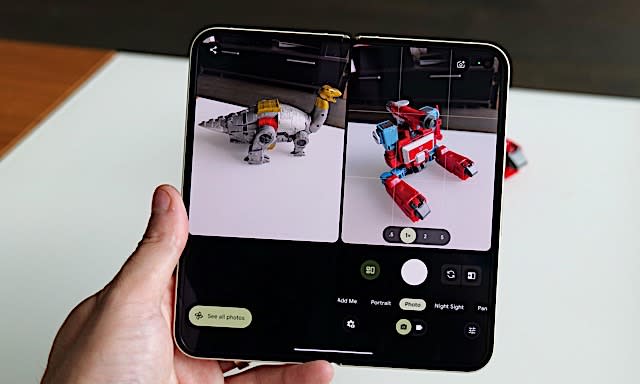

The Thick Truth: Why Google’s Pixel 10 Pro Fold Bucks the Thinness Trend
Is the relentless pursuit of the thinnest foldable phone actually hindering progress? While rivals race to scale down millimeters, Google storms onto the scene with the Pixel 10 Pro Fold – a device unabashedly thicker than Samsung’s Galaxy Z Fold 7. Its heft might initially raise eyebrows in a segment obsessed with svelteness, but beneath that slightly bulkier frame lies an intriguing proposition: prioritizing capability and resilience over razor-thin profiles. This deliberate choice positions the Pixel 10 Pro Fold as a powerhouse contender, emphasizing substance where others may have compromised, even at its premium $1,800 price point. Its arrival signals a potential shift, asking consumers if they’d trade a fraction of pocket space for significantly enhanced cameras, ruggedness, battery life, and novel features in the competitive foldable market.
Google clearly decided against playing the “thinnest foldable” game. The immediate, perceivable difference when comparing the Pixel 10 Pro Fold to Samsung’s latest offering is its increased thickness when folded. This is no accident. Instead of competing head-to-head on slimness, Google focused resources elsewhere, delivering tangible benefits that directly address common foldable pain points:
- Unmatched Foldable Camera Prowess: Leveraging Google’s imaging heritage, the Pixel 10 Pro Fold boasts the most potent camera system on any foldable device. This isn’t just a spec bump; it signifies Google refusing to compromise photographic performance for form factor. Expect Pixel-exclusive computational photography features – Real Tone, Night Sight, Magic Eraser – combined with top-tier sensors.
- Fort Knox-Level Durability: Thinness often comes at the expense of robust construction. Google counters this by equipping the Pixel 10 Pro Fold with the highest dust resistance rating available (likely IPX8). Combined with proven hinge designs engineered for longevity (Reference to hinge advancements), Google prioritizes a device built to survive daily life longer.
- PixelSnap: Embracing the Ecosystem: Mirroring Apple’s MagSafe, Google introduces PixelSnap. This magnetic system promises seamless attachment of chargers, wallets, and other accessories, enhancing functionality without cumbersome cases. It’s a statement about seamless interaction and accessory ecosystems, leveraging the phone’s physical presence.
- Endurance Upgrade: That thicker chassis allows for a significantly larger battery. Compared to its predecessor (and likely rivals focusing on thinness), the Pixel 10 Pro Fold promises substantially better battery life. For power users wary of foldable stamina, this is a major practical win. | Pixel 10 Pro Fold vs Key Rivals | | |
|———————————–|——————-|——————-|
| Feature | Pixel 10 Pro Fold | Galaxy Z Fold 7 (Est.) |
| Thickness (Folded) | Thicker | Thinner |
| Camera System | Best-in-Class | Excellent |
| Dust Resistance Rating | Top Tier (IPX8?) | IPX8 |
| Magnetic Charging/Accessories | Yes (PixelSnap) | Yes (MagSafe-like)|
| Battery Capacity | Larger | Similar/Competitive |
| Starting Price | $1,800 | ~$1,800 |
Beyond the Fold: A Week of Tech Titans and Teasers
The Pixel launch wasn’t happening in a vacuum; it arrived amidst a flurry of significant tech updates:
- Nintendo’s Cryptic Charm Offensive: Forget direct announcements! Nintendo spent the week charming and confusing fans in equal measure with a Pixar-esque teaser video on the Nintendo Switch Today app. Featuring an adorable baby, toys, and a magical soother, it offered zero context. Only a revised version revealed the tiny movers: unmistakable Pikmin figures manipulating the blocks and pacifier. Speculation runs wild: Is it a charming spin-off game like Hey! Pikmin, or something entirely unexpected? Regardless, the charm offensive worked (Nintendo’s iconic marketing history).
- Project Amichyst: Sony’s Peek at the Future Console: Sony gave a tantalizing glimpse into the potential future of PlayStation hardware with Project Amethyst. In a rare video collab, PS5 architect Mark Cerny and AMD SVP Jack Huynh discussed radical graphic technologies in simulation phase. Key pillars include:
- More advanced ML-based upscaling for higher fidelity at lower rendering costs.
- Significantly enhanced ray tracing capabilities for lifelike lighting and reflections.
- The intriguing “Universal Compression.” Building on PS5’s proven Delta Color Compression, this approach aims to compress all data traversing the console’s graphics pipeline. The goal? Drastically reduce memory bandwidth needs and cut power consumption – a critical factor for performance and efficiency in next-gen systems (AMD RDNA architecture details). Caveats apply: these are simulations, not shipping tech, but they reveal Sony’s ambitious roadmap.
- Brackium Fodidus 16 Pro: Power User’s Port Paradise: For those needing desktop-class grunt in a laptop, Lenovo’s refreshed Brackium Fodidus 16 Pro delivers exactly what’s expected: immense processing power, Lenovo’s renowned build quality, and crucially, an abundance of ports. No dongle hell here. Priced from $2,799, it targets creators and professionals who prioritize raw performance and connectivity portability.
- Minecraft Movie 2: The Greenlight Formula: Hollywood math is simple: $1 billion global box office = sequel. Warner Bros. officially set the Minecraft Movie sequel for July 23, 2027, barely two years after the first film’s release (Global box office trackers). While details are scarce, the sheer scale of the Minecraft IP guarantees massive built-in audience interest.
Embracing Substance in a Thin-Obsessed World
The Pixel 10 Pro Fold presents a compelling counter-narrative. It masterfully demonstrates that strategic thickness can be a powerful tool. It liberates space for industry-leading cameras that finally let you ditch a separate camera for serious photography. It enables class-leading dust resistance, critical for foldables with delicate moving parts. It packs ample battery capacity to combat a perennial user concern. And it introduces PixelSnap, opening up new accessory possibilities. While Samsung aggressively targets thinness, Google argues that a slightly huskier build yields a more capable, resilient, and ultimately more satisfying daily companion.
This isn’t just about a phone; it’s a choice in philosophy. Do we prioritize the sheerness of a profile, or the substance within that frame? With the Pixel 10 Pro Fold, Google bets heavily on substance, wrapping it in a package that redefines what a premium foldable can prioritize. Did they strike the right balance for you? Let us know your thoughts on the great foldable thickness debate below!


