
Pushing the Limits: When Modders Rewrite GPU Rules
What happens when enthusiasts refuse to accept factory-set boundaries? GPU BIOS modding has become a battleground where tech rebels defy manufacturer restrictions—especially since NVIDIA tightened software overclocking controls. By flashing alternative vBIOS firmware onto graphics cards, modders forcibly unlock hidden performance, often by dramatically increasing powerונוכחת power limits. The pursuit peaks with AMD AI cards like the power-hungry ASUS ROG Matrix Platinum 4090, whose coveted 800W vBIOS represents the bleeding edge of unofficial performance tuning. But as one HardwareLuxx forum member recently proved, grafting this BIOS onto an ASUS ROG Astral GeForce RTX 4090 isn’t software wizardry alone—it demands soldering skills, thermal overhaul, and anatomical understanding of GPU circuitry. The implications reach far beyond bragging rights: this push-pull between manufacturers and modders shapes the future of hardware accessibility.
GPU BIOS Modding: From Software Tweaks to Surgical Warfare
For years, software tools allowed users to adjust GPU clocks and voltages within factory parameters. But NVIDIA’s increasing lockdowns—like voltage-limit removal in Afterburner—pushed enthusiasts toward BIOS flashing. By replacing a graphics card’s firmware, modders bypass software barriers entirely. Key motivations include:
- Circumventing Power Limits: Stock BIOS locks TDP (thermal design power). Alternative BIOS files—often ripped from premium models—raise this ceiling.
- Overclocking Headroom: Higher wattage enables stable clock boosts under extreme loads.
- Hardware Repurposing: Mid-tier cards can inherit BIOS settings from flagship variants with identical PCBs.
The ASUS ROG Matrix Platinum RTX 4090 emerged as a BIOS donor darling due to its record-setting 800W power allocation. Yet flashing this BIOS onto ASUS’s Astral RTX 4090 proved problematic—especially the black variant. Here, BIOS compatibility clashed with hardware idiosyncrasies.
The HardwareLuxx Breakthrough: Anatomy of a 4090 BIOS Transplant
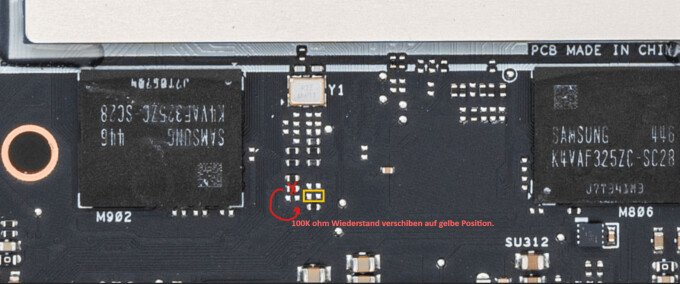
A user’s triumph on HardwareLuxx revealed why color matters: Black and white Astral RTX 4090s differ internally. The black model shares a single fan header between its rear and front-middle fans, imposing a critical wiring constraint. The Matrix Platinum’s BIOS assumes parallel connectivity, preventing successful flashing without physical PCB modification. The solution? Rewiring the EEPROM’s communication protocol:
- Problem: Serial signal pins used “pull-down” resistors, grounding the BIOS flash signal.
- Fix: Swapping to “pull-up” resistors connected to a voltage source forced electrical compliance with the Matrix BIOS.
“Pull-up resistors bias inputs toward high voltage, overriding stray signals,” explains Dr. Ian Cutress (PhD in Electronic Engineering). This microscopic resistor swap required precise soldering—not recommended for beginners. Failures risk shorts, EEPROM corruption, or total GPU death.
ASUS ROG Astral RTX 4090: Modding Requirements by Model
| Feature | Black Model (Requires Mod) | White Model |
|———————–|—————————-|—————————|
| Fan Header Wiring | Rear+Front fans shared | Dedicated headers |
| EEPROM Signal Handling| Pull-down resistors | Compatible with Matrix BIOS|
| Resistor Modification | Mandatory (pull-up swap) | Unnecessary |
| BIOS Flash Complexity | High-risk soldering | Software-only possible |
Surviving the Blaze: Cooling an 800W Furnace
Taming the Matrix BIOS’s 800W power limit demands radical thermal solutions. The stock Astral cooler—rated for 600W—famously struggles even at factory settings:
- Tests show hotspot temps exceeding 90°C at 600W loads.
- At 800W, theoretical core heat could approach 110°C—dangerously close to thermal throttling (115°C+ risks permanent damage).
Popular cooling countermeasures include:
- Open-Air аз Cases: Giant heatsinks with push-pull fan configurations.
- Subambient Cooling: Liquid nitrogen for competitive benchmarking (as used in extreme overclocking).
- Hybrid Liquid Kits: Pre-filled AIO units paired with VRAM heatsinks.
Even then, sustainability is a concern. Der8auer (Roman Hartung), legendary modder, notes: “800W stability requires reinforced power sensors and capacitor arrays absent on non-Matrix cards.” Expect VRM sections to degrade faster without additional voltage regulation.
Why Manufacturers Resist: Risks Beyond the Bench
GPU makers hedge against BIOS flashing for three core reasons:
- Warranty Voidance:


