
The Silent Threat: Exposing the Truth Behind Instagram’s Massive Account Leak Crisis
Have you ever received an unexpected password reset email? What if it wasn’t just spam, but a targeted trap exploiting your compromised Instagram data? Alarmingly, despite Instagram boasting over 3 billion monthly active users as announced by Mark Zuckerberg in late 2025, up to 17.5 million accounts may be silently entangled in a dangerous Instagram data breach. Cybersecurity experts warn that leaked personal information is fuelling sophisticated phishing attacks, putting millions at risk of account hijacking. This isn’t a theoretical threat; it’s unfolding right now, relying on user panic and exploiting inherent trust in communications. Understanding the scale of this Instagram hack, the stolen data exposure, and immediate protective steps isn’t just important – it’s critical for your online security.
Dissecting the Breach: Who’s Behind the Instagram Account Compromise?
The chilling details emerged publicly on January 10, 2026, when cybersecurity firm Malwarebytes published a report, corroborated by Cyberinsider. Their investigation pointed a finger squarely at a significant leak originating from Instagram’s systems back in 2024, allegedly exploited through vulnerabilities in an API (Application Programming Interface). This silent leakage funneled sensitive user data into the hands of cybercriminals for nearly two years before erupting onto the dark web.
Key Breach Details Revealed:
- Source & Timing: Data sourced from an “Instagram API leak” reportedly occurring sometime in 2024.
- Data Exposure Date: January 7, 2026 – A dataset containing over 17 million records was allegedly published by a hacker using the alias “Solonik”.
- Distribution Platform: The data was dumped on BreachForums, a notorious online marketplace and meeting ground for hackers to trade, sell, and share vast databases of stolen information. Its very existence highlights an active underground economy fueled by breaches like this.
- Content: The stolen treasure trove, found in JSON and text formats, included sample data exposing:
- Usernames
- Email addresses
- International phone numbers
- Physical addresses
- Unique Instagram user IDs
- Potentially other linked profile information (based on Malwarebytes’ findings of “and more”).
The sheer volume – encompassing potentially 17.5 million profiles – transforms this from a minor incident into one of the most significant Instagram account leaks in recent years. Critically, while passwords weren’t found in the leaked samples, the exposed personal details provide attackers with potent ammunition for highly convincing social engineering attacks. Individual user IDs are particularly valuable for cybercriminals attempting targeted fraud or bypassing security protocols. Even without passwords initially, attackers leverage the exposed credentials – email addresses associated with Instagram accounts – to launch highly targeted phishing attacks.
From Leak to Attack: How Phishing Exploits Breached Instagram Credentials
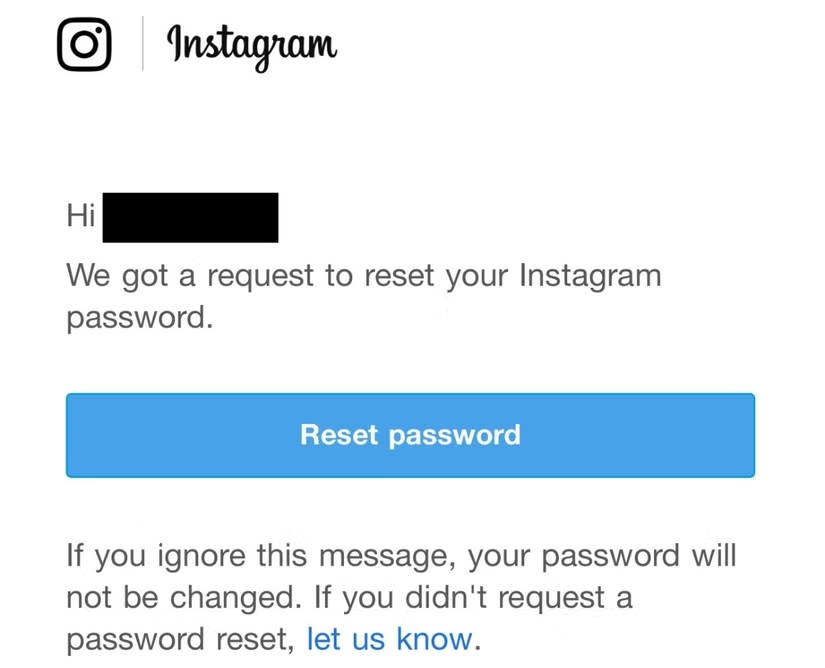
This Instagram account leak didn’t merely result in stolen data sitting on a server. Its dangerous transition into active cyber aggression became immediately evident. Victims whose data was compromised started reporting suspicious emails mimicking official Instagram password reset requests – a classic phishing tactic supercharged with genuine stolen details.
The Anatomy of a Post-Breach Phishing Attack:
- The Lure: An email arrives, ostensibly from Instagram (support@instagram.com, security@instagram.com – easily spoofed addresses). Subject lines like “Action Required: Secure Your Account” or “Unauthorized Login Attempt Detected – Reset Your Password Now” induce immediate panic.
- Personalization: The email likely references the user’s actual Instagram username or associated email address – details directly obtained from the breached dataset. This shred of real information significantly elevates the scam’s credibility.
- The Bait: A prominent, legitimate-looking “Reset Password” button dominates the email. Crucially, clicking this redirects the user not to Instagram’s secure domain (instagram.com), but to a malicious clone website meticulously crafted to harvest login credentials.
- Psychological Pressure: Messaging underneath intensifies the urgency: “If you ignore this message, your password will not be changed.” A secondary line, “If you didn’t request a password reset, let us know,” seemingly offers reassurance but in reality masks an alternative phishing link or creates distrust toward Instagram’s legitimate warnings that will inevitably arrive later. Hackers prey on cognitive overload during moments of alarm.
- The Payoff: Users who click and enter their credentials grant attackers full control over their Instagram account. This unlocks terrifying possibilities: hijacking linked accounts (like Facebook), stealing sensitive messages/media, impersonating the victim to scam friends/followers, spreading malware further, exploiting payment methods linked to business accounts, or selling access.
This exploit methodology isn’t random cyber-noise; it’s a calculated strategy utilizing the exposed Instagram credentials collected in the massive breached Instagram assets. The attacker leverages the breached data’s inherent trust factor – users recognize their own username/email, lowering suspicion drastically. The FBI’s Internet Crime Complaint Center (IC3) consistently identifies phishing as one of the top cybercrime threats, with billions lost annually – breaches like this amplify its effectiveness exponentially.
Common Phishing Email Tactics vs. Instagram Legitimate Emails
| Feature | Phishing Email Warning Signs | Instagram Legitimate Email Indicators |
|---|---|---|
| Sender Address | Slightly misspelled (support@instagrom.com), fake domain | From official domains (` |


