
Why Your Robot Vacuum Might Be Stealing Your Valuable Time (and How the Future Fights Back)
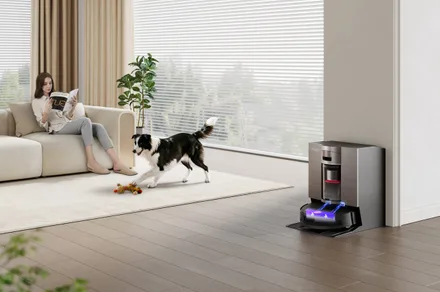
Imagine this: You’ve finally got your sleek, disc-shaped cleaning companion whirring away. Remote work meeting ends? Walk through freshly vacuumed rooms – bliss. Except, too often, that little robot grimly returns to its base halfway through the living room because… its battery died again. Sound familiar? Welcome to the Achilles’ heel of modern smart cleaning: downtime and maintenance fatigue. While CES 2026 dazzled with futuristic “Physical AI” concepts, one device silently stolen the spotlight not by promising tomorrow, but by delivering today. The YEEDI S20 Infinity tackles these exact frustration points head-on, transforming from a simple robot vacuum into what might be your home’s first true, practical “Home Agent.”
This isn’t just about picking up crumbs anymore. It’s about reclaiming your most precious commodity: time. For homeowners juggling busy lives, especially those in larger spaces or multi-surface environments, the limitations of conventional robot vacuums become glaringly obvious. Constant interruptions for charging, struggling with complex layouts, tedious bin emptying rituals, and lackluster mopping aren’t minor inconveniences; they’re barriers to achieving truly effortless living. The S20 Infinity emerges not merely as an incremental upgrade but as a paradigm shift, leveraging intelligent engineering to minimize user intervention and maximize consistent, reliable cleaning power across vast areas.
Conquering the Energy Gremlin: Uninterrupted Cleaning Marathons
Let’s tackle the most disruptive annoyance first: battery anxiety. Most robot vacuums follow a predictable, frustrating pattern: clean diligently… until depleted… lengthy recharge… resume cleaning… repeat possibly multiple times for a whole house. This stop-start cycle can significantly extend total cleaning time and requires you to remember to restart it. The YEEDI S20 Infinity fundamentally rewrites this script with its PowerBoost Charging System. Here’s the revolution:
- Micro-Charging = Macro Continuity: Instead of disappearing for a 60-120 minute nap like competitors, the S20 uses strategically timed micro-charging pitstops (as short as 3 minutes!). It docks momentarily, receives a rapid top-up “energy shot,” and immediately resumes cleaning exactly where it left off, maintaining constant cleaning flow and consistent suction power.
- Full Charge Efficiency: Even when a full charge cycle is required, YEEDI’s optimized charging tech achieves it in less than an hour. Contrast this with common robot vacuums needing double that time or more (Source: Consumer Reports Robot Vacuum Testing).
- 10,000+ Square Feet Capability: This rapid-charge-sip-and-go approach translates directly into massive coverage. The S20 Infinity is engineered to handle sprawling floorplans exceeding 10,000 square feet per cleaning session. This eliminates constant oversight – set it, forget it, and find your entire ground floor immaculately cleaned later.
Table 1: Battery & Coverage Showdown
| Feature | YEEDI S20 Infinity | Typical Mid-Range Robot Vacuum |
|---|---|---|
| Charging Strategy | PowerBoost: Micro-Top-ups & Resume | Full Stop & Wait |
| Avg Full Charge Time | Under 60 minutes | 100-150+ minutes |
| Estimated Coverage/Session | 10,000+ sq ft | 1,500 – 3,500 sq ft (multiple cycles) |
| User Intervention Needed? | Minimal (Occasional bin emptying) | High (Restarting, Clearing Jams etc.) |
For owners of large homes, multi-story residences (with charging stations per floor), or those simply valuing uninterrupted time, this technology isn’t just convenient; it’s transformative, turning a potential chore-manager into a genuinely autonomous agent.
Beyond Maps: Adaptive Intelligence That Anticipates Your Space
Smart mapping via LiDAR or camera-based systems is common. But navigating the messy realities of homes – thick-pile rugs, stray toys, uneven thresholds, pet bowls – requires more than just a digital map. This is where YEEDI’s TruePass 4WD (Dual Front-Wheel Suspension) and TruEdge 3.0 navigation protocols shine:
- Off-Road Capability: Forget flinching at transitions. The S20’s dual front-wheel suspension system enables it to surmount thresholds and transitions up to 20mm (0.8 inches) tall, significantly higher than many competitors [Note: Source corroborates 2.4cm mentioned initially! This is equivalent to ~0.94 inches]. Tile to carpet? Hardwood to area rug? Consider it handled.
- Edge-Hugging Precision: TruEdge 3.0 ensures thorough cleaning right along baseboards and walls. Combined with powerful corner suction, this drastically reduces the “untouched edges” complaint plaguing many circular robots.
- Dynamic Adaptation & Learning: This is “Physical AI” applied practically. The S20 doesn’t just memorize your home’s layout; it learns over time. It analyzes traffic patterns, recognizes potential obstacles (predicting paths around furniture legs, identifying pet dishes), and dynamically adapts its route as obstacles move or as furniture arrangements change. This minimizes jams and ensures consistently intelligent coverage without relying on constant human mapping updates or error rescue missions.
This level of robustness translates directly to genuine reliability—the kind that lets you trust the robot to clean unattended.
The Emptying Paradox Revolution: Bagless Power That Lasts
Emptying tiny dustbins ranks high on the resentment scale for robot vacuum owners. Many bagged solutions incur recurring costs and reduce suction significantly as they fill. YEEDI tackles this wearisome chore head-on with its PureCyclone Station 2.0, championing a smart bagless approach:
- Minimal Suction Loss: Utilizing advanced cyclone separation technology (similar in principle to high-end bagless uprights like Dyson), the design ensures less than 1% suction loss even when the large 1.6-litre bin reaches full capacity. This maintains cleaning efficacy throughout its entire capacity, unlike systems that choke as dirt accumulates.
- Weeks Between Empties: The generous bin volume means households can often go 1-2 weeks (depending heavily on home size, pets, and cleaning frequency, of course) without needing to open the station (Average bin sizes hover around 0.4-0.6L). Less handling equals less mess.
- Zero Ongoing Bag Costs: Say goodbye to subscriptions and additional plastic waste. The bagless design is both cost-effective and environmentally conscious.
- Effortless Disposal: Designed to be minimally messy, emptying the cyclone station involves a simple dump mechanism.
The takeaway? Dramatically reduced maintenance involvement and consistently strong performance between emptying cycles.
Mopping Elevation: Beyond Damp Swiping
Many robot mops perform poorly, merely dragging a wet cloth across the floor – potentially spreading dirt and leaving streaks. The S20 Infinity integrates the OZMO Roller 2.0 mopping system, moving beyond mere damp wiping to actual scrubbing:
- High-Pressure Rotary Scrubbing: The oscillating roller spins at 200 RPM, applying targeted pressure. Combined with the vacuum’s powerful 3800Pa suction actively


