
The Quiet Revolution: Volkswagen Declares War on Touchscreen Fatigue
Ever found yourself frantically stabbing at an unresponsive screen while navigating city traffic, desperately trying to adjust the AC or skip a track? You’re not alone. Drivers increasingly report frustration with disappearing physical controls replaced by sleek-but-complex touchscreen interfaces. Volkswagen, responding to this growing chorus of discontent, is making a bold declaration with its upcoming ID. Polo: The era of touchscreen dominance is being challenged. This compact electric vehicle signals a strategic retreat from the minimalist trend, championing the tactile feel and intuitive simplicity of real buttons, knobs, and switches—a potential renaissance for cockpit usability driven by genuine driver feedback.
Shifting Gears: VW’s Tactile Turnaround
The trend towards capacitive touchscreens accelerated rapidly over the past decade, promising sleek aesthetics and software-driven customization. However, the honeymoon phase appears to be ending. Drivers and reviewers consistently cite significant drawbacks:
- Distraction: Locating and activating a virtual control often requires significantly more visual attention and cognitive load than pressing a physical button.
- Lack of Tactile Feedback: Without the sensation of pressing a button or turning a knob, drivers lack confirmation and precision, forcing over-reliance on vision.
- Usability Issues: Gloved hands, screen reflections, laggy software, and complex hierarchical menus degrade the driver experience, especially for critical functions.
A 2019 study by the NHTSA (National Highway Traffic Safety Administration) highlighted the increased distraction potential of in-vehicle tasks requiring more than 2 seconds to complete using capacitive screens. Volkswagen Chief Designer Andreas Mindt explicitly acknowledged this shift in mindset. His statement from last year, reaffirmed by the ID. Polo’s design, is foundational: VW commits “to reintroducing physical buttons for the most important functions ‘in every car we make from now on’.” This isn’t just a one-off experiment; it’s a core strategic shift borne from listening to customers weary of technology that compromises ease-of-use.
Intuitive Interactions: Engineering Trust at First Touch
The ID. Polo’s interior design philosophy prioritizes instinctive interaction. Mindt describes it as feeling “like a friend from the very first contact.” How does VW achieve this?
- Core Controls Return: Tangible buttons reside directly under the infotainment screen. This placement is critical – drivers can quickly glance at the screen and find the corresponding physical control nearby without deep menu dives.
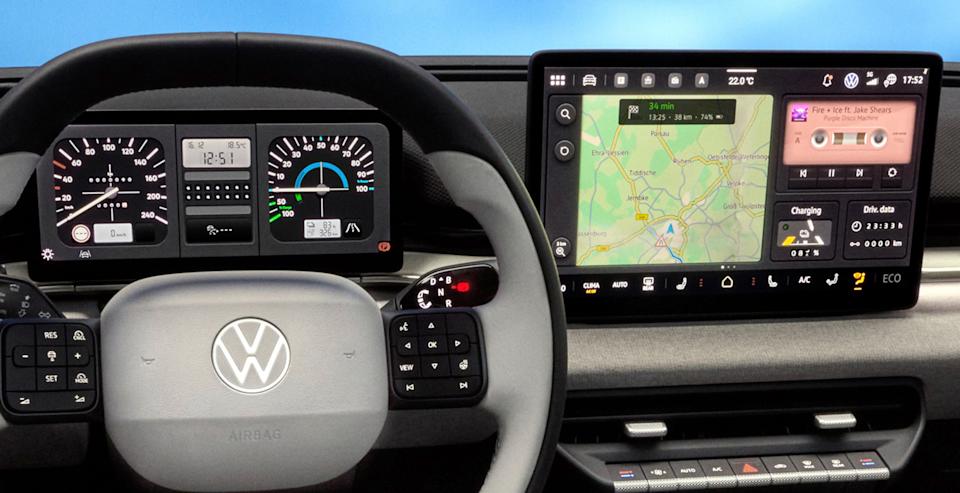
- A Steering Wheel Renaissance: The VW steering wheel now hosts significantly more clear, dedicated buttons compared to predecessor models. Essential driving functions (cruise control, audio track skip, volume adjustment, phone call hangup/answer) receive distinct physical switches within thumbs’ reach.
- The Triumphant Knob: Flanking the gear selector/drive mode controller between driver and passenger sits a physical knob controlling audio volume and track/station shuffling. This simple rotary control epitomizes intuitive interaction – no fiddling, instant muscle-memory adjustment, eyes firmly on the road.
These tactile elements provide “stability and trust,” as Mindt puts it. The confidence of knowing you’ve pressed the traction control button without looking, or adjusted the temperature to exactly 22°C by feel, is a significant safety and usability advantage over hunting through touchscreen sub-menus at highway speeds.
Why Buttons Win on Usability: A Quick Comparison
| Feature | Physical Controls (Buttons/Knobs) | Touchscreen Controls |
|---|---|---|
| Directness | Immediate, one-step action | Often requires navigating menus or multiple taps |
| Tactile Feedback | Enhances confirmation, reduces visual reliance | No feedback beyond visual/haptic buzz (can be unreliable) |
| Glove Use | Functions reliably | Usually problematic or requiring specific glove modes |
| Situational Awareness | Lower visual demand, feels natural | High visual demand to locate and press correct area |
| Precision | Precise adjustments (e.g., volume tuning) easily made | Sliding controls lack granularity, prone to errors |
| Reliability | Less prone to lag/freezing during critical maneuvers | Susceptible to system slowdowns/crashes |
Embracing the Future Without Forgetting the Past
Volkswagen’s embrace of physicality doesn’t equate to abandoning technology. The ID. Polo boasts a fully modern digital interface:
- A 10.25-inch Digital Cockpit Display directly in front of the driver.
- A large ~13-inch Central Touchscreen controlling navigation, media selection, vehicle settings, and connectivity functions.
Crucially, VW integrates its heritage cleverly. Through a dedicated steering wheel button or a touchscreen option, drivers can activate a unique retro gauge display, visually inspired by the iconic Volkswagen Golf I from the 1980s. This charming detail – a wink to VW’s rich history – showcases how digital advancements can coexist harmoniously with nostalgia and distinctive design character. The blend of “warm materials” alongside these digital-analog elements aims for an inviting, timeless feel.
A Broader Strategy: The ID. Polo Leads a Fleet
The ID. Polo is positioned as more than just a single model; it’s the vanguard leading Volkswagen’s renewed charge in the crucial small and compact EV segment in Europe. As Mindt indicated, the physical button commitment applies to “every car” VW makes moving forward, suggesting the Polo’s design language will cascade through the lineup. It heralds four forthcoming EVs targeting practicality and affordability for European drivers seeking sustainable mobility without sacrificing driver-centric usability. This segment is fiercely competitive, dominated by technologically advanced rivals also grappling with ergonomic challenges. VW’s distinct emphasis on intuitive controls could prove a key differentiator.
The US Miss: Disappointment Across the Pond
For North American EV enthusiasts excited by VW’s pragmatic controls shift, the ID. Polo announcement brings mixed emotions. Volkswagen has explicitly stated no plans to bring this specific compact EV to the United States market. While disappointing, this doesn’t preclude VW’s US-bound EVs (like the next-gen ID.Buzz van, perhaps) from incorporating the same tactile control philosophy championed by Mindt. The decision likely reflects market prioritization: Europe has considerably stronger demand for compact hatchbacks like the Polo, while US buyers lean toward larger SUVs and Crossovers. However, the underlying principle – prioritizing driver-focused interaction – remains highly relevant globally.
Beyond Volkswagen: The Industry Ripple Effect?
Volkswagen’s bold pivot taps into widespread driver sentiment. Major publications and safety advocates have increasingly questioned whether touchscreen race compromises safety too much. Whether other manufacturers follow VW’s lead significantly remains uncertain. Some high-end brands (e.g., Porsche with the Taycan’s central console controls) already blend touchscreens and physical elements thoughtfully. However, VW’s explicit declaration to return physical buttons to fundamental functions across its entire volume-focused lineup could accelerate a broader reassessment. If the ID. Polo resonates strongly with European buyers – prioritizing ease-of-use and safety alongside electric drivetrains – competitors ignoring this feedback may find themselves at a disadvantage.
The Volkswagen ID. Polo represents a powerful rebuttal to the assumption that progress means losing tangible controls entirely. Its design confidently argues that the future is integrative: leveraging digital displays’ strengths while respecting the fundamental human need for intuitive, dependable interaction with our vehicles. By bringing back buttons where they matter most and integrating them thoughtfully with modern technology, Volkwagen isn’t just launching a car; it’s championing a driver-first philosophy where technology enhances, not hinders, the experience on the road. Will other automakers heed the call to make driving feel effortlessly connected again? What features are you desperate to have back on a dial or switch?


