
The Silent Sentinels: Baton Rouge Bets Big on Advanced Police Drones After Tragedy Strikes
Imagine a line of duty where simply going to work involves significant risk of death – a sobering reality for police helicopter pilots. In March 2023, Baton Rouge, Louisiana, faced this devastating truth head-on when its police helicopter crashed during a storm mid-pursuit, tragically killing two veteran officers. This incident didn’t just shatter a community; it forced the Baton Rouge Police Department (BRPD) into a radical reevaluation of aerial policing. Their solution emerged not from another crewed aircraft, but from the burgeoning world of unmanned systems: deploying a cutting-edge, large-scale drone designed as a potential successor to the traditional police helicopter. This strategic shift towards sophisticated police drones underscores a transformative moment in law enforcement technology, driven by necessity, enhanced capability, and a fundamental concern for officer safety.
From Tragedy to Transformation: Baton Rouge’s Drone Evolution
The abrupt grounding of the BRPD helicopter unit following the fatal crash created an operational void. Aerial surveillance – crucial for pursuits, large-scale searches, event monitoring, and locating fleeing suspects or vulnerable individuals – couldn’t be abandoned. Yet, the human cost was now tragically measured. The Department’s leadership sought an alternative that mitigated risk without sacrificing capability. Enter unmanned aerial vehicle (UAV) technology. While BRPD wasn’t new to drones (operating a fleet of smaller units), it needed something far more substantial to replace the persistent surveillance power of a helicopter.
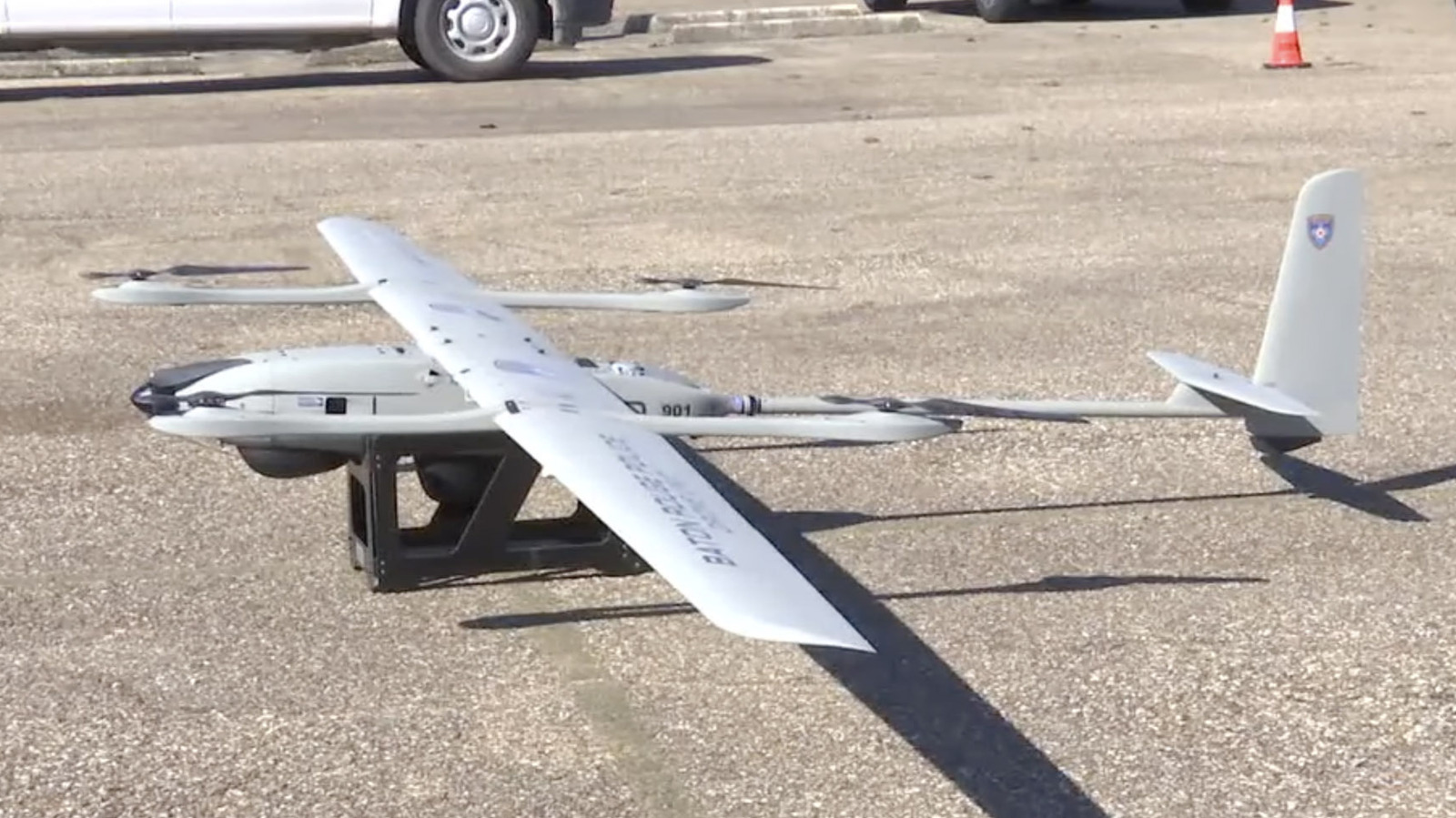
Their answer arrived nearly three years later: the Lockheed Martin Stalker VXE30, procured through Edge Autonomy. This aircraft isn’t your typical hobbyist quadcopter; it’s the undisputed flagship of the BRPD’s now 30+ drone fleet, representing a quantum leap in capability tailored specifically for law enforcement missions demanding extended reach and endurance.
Unpacking the Stalker VXE30: A Game Changer in Police Drone Capability
So, what makes the Stalker VXE30 stand out in the crowded landscape of law enforcement drones? It breaks the mold established by smaller UAVs:
- Scale and Endurance: With a 16-foot wingspan, it dwarfs typical quadcopters. Critically, it boasts flight durations of up to 4 hours on battery power (with fuel-powered variants reportedly reaching a staggering 8 hours), eclipsing the mere 20-45 minutes of smaller UAVs. Its current operational range is 30 miles, slated to expand to 100 miles – figures reminiscent of manned aircraft capabilities.
- VTOL Flexibility: The Vertical Take-Off and Landing (VTOL) design eliminates the need for runways, allowing deployment from police stations, parking lots, or mobile commands – essential for rapid response in urban policing.
- Higher Altitude:** Able to fly up to 400 feet (the FAA ceiling for its classification) and capable of reaching up to 12,000 feet, the VXE30 provides a significantly broader field of view compared to low-flying small drones.
- Multisensor Payload: Crucially, it integrates advanced electro-optical/infrared (EO/IR) systems, including high-resolution daytime cameras and powerful thermal imaging. This enables tasks like tracking suspects in darkness, identifying heat signatures for firefighting support (pinpointing hotspots in burning buildings), and providing detailed situational awareness over wide areas day or night.
- Resilience and Range: Designed for military-grade endurance, its operational parameters (altitude, duration, payload capacity) place it firmly in a tier above conventional policing UAVs.
The entire package, including the drone system and necessary training for BRPD operators, came with a price tag of approximately $1 million – a significant investment, yet framed against the backdrop of safety and capability replacement.
Beyond Toys: Can Advanced Drones Realistically Replace Police Helicopters?
The BRPD envisions the Stalker VXE30 tackling core missions historically reserved for helicopters:
- Sustained high-speed pursuit tracking over long distances.
- Wide-area search operations for missing persons or suspects.
- Long-range surveillance of critical incidents over extended periods.
- Providing aerial overwatch during tactical operations.
- Assisting fire departments with thermal imaging during structure fires and wildfires.
Proponents highlight several compelling advantages compared to crewed helicopters:
- Dramatically Lower Operational Costs: Beyond the initial purchase price ($1 million vs. $3-5M+ for a light helicopter), operating drones eradicates substantial ongoing costs:
- Pilot salaries and extensive recurrent training.
- Helicopter fuel (much higher consumption than UAVs).
- Maintenance and hangar costs for large aircraft.
- Enhanced Officer Safety: Removing pilots from inherently dangerous airborne roles is paramount, especially recalling the BRPD tragedy.
- Increased Versatility and Persistence: Smaller drones offer agility; the VXE30 adds endurance. Multiple drones can be deployed relatively easily compared to fielding multiple helicopters. Longer flight times mean persistent surveillance without refueling gaps.
- Safer Operations in Adverse Weather: While severe weather still grounds UAVs, advanced systems like the VXE30 often have better tolerance for marginal weather unsuitable for helicopters, and critically, no pilot is endangered.
- Reduced Auditory Footprint: Quieter operation compared to helicopters reduces disturbance to communities during operations.
Comparing Key Operational Aspects: Helicopters vs. Advanced Police Drones (e.g., Stalker VXE30)
| Feature | Helicopter | Advanced Police Drone (e.g., Stalker VXE30) |
|---|---|---|
| Primary Cost Driver | High Acquisition ($3M-$5M+), Fuel, Pilot Salaries | Lower Acquisition ($1M-$2M), Minimal Fuel Costs |
| Endurance | 1.5 – 3 Hours (Typical Police Heli) | 4 – 8 Hours |
| Operational Altitude | Up to several thousand feet | Up to 400 ft FAA (Design capable of 12,000 ft) |
| Personnel Risk | Pilots & Crew at Risk | No Pilots/Crew in Harm’s Way |
| Deployment Speed | Requires Crew, Pre-flight checks | Faster Launch from Prepared Stations |
| Weather Limitation | Significantly impacted by wind/turb/ice | More tolerant; limited by severe wind/ice |
| Noise Level | High | Significantly Lower |
| Payload Flexibility | High Capacity | Moderate Capacity (EO/IR, comms relays) |
Clearing the Regulatory Airspace: The FAA Hurdle
Available data sourced from FAA regulations (FAA Part 107), Lockheed Martin announcements, and estimated common police helicopter operating costs. Endurance/ranges represent typical nominal operational capacities.
The path for widespread adoption of large UAVs like the Stalker isn’t solely dependent on their technology. The primary constraint often boils down to Federal Aviation Administration (FAA) regulations governing the increasingly complex National Airspace System. As UAVs get larger, fly higher, and traverse longer distances, they intersect more directly with manned aircraft corridors. Key considerations include:
- Beyond Visual Line of Sight (BVLOS): Flying high-endurance drones effectively requires beyond-line-of-sight operation. Gaining FAA approval for routine BVLOS flights remains a significant regulatory hurdle, requiring advanced detect-and-avoid systems, robust communications links, and stringent risk assessments.
- Airspace Integration: Ensuring safe interaction with helicopters, planes, and increasingly, other UAVs, especially near airports or congested airspace (FAA UAS Integration Office) is critical. Procedures for traffic alerting, navigation, and communication need refinement.
- Takeoff Weight and Licensing: Larger drones potentially fall into categories requiring specific FAA certification or waivers impacting operations and pilot qualifications.
We see similar regulatory challenges impacting burgeoning industries like Urban Air Mobility (eIVOL taxis planned for events like the LA Olympics). Success for large-scale police UAVs hinges as much on navigating evolving FAA Part 107 waivers and future rule sets as it does on technical prowess.
Broader Implications: Aerial Policing Reimagined
Baton Rouge’s investment is a highly visible test case with national implications. If the Stalker VXE30 successfully performs the breadth of tasks currently handled by helicopters—reliably, cost-effectively, and safely—it presents a compelling model for other police departments. Departments nationwide grapple with aging helicopter fleets, soaring maintenance costs, and pilot shortages. Advanced drones offer a technologically advanced, resource-efficient solution.
Furthermore, the utility extends beyond traditional policing:
- Disaster Response: Rapid aerial assessment after storms or earthquakes.
- Search and Rescue: Extended thermal imaging searches over difficult terrain.
- Public Event Security: Persistent monitoring over large crowds or critical infrastructure.
- Fire Department Support: Live thermal mapping of fire progression.
However, this evolution isn’t without valid concerns regarding privacy and surveillance powers that must be addressed through transparent policies and community engagement.
Baton Rouge’s Flight Path Marks a Milestone
The skies over Baton Rouge now host a different kind of guardian. Born from profound loss, the BRPD’s embrace of the Stalker VXE30 signifies more than just adopting new kit; it represents a pivotal moment in redefining aerial policing paradigms. This sophisticated UAV bridges the gap between fragile quadcopters and resource-intensive helicopters, offering unprecedented endurance, versatility, and, crucially, a solution that prioritizes officer safety without compromising mission effectiveness. While FAA regulations present crucial challenges requiring careful navigation, the tangible advantages in cost, capability, and risk reduction make the trajectory clear. Baton Rouge’s bold move positions advanced drones firmly as indispensable assets in modern policing, no longer merely supplemental tools but credible replacements poised to reshape how law enforcement surveils and protects from above. Do you see large-scale drones like Baton Rouge’s becoming the standard for aerial policing? Share your perspective below!


