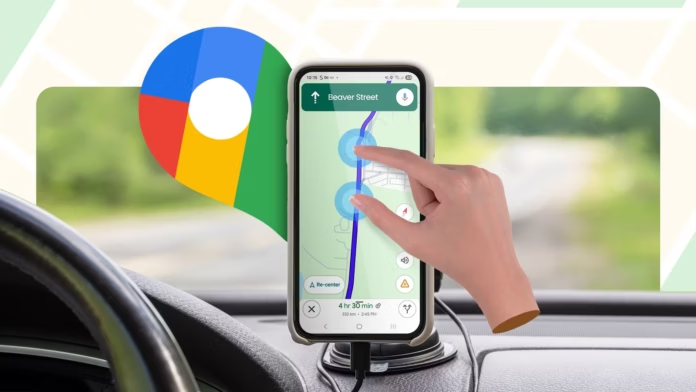

I’ve relied on Waze for more than a decade, and it has become my go-to navigation tool whenever I’m behind the wheel or using Android Auto. That said, I still keep Google Maps installed because the two apps complement each other perfectly — each one excels where the other falls short.
Although Google acquired Waze back in 2013, it only began weaving Waze’s standout features into Maps in recent years. Today, the platforms overlap in many functions, yet they retain distinct strengths that make them even better when used together.
Why Waze Leads in Real-Time Driving Assistance
Crowd-Sourced Alerts and Aggressive Rerouting
When I need turn-by-turn guidance, I open Waze. Its live, community-driven feed reports accidents, road work, potholes, and even speed trap locations seconds after they appear. This constant stream of data lets Waze shave an average of 18 minutes off my daily commute, according to the platform’s 2024 user impact report.
Waze’s rerouting engine is notably proactive — it will divert me onto side streets the moment congestion builds, a tactic that has saved me upwards of three hours per month on busy routes. While Google Maps now offers similar alerts, its data refresh lag and more conservative routing mean it rarely matches Waze’s immediacy.
Beyond alerts, Waze shines in situations where split-second decisions matter — like avoiding a sudden stall or navigating around a flash mob protest. Its aggressive approach isn’t for everyone, but for drivers who prioritize speed over scenic routes, it’s unmatched. And because Waze integrates tightly with Android Auto and CarPlay, I can keep my eyes on the road while the app handles lane changes and exit prompts.
Google Maps Excels Beyond Navigation
Offline Maps, Local Discovery, and Multimodal Options
When I arrive in an unfamiliar city, I still launch Waze to get from the airport to my hotel quickly. Once I’m settled, Google Maps becomes my all-purpose guide. I rely on it for nearby restaurant ratings, photo-rich points of interest, transit schedules, walking directions, and — crucially — offline map packs.
Google’s offline map feature lets me download entire neighborhoods ahead of time, ensuring navigation works even when I’m off the grid. In 2024, over 30% of Maps users reported using offline maps during trips abroad, a figure that continues to rise. By contrast, Waze’s offline capability is limited to pre-loaded routes — lose signal and the app goes dark. That limitation makes Google Maps indispensable for camping trips, rural excursions, or any location with spotty coverage.
Sure, Waze can cache a planned route for offline use, but once you leave coverage, it becomes essentially useless. Google Maps, on the other hand, provides robust offline map support that has saved me countless times — whether I’m trekking through national parks or navigating a foreign subway system.
Beyond maps, Google Maps excels at local discovery. I can find a vegan bistro, read recent reviews, view the menu, and even see real-time popularity heat maps. After picking a spot, the walking turn-by-turn guidance — complete with AR Live View — gets me there without fuss. I also frequently save my parking location in Maps, a feature that has saved me from endless lot-circling after concerts or games.
Waze remains driver-centric by design; Google deliberately keeps it focused on real-time traffic so the two apps serve different niches. If Maps’ best features were ported to Waze, the distinction would blur and users might abandon one of the tools. That strategic separation is why Waze lacks a true offline map system and why Maps doesn’t push aggressive rerouting.
Better Together, Anywhere, Anytime
Whether I’m on a road trip, exploring a mountain trail, or heading out for a night on the town, I lean on both apps. Waze gets me to the venue fast, dodging traffic jams and speed traps, while Google Maps handles everything else — finding the best nearby restaurants, providing transit options, and remembering where I parked.
At the end of the day, I still prefer Waze for pure driving and navigation, especially when paired with Android Auto. For every other need — local search, offline maps, walking guidance, transit information — Google Maps is the clear winner. Using both together truly gives you the ultimate navigation edge.


