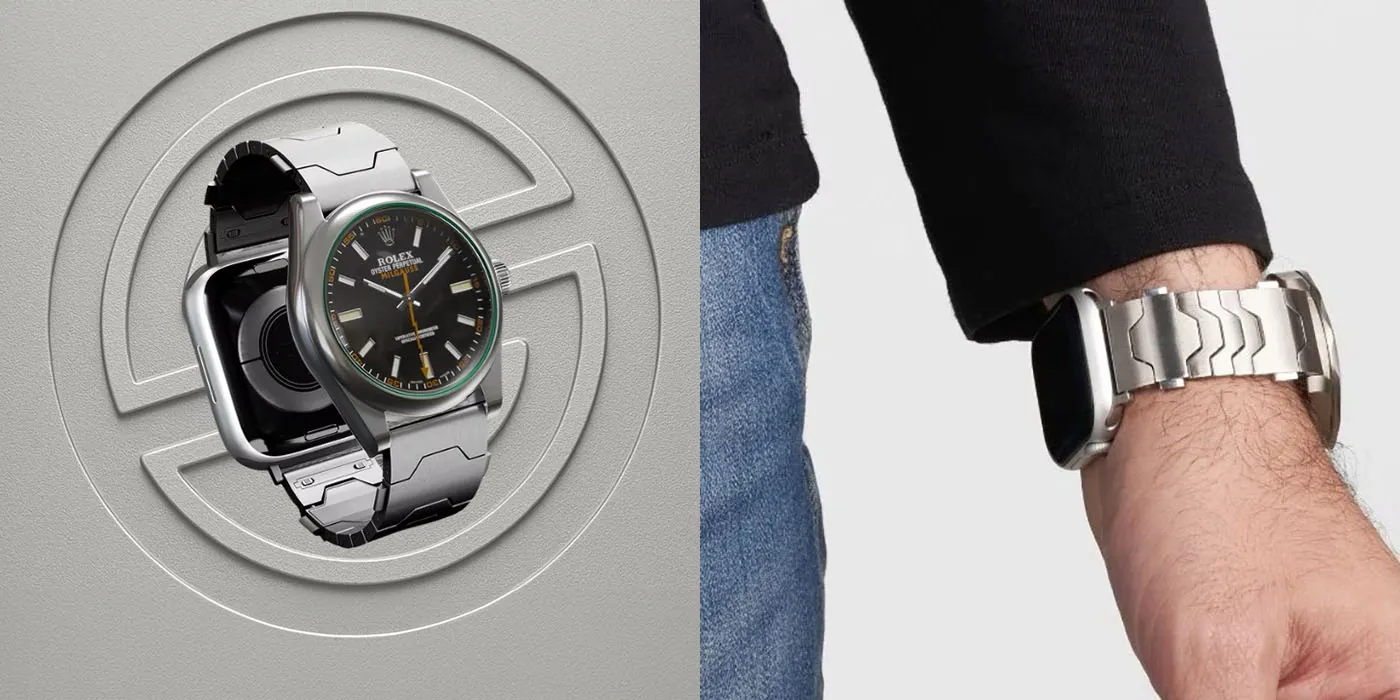

Why Settle for One Timepiece When You Could Wear Two?
For decades, wristwear represented either heritage craftsmanship or cutting-edge tech – but rarely both. This divide sparks frustration: Must you abandon centuries of horological artistry for real-time heart-rate monitoring and notifications? Stats reveal the dilemma’s prevalence. A Deloitte survey notes 82% of luxury watch owners also wear smartwatches, yet juggling both often means alternating wrists or compromising style. Enter Silicon Valley’s latest answer: wearable duality. And arguably, the most unconventional Apple Watch accessory yet promises to let you defy the compromise entirely. This Apple Watch accessory (target keyword included) reimagines wrist real estate, positioning itself as the ultimate hybrid solution—whether you value timeless elegance or digital convenience most.
The Fundamental Divide: Analog Legacy vs. Digital Utility
Smartwatches excel in functionality yet falter in aesthetic permanence. While the Apple Watch underwent significant design refinement since its 2015 debut—showcasing titanium cases and premium straps—it lacks the centuries-old heritage emblematic of Swiss giants like Patek Philippe or Rolex. A Rolex Submariner, hand-assembled by artisans, appreciates over time and signifies enduring luxury. Conversely, a Series 9 Apple Watch becomes obsolete tech within five years. As The New York Times notes, traditional watches symbolize tradition and emotional value, while smartwatches prioritize utility and constant innovation.
The conflict extends beyond sentimentality. Practical needs compel dual ownership:
- Health Tracking: Smartwatches monitor sleep patterns, ECG, and workout metrics comprehensively.
- Professional Settings: High-stakes meetings favor analog watches’ subtle sophistication over disruptive notifications.
- Battery Anxiety: Mechanical watches run perpetually, whereas smartwatches need daily charging.
This irreducible tension led users like tech journalist Ben Lovejoy (source author) to abandon his Apple Watch altogether—replacing it with mechanical timepieces augmented by an Oura smart ring for biometrics. But now, innovators challenge the “either-or” dogma.
Enter Smartlet: Engineering a Wrist Revolution
Dismissed initially as absurd, the Smartlet band tackles the coexistence dilemma head-on. Its ingenious design layers an Apple Watch under a conventional watch—or vice-versa—on a single modular strap system. Constructed from lightweight aerospace-grade aluminum, the band incorporates adjustable tiers:
- Top Tier: Hosts a traditional watch via spring-loaded lugs (compatible with 20mm/22mm widths).
- Bottom Tier: Secures an Apple Watch using standard connection points.
You switch positioning based on priority—showcasing your Rolex Datejust while covertly tracking steps or flipping the Apple Watch atop during workouts. Crucially, Smartlet clarifies compatibility:
| Component | Compatibility |
|---|---|
| Apple Watch | All models (Series 1-Ultra 2) |
| Analog Watches | Lug widths: 20mm or 22mm |
| Featured Brands | Rolex, Omega, Tag Heuer, Tudor, Zenith |
Vanessa Hand Orellana of CNET underscores its wearability: in person, the double-stack appears less jarring than expected, minimizing bulk via a slimmer profile than rivals like the Cohaesus Duo. Yet gaps persist—how seamlessly does it slide under tailored shirt cuffs? User reviews addressing formal attire remain sparse.
Market Response: Niche Genius or Accessory Excess?
Detractors mock Smartlet as peak Silicon Valley overengineering—an emblem of the “ridiculous Apple Watch accessory” category Lovejoy humorously crowned. Competitors abound, from necklace-converted AirTags to wearable UV sensors. Yet industry analysts observe strategic nuance here:
- Core Audience: Luxury collectors who refuse to forsake investments ($10k+ watches) for smart features.
- Market Gap: Hybrid smartwatches (e.g., Garmin Marq) blend analog faces with sensors but still lack iOS integration and prestige branding.
- Social Experiment: Wearing dual watches deftly signals tech-fluent tradition.
A Morning Consult survey reveals 50% of Gen Z buyers prioritize versatility in accessories—suggesting Smartlet’s practicality resonates despite eccentric optics. For context:
Alternatives like Oura Rings enable health tracking sans wrist disruption.
Bluetooth-enabled analog watches (e.g., Hamilton PSR) offer limited features without Apple’s ecosystem depth.
Smartlet occupies a middle ground. Finnish tech reviewer Jarno surmises: “It solves a problem most don’t have… yet feels inevitable for those grappling with horology’s digital transition.”
The Viability Test: Comfort, Credibility, Context
Beyond novelty, three hurdles define Smartlet’s staying power:
1. Comfort & Ergonomics
The weight of two watches challenges wrist fatigue. Smartlet mitigates this via skeletonized framework and aluminum alloy—reducing added grams versus oversized dive watches. Still, sleep tracking would prove cumbersome.
2. Style Integration
While CNET validated subtlety, cuff compatibility remains untested publicly. Luxury retailers suggest pairing Smartlet solely with sport models (Oyster bracelets, NATO straps), avoiding complications like chronographs that increase height.
3. Brand Alliances
Legitimacy hinges on recognition. Smartlet’s explicit Rolex/Omega compatibility bypasses legal peril since adapters don’t counterfeit logos—mirroring Apple’s “Designed for” certification. Premium partnerships could accelerate adoption.
The University of Oxford’s wearability studies affirm dual-device acceptance when ergonomics align with neural adaptation patterns: users acclimate within days.
Beyond Gimmickry: A Calculated Gamble on Human Nature
Calling Smartlet ridiculous oversimplifies. Psychologically, humans crave integration—bridging identity markers (luxury watches) with utility tools (smart tech). Rolex and Apple dominate distinct domains; Smartlet exploits synergy. As watch historian Rebecca Struthers observes, wristwatches always evolved via societal shifts—from wartime trench necessities to Apollo 11-certified chronographs. Hybridization might merely accelerate this evolution. Then again, elegant compromises like Oura Rings satisfy minimally. Perhaps this accessory triumphs not through pragmatism, but irrational passion—symbolizing refusal to choose among life’s inspirations. After all, Tudor didn’t eclipse Rolex; they coexisted for differing tastes.
Ultimately, Smartlet validates human stubbornness: Would you forfeit an heirloom Omega Speedmaster’s chronograph because Apple measures VO2 max? Perhaps not. But rather than compromise, why not assemble your own unbeatable ensemble? For disambiguation-seekers, this band transforms dilemma into declaration: loyalty to tradition and innovation. Its success hinges on silencing critics through seamless execution—one double-stacked wrist at a time.
Do you own both watch types? Would you strap them together or declare it madness? Weigh in below and debate our quadrant comparison.


