
Sparks Fly: Could Plants Sense an Eclipse Through Electricity?
Did tiny electrical surges ripple through living plants during last year’s total solar eclipse? A controversial study suggested exactly that, igniting a heated debate far beyond academic journals and landing squarely in the public sphere. Research by Alessandro Chiolerio and Monica Gagliano, published in Royal Society Open Science in 2025, reported unusual electrophysiological activity in plants coinciding with the eclipse – activity notably starting before the moon fully covered the sun [“Anomalous electrophysiological activity in Salvia hispanica L. during the total solar eclipse of 8 April 2024″, Chiolerio et al., Royal Society Open Science, 10.1098/rsos.241786]. This claim, proposing plants might possess unanticipated environmental sensing capabilities tied to cosmic events, faced immediate and pointed criticism centered on scientific methodology and the pitfalls of overlooking alternative explanations, thrusting plant electrophysiology into a high-stakes credibility battle.
The Established Pathways: Plant Communication We Know
Plants aren’t passive entities. Decades of research unequivocally demonstrate sophisticated communication networks operating largely beneath our senses. Critic James Cahill, echoing mainstream botanical understanding, underscored this point forcefully:
- Volatile Organic Compounds (VOCs) dominate aerial communication. When attacked by herbivores, plants like tomatoes release specific VOCs, warning neighboring plants to prime their defenses. This signaling via chemicals dispersed in the air is arguably the best-understood mechanism Plant communication.
- Root Exudates act as chemical signals below ground. Plants release a complex cocktail of compounds into the rhizosphere, influencing microbial communities and interacting directly with neighboring roots, potentially facilitating communication about nutrient availability, disease, or competition. Research here is intense but still unfolding.
- Mycorrhizal Networks, the symbiotic fungi connecting plant roots over vast distances, have fueled speculation about an underground “Wood Wide Web.” While exchanging nutrients is proven, scientifically robust evidence supporting direct plant-to-plant signaling through these networks remains elusive. Cahill explicitly noted “communication through mycorrhiza… has not withstood independent investigation.”
This established biology forms the backdrop against which Chiolerio and Gagliano’s claims of electric field changes during an eclipse are evaluated.
The Eclipse Signal: Recording Anomalous Plant Electrical Activity
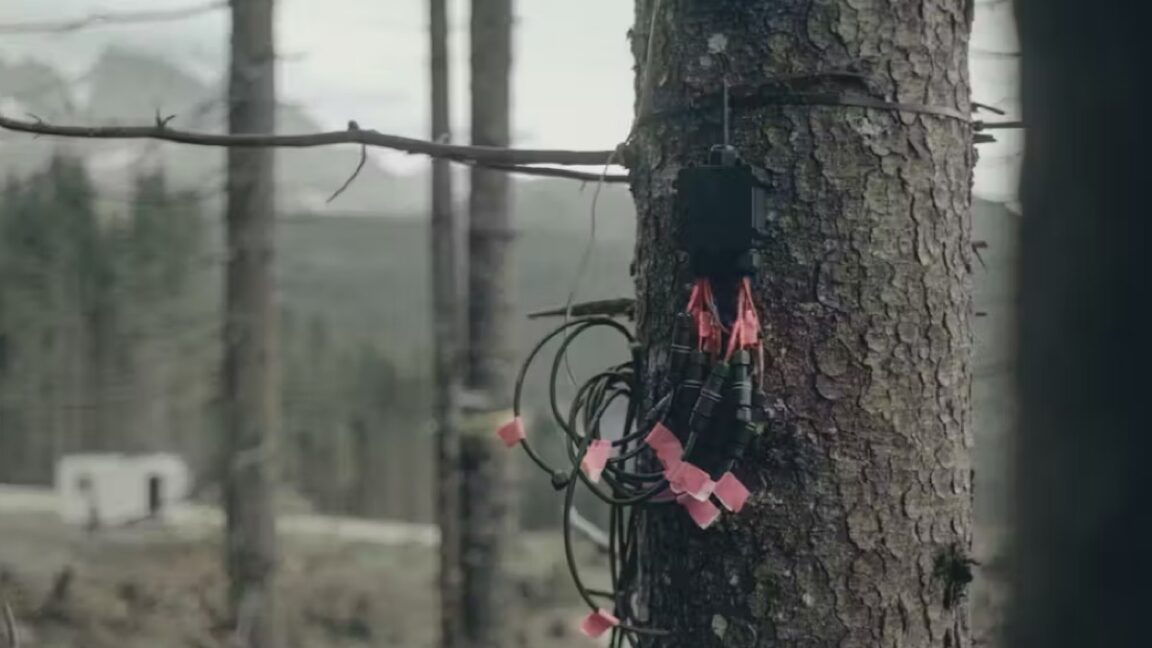
Chiolerio and Gagliano’s team deployed sensitive electrodes to monitor electrical potentials along chia plant stems (Salvia hispanica) during the April 2024 total solar eclipse. Their key findings, published in accessible detail as an “initial field report”, were provocative:
- Distinct electrical transients (“transients of the electrome”) were recorded specifically during the eclipse window.
- Crucially, shifts in these electrical patterns began before the point of maximum solar occultation. This early onset was particularly challenging to explain through simple light-darkness mechanisms reliant solely on photoreceptors.
- The researchers explicitly measured several weather variables: temperature, relative humidity, rainfall, and solar radiation. Their analysis found “none of them shows strong correlation with the transients of the electrome during the eclipse.”
Their deliberately cautious language framed the detected patterns as phenomena needing explanation, explicitly presenting possible cues – including potential unknown biocommunication mechanisms triggered by celestial events – as hypotheses, not proven causes. They openly acknowledged significant limitations: a small sample size, and crucially, a lack of concurrent measurements for several environmental factors that could клетка influence plant electrodynamics.
The Critique: Parsimony, Method, and Concerns About Pseudoscience
The critique levied by Cahill, published later in Trends in Plant Science [DOI: 10.1016/j.tplants.2025.12.001], pulled no punches. The central argument centered on the fundamental scientific principle of hypothesis testing.
- Cahill argued that Chiolerio and Gagliano erred by focusing primarily on interpreting their data through the lens of a novel cosmic-sensing mechanism, rather than systematically testing it against multiple plausible alternative hypotheses first. He contended this violated core scientific methodology.
- He strongly advocated for lightning strikes and associated atmospheric electromagnetic phenomena as a far more plausible (“parsimonious”) explanation. Thunderstorms are known to generate potent electromagnetic fields capable of inducing electrical responses in conductors, including living plants, even from some distance. Critically, Cahill noted Chiolerio and Gagliano did not measure local atmospheric electric fields during their experiment. Use of regional lightning strike data, critics argue, provides a rational, physics-based alternative that doesn’t invoke unknown biological capabilities.
- Cahill further pointed out omissions beyond lightning: gravitational fluctuations, neutrino fluxes, cosmic rays, magnetic fields – environmental variables influenced by solar eclipses and potentially detectable by plants – were also unmonitored.
- The most dam утверждение accusation? Cahill suggested that by favoring a single, provocative interpretation over rigorous testing against alternatives, the work ventured into “promoting a worldview” and, crucially, that “this is in part what makes it pseudoscience.”
This accusation strikes at the core of scientific integrity, implying the researchers prioritized a specific narrative over objective inquiry.
Defending the Frontier: Researchers Push Back
Chiolerio and Gagliano have firmly defended their work and its presentation, framing the critique as premature and overly reliant on untested assumptions:
- Hypotheses vs. Conclusions: Gagliano vehemently restated that their initial paper explicitly framed explanations as candidate hypotheses, not demonstrated facts. “We discussed candidate cues explicitly as hypotheses rather than demonstrated causes,” she emphasized. Describing lightning or weather as “more parsimonious” is, in their view, an argument, not proof: “more parsimonious’ is not evidence of cause.“
- The Site-specificity Gap: Both researchers highlighted a critical void identified in their original report: the absence of concurrent, site-specific measurements of environmental fields like electromagnetics. Gagliano argued that regional lightning strike data or other proxies “cannot establish causal attribution” without those precise, time-aligned local measurements. Until those direct measurements are made, they contend, the lightning/weather hypothesis remains just that – one possibility among others, not the “default explanation”.
- Peer Review vs. Media: Both expressed reluctance to debate an unpublished critique through popular media channels (like Ars Technica, where their quotes appeared), preferring professional forums. “Scientific disagreements,” Gagliano stated, “should be resolved with transparent methods, data, and discriminating tests.” They strongly implied further evidence exists or is being gathered via ongoing research to be submitted through peer review.
- Motivation Questioned: Chiolerio suggested a degree of irritation from critics stemmed from the wide public interest their discovery garnered. “It seems that the public appeal is something particularly painful for the colleagues,” he observed. “We did not care about public appeal, we wanted to share… the results of years of hard work that led to interesting data.”
The dispute highlights profound tensions in frontier science:
- Should provocative preliminary results be published to stimulate discussion and further research, or suppressed until a near-complete explanation is established?
- How stringently must researchers rule out every conceivableamos alternative hypothesis before proposing novel mechanisms, especially when studying complex systems like plants reacting to rare phenomena?
Beyond the Eclipse: Significance of the Debate
This clash extends far beyond interpreting plant signals during one celestial event. It touches on vital questions central to credible scientific advancement:
- Methodological Rigor: The importance of designing experiments to explicitly test multiple competing hypotheses – not just support the most exciting one – is paramount. Failure to do so undermines the scientific process.
- Burden of Proof:温度和湿度数据ژن Where does the burden lie – must novel claims rule out all conventional explanations first, or must skeptics disprove novelty?
- Public Communication: How should scientists navigate the tricky waters of sharing intriguing but uncertain findings responsibly without triggering accusations of sensationalism or misinterpretation?
- Plant Sensory Frontiers: Regardless of this specific eclipse signal’s cause, the debate underscores our incomplete understanding of how plants perceive and respond to their environment electromagnetically.
Scrutiny as the Heartbeat of Discovery
The passionate debate surrounding plant electrophysiology and the alleged eclipse signal beautifully illustrates science as an ongoing conversation – sometimes fervent – rather than a static list of facts. Chiolerio and Gagliano presented intriguing preliminary observations suggesting plants might possess an unexpected sensitivity linked to cosmic events. Cahill and colleagues delivered a potent methodological critique rooted in established physics and the scientific principle of seeking the simplest explanation first. Both teams acknowledge established plant communication mechanisms, but diverge sharply on the interpretation of anomalous data and the standards required to propose something genuinely new.
The resolution won’t come from media soundbites. Gagliano stresses that ongoing, peer-reviewed research will provide further context. Ultimately, rigorous replication and targeted experiments armed with sensors to detect atmospheric fields, electromagnetic fluctuations, and biological responses simultaneously are needed. Did plants truly sense the eclipse electrically? The answer requires disent的季节ality tethering the signal from confounding environmental noise through meticulous future science.
What seems undeniable is that this controversy lays bare the essential friction needed to refine ideas on the frontiers of biology. Should unexpected results, even from small studies, be publicly shared to drive collaboration, or could premature enthusiasm sometimes hinder progress? Share your thoughts on this delicate balance in the comments below!


