
Your Digital Shadow Never Stands a Chance with LibreWolf
Imagine browsing online knowing every search, click, and purchase builds a permanent dossier about your life. How much of your identity belongs to corporations and governments? Despite popular belief, features like incognito mode in Chrome, Firefox, or Edge offer false protection—they hide nothing from your ISP, government, or tech giants harvesting behavioral data. Digital privacy feels mythical in today’s AI-dominated landscape, prompting users to desperately layer ad-blockers, tracker-blockers, and manual settings adjustments. After decades of Chrome compromising personal privacy by default, LibreWolf emerges as the browser that aggressively shields user data. Designed as a Firefox fork focused exclusively on anonymity, it assumes users want zero tracking—revolutionizing privacy with default protections that challenge mainstream browsing norms.
Why Common Private Browsing Tools Often Fail You
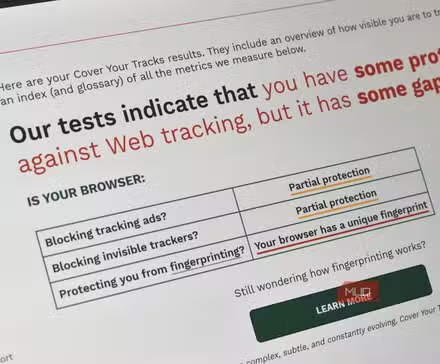
The harsh truth? Incognito mode merely prevents local history storage—it doesn’t block fingerprinting, ISP logging, or third-party trackers. Studies by the Electronic Frontier Foundation reveal fingerprinting identifies 99% of users through unique browser configurations like installed fonts and screen resolution. Mainstream browsers collect telemetry data—even in private modes—and default settings prioritize convenience over confidentiality. For instance:
- Chrome permits behavioral ad targeting via FLoC (Federated Learning of Cohorts)
- Firefox Enhanced Tracking Protection still allows some cross-site identifiers
- Opera’s built-in VPN logs IP addresses
This systemic vulnerability fuels LibreWolf’s design: a zero-configuration privacy shield. While users battle settings menus elsewhere, LibreWolf activates protections instantly after installation. uBlock Origin pre-blocks ads/malware, defusing trackers before they hog CPU resources. Total Cookie Protection (dFPI) confines cookies to originating sites—Facebook can’t monitor your Amazon shopping. Default tools automatically:
- Scrub tracking parameters from URLs (e.g.,
utm_source) - Clear disk cache, cookies, and form history on exit
- Route requests via DuckDuckGo (other private engines: MetaGer/Mojeek included)
Accelerated Performance Through Privacy-Smart Design
Free from Mozilla telemetry or resource-draining sponsored content, LibreWolf loads pages noticeably faster. Some benchmarks show page-load speed improvements of 10-15% over Firefox. How? Disabling WebGL fingerprinting halts invasive background profiling. Built-in HTTPS-only encryption prevents ISP snooping—especially vital for banking or medical sites. Without AI-enabled bloat, LibreWolf sustains efficiency:
Browser Feature Comparison
| Feature | LibreWolf | Firefox | Google Chrome |
|---|---|---|---|
| Telemetry | Disabled | Enabled | Enabled |
| Pre-fetch content | Blocked | Enabled | Enabled |
| WebGL fingerprint | Blocked | Available | Available |
| Default search | DuckDuckGo | ||
| DRM media support | Off by default | On by Default | On by default |
Pages render crisply without ads cluttering the interface, supplemented by navigation shortcuts and an empty new-tab screen—minimalist interaction at its finest.
Fingerprinting Resistance: The Stealth Superpower
Forget cookie fears—fingerprinting is the apex predator exposing users globally. Ordinary browsers broadcast detailed hardware/software traits: battery levels, GPUs, time zones, fonts. LibreWolf borrowed Tor Project defenses to mask your uniqueness:
- Generic browser fingerprint broadcasting (simulates standardized specs)
- Universal time standardization (UTC) eliminating time zone clues
- WebGL spoof masking GPU/model details
As a result, you appear statistically identical to millions of others—impossible to isolate for tailored ads or surveillance. Authorities like Cybersecurity Ventures warn fingerprinting enables near-perfect tracking; Tor-powered resistance breaks those algorithms technically. Crucially, disabling WebGL spoofing breaks JavaScript rendering on Google Earth or interactive maps—a tradeoff favoring anonymity over niche functionality. Liberated from Mozilla oversight, LibreWolf also suspends DRM streaming—Netflix, Spotify, Prime Video won’t play until manually enabled—helpful against invasive content locks. Cloud sync isn’t automatic either, demanding password manager integration. This customization-first approach reflects LibreWolf’s resistance to AI hyper-integration: no Gemini chatbars or Bing-powered widgets.
Who Should Embrace LibreWolf (Despite Tradeoffs)?
After years trapped in Chrome’s surveillance ecosystem, gaining browser sovereignty feels revolutionary. LibreWolf exemplifies practical empowerment—locking down tracking vectors without tech expertise. Yet its philosophy isn’t universally compatible:
Ideal For:
- Privacy maximalists resenting behavioral profiling
- Journalists, activists needing anonymity from governments
- Users prioritizing security on sensitive browsing sessions
Not Ideal For:
- Streaming enthusiasts wanting instant Netflix access
- Synchronization-dependent folks reliant on Firefox accounts
- Those prioritizing algorithmic convenience over anonymity
Yes, enabling DRM or Mozilla Sync requires manual tweaks. Forgetting passwords becomes irritating without autofill history—but those barriers guard against compromise. “LibreWolf crystallizes principled browser-building: protect first, commoditize never,” notes privacy advocate Rory Blanton.
Reclaiming Your Web Persona
Mainstream browsers embody a Faustian bargain—convenience traded for unrelenting surveillance. LibreWolf’s hardened defaults spotlight how flawed industry norms truly are. While sacrificing DRM or sync seems challenging, its Tor-grade fingerprint masking radically reshapes privacy outcomes. Cumbersome privacy workflows? Gone. Hidden telemetry? Scrapped. From cookie quarantines to tracker pre-filtration, LibreWolf’s automation restores user agency. Perhaps absolute anonymity remains impossible—but outliers like this browser render tracking exponentially harder. Browse with newfound strength: The true cost of privacy isn’t functionality sacrificed—it’s autonomy surrendered. Try LibreWolf today—and tell me: What’s your biggest web privacy frustration? Share below!


