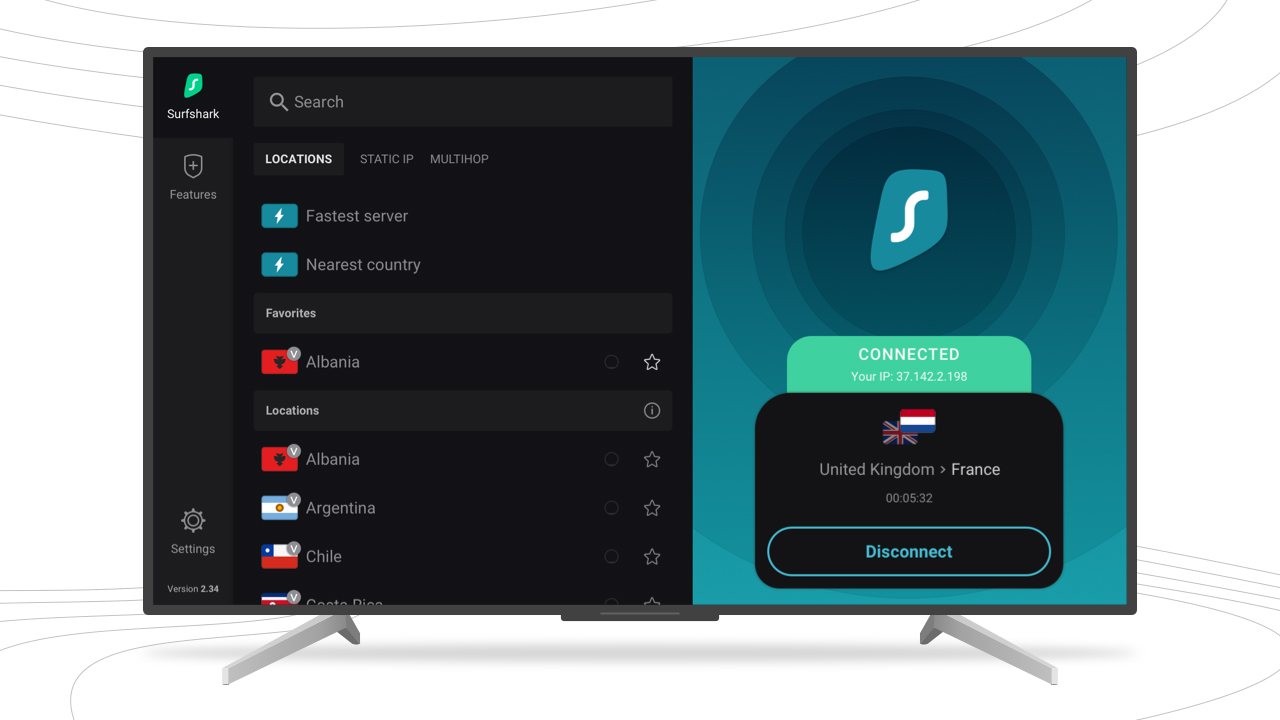

Surfshark VPN in 2025: Beyond Affordability into Innovation Dominance
Have you ever wondered how a VPN provider consistently ranked among the top contenders manages to stay ahead? Surfshark VPN, holding that coveted #2 spot, answered that question emphatically in 2025. Far from resting on its reputation for incredible value – offering a comprehensive suite of privacy tools, blazing speeds, stellar unblocking capabilities, unlimited connections, and user-friendly apps for roughly $2/month – Surfshark unleashed a whirlwind of advancements. Choosing a cheap VPN service often means compromised features, but Surfshark shattered that perception entirely last year. This deep dive unpacks every significant Surfshark VPN development from 2025, revealing how they pushed the boundaries of security, usability, and performance.
Reinventing Private Messaging: The Patent for Decentralized Ownership
Surfshark tackled a fundamental privacy gap beyond standard VPN encryption. Recognizing that ubiquitous end-to-end encryption (E2EE) doesn’t conceal revealing metadata – sender, recipient, timestamps, message size – they registered a groundbreaking patent. This innovation directly addresses ownership concerns inherent in centralized messaging platforms where providers inherently have access to this metadata jungle.
- The Core Innovation: Instead of relying on a single entity, Surfshark’s method splits the encrypted message information between two distinct, unrelated VPN providers during the transmission process. Neither provider ever holds the complete dataset required to decipher both the contents and the associated metadata trail.
- Enhanced User Privacy: This decentralized approach significantly complicates any attempt to link communication endpoints or reconstruct user activities, offering a substantial boost to anonymity. Think of it as a “need-to-know” basis enforced by architecture – each VPN provider only possesses fragmented, unusable pieces of the puzzle.
This move signals Surfshark’s ambition to tackle privacy problems less conventional VPNs address, proactively hardening communication channels against potential surveillance or exploitation of metadata leaks.
Expanding Control: macOS Bypasser Joins the Ranks
Solidifying its position as a leading Mac VPN, Surfshark extended its powerful “Bypasser” feature (launched on iOS in late 2024) to macOS users in April 2025. Bypasser is Surfshark’s branding for split tunneling, a sophisticated VPN feature granting users granular control over application-level internet routing.
- Precision Routing: Users can select specific applications (e.g., your bank app) or websites to bypass the VPN tunnel, accessing them directly through their regular ISP connection, while simultaneously routing everything else (e.g., torrent client, streaming app) securely through the VPN.
- The macOS Challenge: Historically, macOS’s System Extensions framework posed limitations for VPNs implementing robust split tunneling. Earlier solutions often restricted functionality or couldn’t offer app-level exclusions effectively.
- Surfshark’s Achievement: Crucially, Surfshark did not detail encountering these typical macOS network-level restrictions with its Bypasser implementation. This suggests a sophisticated technical solution providing macOS users with a flexible and unrestricted split tunneling experience comparable to what’s often easier to achieve on Windows. This freedom is vital for running local services or accessing geographic-specific services without VPN interference.
Removing Risk: The Platform-Wide 7-Day Free Trial Arrives
In a customer-centric move that set it apart in May 2025, Surfshark expanded its existing 7-day free trial beyond just mobile (iOS/Android) to cover all platforms (Windows, macOS, Linux). This made it the first major VPN provider to offer a genuinely universal, no-strings-attached trial period.
- Beyond Refund Guarantees: While Surfshark (and competitors) have 30-day money-back guarantees, these require upfront payment and potential refund processes. The free trial eliminates that financial friction entirely.
- Risk-Free Evaluation: Users can download the app, configure settings, test speeds, verify unblocking capabilities, and assess interface usability for a full week without entering any payment details.
- Strategic Flexibility: This builds immense trust. Users unsatisfied can simply walk away. Those wanting more time seamlessly transition to a paid plan, still covered by the 30-day guarantee starting from subscription sign-up. It fundamentally lowers the barrier to experiencing premium VPN features.
Achieving Always-On Privacy: Surfshark Everlink Debuts
While VPN kill switches are essential safety nets (cutting internet access if the VPN drops to prevent IP leaks), they create a frustrating user experience – sudden disconnection requiring manual intervention. Surfshark tackled this head-on in June 2025 with Everlink.
- Self-Healing VPN Connection: Everlink acts as an intelligent “self-healing mechanism.” If your VPN connection unexpectedly fails for any reason (server issue, network instability), it instantly and automatically reroutes your traffic to another operational server nearby, avoiding any noticeable interruption or exposure.
- Never Disconnected: The seamless transition ensures your internet session continues uninterrupted, and critically, your real IP address and online traffic remain continuously hidden behind the VPN tunnel. This elevates VPN reliability and convenience, particularly crucial during sensitive online activities like file transfers or video calls.
- Proactive Protection: Moving beyond merely reacting to failures, Everlink proactively works to maintain a persistent, secure connection shield.
Verifying Trust: A Second Conclusive No-Logs Audit
Trust is paramount in VPN services. Surfshark reaffirmed its commitment in June 2025 by undergoing – and passing – its second independent no-logs audit by global consulting giant Deloitte.
- Comprehensive Scrutiny: Deloitte’s audit wasn’t superficial. They meticulously examined Surfshark’s server infrastructure configurations, internal security processes, deployment procedures, privacy settings, and conducted in-depth interviews with relevant personnel.
- Policy vs. Practice: Crucially, auditors didn’t just look at promises; they verified that Surfshark’s operational practices rigorously align with its clear no-logs policy. Deloitte conclusively confirmed Surfshark does not log user IP addresses, browsing history, session information, used bandwidth, connection timestamps, network traffic, or any other identifying online activity.
- Building Credibility: Passing multiple independent audits significantly strengthens Surfshark’s claim to be a genuinely logless VPN provider, an essential factor for privacy-conscious users. This tracked verification process is more reassuring than a once-off promise.
The Need for Speed Accelerates: Introducing FastTrack
Speed is consistently one of the top VPN selection criteria. In August 2025, Surfshark unveiled FastTrack (initially exclusive to macOS), promising dramatic performance enhancements – up to 70% faster speeds according to internal testing.
- Nexus Foundation: Built upon Surfshark’s proprietary Nexus network infrastructure, FastTrack leverages intelligent algorithms.
- Dynamic Routing: It continuously analyzes network congestion, latency, and server load in real-time, dynamically routing your encrypted VPN traffic through the fastest, least congested pathway available within their network.
- Multi-Hop Benefits: Importantly, this optimized routing often means your traffic passes through more than one server (“multi-hop” within Nexus). While primarily for speed, this multi-server hop inherently offers an additional layer of anonymity, making it significantly harder for third parties to trace activity back to the original IP address.
Precision Anonymity: Dedicated IPs Hit the Browser
Previously offered at the device level, Surfshark extended its Dedicated IP (DedIP) feature to its browser extensions in October 2025. This provides unprecedented flexibility for users requiring a fixed IP address for specific tasks.
- Browser-Focused: Users can now assign a dedicated, static IP address solely to their browser traffic (Chrome, Firefox, Edge), while other device traffic continues to use Surfshark’s vast pool of shared, rotating IPs.
- Solving Access Friction: DedIPs are invaluable for accessing sensitive sites prone to blocking shared VPN IPs – online banking portals, corporate networks, e-commerce platforms using strict fraud detection, or services enforcing access restrictions by geography/IP reputation. A consistent, verifiable IP bypasses excessive CAPTCHAs, login verifications, or outright blocks triggered by shifting shared addresses.
- Targeted Anonymity: This granularity lets users enjoy the tailored convenience of a DedIP exactly where needed (browser-based access), while maintaining the heightened anonymity of shared IPs for all other device activity like streaming or general browsing.
Prioritizing Advanced Security: Sunsetting Legacy Apple OS Support
To fuel future innovation, Surfshark made the strategic decision in October 2025 to end official app support for older Apple operating systems: iOS 14 and below, and macOS Big Sur (11) and below.
- Why Deprecate?: Older OS versions lack critical APIs and underlying technologies required to implement Surfshark’s newest security features (like advanced obfuscation, Everlink mechanisms, FastTrack), performance upgrades, and kernel-level integrations. Continuing support severely limits progress.
- Security Imperative: Crucially, unsupported OSes stop receiving vital security patches from Apple, leaving users vulnerable to known exploits. Surfshark prioritizes user safety by encouraging upgrade.
- Legacy Options Exist: Surfshark detailed practical alternatives:
- Mac Users: Can download and install archived older Surfshark app versions compatible with macOS 11 or earlier directly from Surfshark’s website historical downloads section.
- iOS Users: Can utilize manual VPN configuration files supporting protocols like IKEv2/IPsec to connect to Surfshark servers. However, this lacks the app’s features and convenience.
*Strong Recommendation: Surfshark strongly advises upgrading to iOS 15+/macOS Monterey (12+) or later for enhanced security and full access to all features.
Future-Proofing Bandwidth: Launching 100 Gbps Servers
Anticipating explosive growth in demand and bandwidth-hungry applications (think 8K streaming, massive file sharing, cloud computing), Surfshark began deploying cutting-edge 100 Gbps-capable servers in October 2025.
- Exponentially Higher Capacity: Compared to the standard 1 Gbps or 10 Gbps servers common across VPNs, 100 Gbps offers monumental headroom. A single 100 Gbps server can theoretically handle traffic equivalent to ten 10 Gbps servers concurrently.
- Phase Deployment: These are currently undergoing testing within Surfshark’s network. While only a limited number are live initially, the strategy is clear: transition these ultra-high-speed servers into the standard infrastructure portfolio.
- Leading Performance Benchmark: This initiative reinforces Surfshark’s commitment to being a top-speed VPN. Independent tests like WireGuard protocol speeds exceeding 1,600 Mbps already place them near the


