
Is China’s J-20 a True Rival to Western Stealth Fighters?
Is the Chengdu J-20 “Mighty Dragon” a game-changer, or just an expensive imitation? With China’s growing military might, its advanced fighter jets are attracting global attention. Among them, the J-20 stands out as China’s first fifth-generation stealth fighter, designed to compete with the best the West has to offer. This article delves into the capabilities of the Chengdu J-20, compares it to its rivals like the F-22 Raptor, and analyzes whether it poses a real threat to Western air dominance.
Decoding the Chengdu J-20: China’s Stealth Fighter
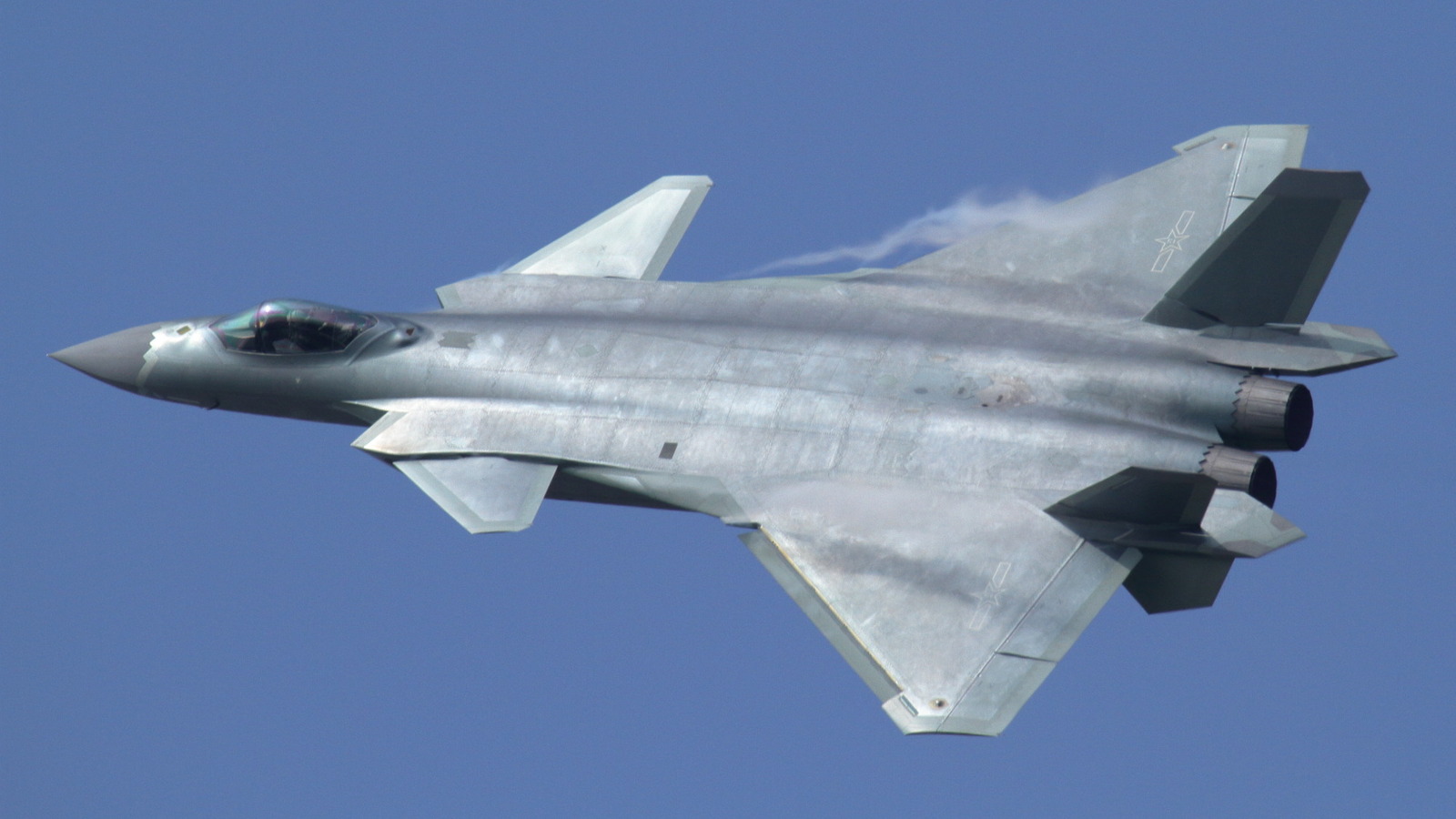
The Chengdu J-20, nicknamed the “Mighty Dragon,” represents a significant leap forward in China’s military aviation capabilities. Developed by the Chengdu Aircraft Industry Group, this twin-engine, all-weather stealth fighter is designed for air superiority and long-range strike missions. While it bears a resemblance to the American F-22 Raptor and the YF-23, the J-20 incorporates unique design features and technologies.
A History of Development and Engine Evolution
The J-20’s development has been closely watched by military analysts worldwide. Initial prototypes first flew in 2011, and the aircraft was officially commissioned into the People’s Liberation Army Air Force (PLAAF) in 2017. Early versions of the J-20 relied on Russian Saturn AL-31FM2 engines, each providing approximately 32,000 pounds of thrust. These engines allowed the J-20 to reach speeds of up to Mach 2.55.
However, China has been actively working to replace the imported engines with domestically produced alternatives. Newer J-20 variants are now equipped with Shenyang WS-10B engines, which offer around 30,000 pounds of thrust each. The ultimate goal is to integrate the advanced WS-15 engine, which promises even greater performance and supercruise capabilities. This transition to indigenous engines is crucial for China’s self-reliance and long-term sustainability in military aviation.
Key Design Features and Stealth Considerations
The J-20’s design incorporates several features aimed at minimizing its radar cross-section (RCS) and enhancing its stealth capabilities. These include:
- Shaped Fuselage: The overall shape is designed to deflect radar waves, reducing the aircraft’s visibility to enemy radar systems.
- Internal Weapons Bays: The J-20 carries its missiles internally, further minimizing its RCS. It can carry up to six missiles within its internal bays.
- Radar Absorbent Materials (RAM): The aircraft’s surface is coated with RAM to absorb radar energy, further reducing its signature.
However, some design elements, such as the canards (small wings near the front of the aircraft) and the delta wing layout, have raised concerns about the J-20’s stealth profile. While these features may enhance maneuverability, they could potentially increase the aircraft’s RCS compared to designs like the F-22, which prioritizes stealth above all else.
Performance Specifications: J-20 vs. F-22
While precise specifications for the J-20 are often difficult to confirm due to the secrecy surrounding Chinese military programs, several key performance metrics can be compared to those of the F-22 Raptor, considered by many to be the gold standard of fifth-generation fighters.
| Feature | Chengdu J-20 (Estimated) | F-22 Raptor (Official) |
|---|---|---|
| Top Speed | Mach 1.7 – Mach 2 | Mach 2.25 |
| Climb Rate | 60,000 ft/min | Not Publicly Available |
| Combat Radius | 745 – 1,367 miles | 529 – 679 miles |
| Service Ceiling | 60,000 feet | 50,000-65,000 feet |
| Internal Weapons | 6 Missiles | 8 Missiles |
Speed: The F-22 boasts a higher top speed than the J-20, reaching Mach 2.25 compared to the J-20’s estimated Mach 1.7 to Mach 2. The F-22 can also supercruise at Mach 1.82 without using afterburners, a capability the J-20 is aiming to achieve with the WS-15 engine.
Range: The J-20 has a significantly longer combat radius than the F-22, potentially allowing it to operate further from its bases. However, the US Air Force’s extensive aerial refueling capabilities mitigate the F-22’s shorter range.
Weapons: The F-22 can carry more missiles internally (8) than the J-20 (6), giving it a potential advantage in air-to-air combat.
How Does the J-20 stack up against the F-35?
The F-35 Lightning II is another fifth generation fighter operated by the United States. Here is how these fighters stack up.
| Feature | Chengdu J-20 (Estimated) | F-35 Lightning II (Official) |
| —————- | ———————— | ———————– |
| Top Speed | Mach 1.7 – Mach 2 | Mach 1.6 |
| Climb Rate | 60,000 ft/min | Not Publicly Available |
| Combat Radius | 745 – 1,367 miles | 590 miles |
| Service Ceiling | 60,000 feet | 50,000 feet |
| Internal Weapons | 6 Missiles | 4 Missiles |
Speed: The J-20 boasts a higher top speed than the F-35, Mach 1.7 compared to Mach 1.6.
The J-20’s Role in the Global Stealth Landscape
Currently, China is the only nation besides the United States to field a fully operational fifth-generation stealth fighter in substantial numbers. While Russia’s Su-57 is also considered a stealth fighter, its production and deployment remain limited. As of April 2025, only 44 Su-57 aircraft were in service. Wikipedia
This makes the J-20 a unique player in the global stealth arena, directly challenging the dominance of the F-22 and F-35. While experts generally acknowledge the F-22’s superiority in stealth and overall performance, the J-20’s long range, evolving technology, and ongoing upgrades make it a force to be reckoned with.
Radar Technology and Future Development
China is continuously improving the J-20, focusing on enhancing its radar systems and engine performance. Recent upgrades have reportedly tripled the J-20’s radar detection range, bringing it closer to Western radar technology. The development of the WS-15 engine is a critical step towards achieving true supercruise and thrust vectoring capabilities, further closing the gap with the F-22. These improvements suggest that the J-20 is not a static platform but an evolving one, continually adapting to meet the demands of modern air combat.
Conclusion: A Contender, Not Just a Copycat
The Chengdu J-20 is more than just a “knockoff” of Western stealth fighter designs. While it may have drawn inspiration from the F-22 and YF-23, the J-20 incorporates unique features and technologies that reflect China’s specific requirements and capabilities. While the J-20 might not yet match the F-22 in every performance metric, its long range, increasing radar capabilities, and ongoing upgrades make it a credible contender in modern air combat. As China continues to invest in its military aviation industry, the J-20’s role in the global balance of power will undoubtedly continue to grow.
What do you think about the Chengdu J-20? Will it rival the F-22 in the future? Share your thoughts in the comments below!
Sources & Further Reading:
Original article at www.slashgear.com


