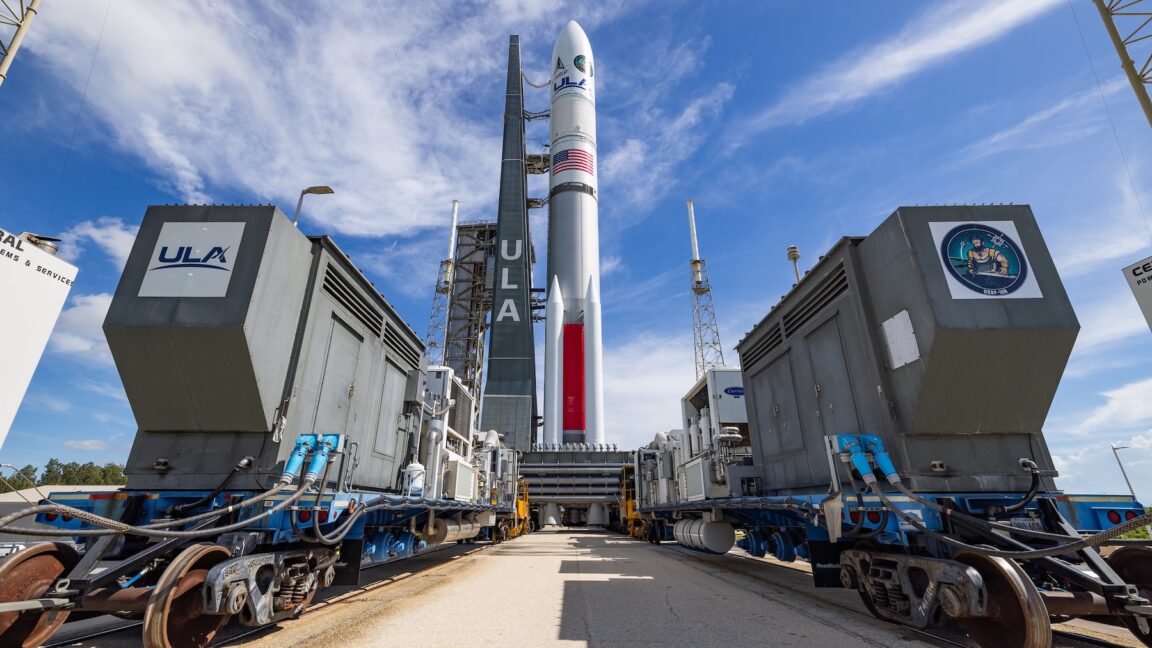

Vulcan Rocket: Ending Russian Dependence and Revolutionizing Military Satellite Access
Did you know that until 2023, critical U.S. national security satellites relied on Russian-made engines? This startling vulnerability persisted for decades, with the workhorse Atlas V rocket’s RD-180 engines supplied by Russia—even as geopolitical tensions escalated following Crimea’s annexation. The era of dependence formally ended with United Launch Alliance’s (ULA) inaugural Vulcan rocket mission, USSF-106, for the Space Force in late 2023. Beyond severing ties with Moscow, the Vulcan ushers in a new paradigm: reduced launch costs, expanded heavy-lift capabilities, and enhanced competition against SpaceX’s dominance. Equally critical is its payload for this mission—the revolutionary Navigation Technology Satellite-3 (NTS-3), designed to combat escalating threats to global GPS systems. This launch represents a trillion-dollar leap forward for America’s space resilience.
Vulcan Rocket: Terminating Decades of Russian Engine Dependence
The Vulcan Centaur directly replaces ULA’s Atlas V, which used Russian RD-180 main engines since 2002. Despite the 2014 invasion of Crimea triggering congressional bans on future Russian engines post-2022, the Pentagon mandated replacements for national security launches. Vulcan answered with BE-4 engines, built by Blue Origin—the first fully American-made liquid-natural-gas-fueled boosters rated for sensitive military payloads. Col. Jim Horne, mission director for USSF-106, emphasized the milestone: “We officially end our reliance on Russian-made main engines with this launch.” Historically, U.S. rocket engine ties with Russia date to the 1990s, when NPO Energomash sold RD-180s cheaply post-Cold War. But mounting sanctions and war in Ukraine turned this partnership into an unacceptable risk. Vulcan eliminates this Achilles heel—a strategic imperative supported by NSF’s analysis of U.S. space industrial base resilience.
Lower-Cost Heavy Lift: Meeting the Pentagon’s Budgetary Demands
Economic efficiency was non-negotiable for Vulcan’s design. Its predecessor, the Delta IV Heavy, cost the Space Force ~$400 million per launch—an unsustainable price tag. ULA CEO Tory Bruno pledged Vulcan would halve that figure. This is achieved through:
- Reusable BE-4 engines with major components refurbished after flight
- Rapid assembly with prefabricated modules replacing Delta IV’s manual welding
- Standardized launch infrastructure requiring minimal pad reconfiguration
| Rocket | Cost per Launch | Max Payload (GEO) |
|—————-|—————-|——————-|
| Delta IV Heavy | ~$400 million | 14,220 kg |
| Vulcan Centaur | ~$180 million | 15,000 kg+ |
*Estimated based on ULA public statements and Space Force contracts.*
Vulcan also delivers increased payload tonnage to high orbits—essential for modern spy satellites. Its modular design (up to 6 solid boosters) scales cost-effectively for heavier missions, a contrast with SpaceX’s Falcon Heavy which requires configuring three Falcon 9 cores for heavy lifts.
Dual-Launch Provider Mandate: Breaking SpaceX’s Monopoly
Since 2022, SpaceX was the only Pentagon-certified medium/heavy launch provider. Vulcan restores competition—mandatory for national security. The Space Force’s “Assured Access to Space” policy prevents single-vendor dependency. An Atlas V launched the final non-SpaceX national security mission a year before USSF-106. Should SpaceX suffer an anomaly (like the 2015 Falcon 9 pad failure), military satellites would be grounded without ULA. Col. Horne stressed Vulcan helps “maintain assured access with at least two independent rocket service companies.” Studies by the Center for Strategic and International Studies (CSIS) highlight how SpaceX’s capped launch cadence and potential workforce disruptions necessitate multiple providers. Vulcan’s certification anchors ULA—now owned partly by Blue Origin—as SpaceX’s proven counterpart.
NTS-3 Satellite: Reinventing GPS Resilience Over 100 Experiments
The $250 million NTS-3 spacecraft, concealed within Vulcan’s fairing alongside classified payloads, is a GPS technology revolution. Led by the Air Force Research Laboratory (AFRL), it tests features critical for next-generation positioning systems:
- Phased Array Antenna: Electronically steerable antennas direct high-power signals to counter jamming—a break from current GPS sats’ fixed antennas.
- Chimera Signal: Anti-spoofing technology distinguishing authentic GPS signals from hacker-generated fakes.
- Software-Defined Payload: On-orbit reprogramming for future threats.
Joanna Hinks, AFRL aerospace engineer, confirmed “over 100 experiments” during NTS-3’s year-long mission. Its modular L3Harris/Northrop Grumman design allows tech upgrades for the 2032 GPS IIIF constellation—demonstrating military “effective prototype” development. Though NTS-3 weighs just 1,250kg—a fraction of Vulcan’s capacity—its innovation is mission-critical.
GPS Jamming: A Real-World Threat Turning Deadly
NTS-3’s urgency is fueled by rampant signal attacks. Jamming overwhelms GPS receivers with noise, while spoofing broadcasts false coordinates. A chilling example: the 2023 crash of Azerbaijan Airlines Flight 8243. Investigators attributed it to Russian GPS jamming (targeting Ukrainian drones near Chechnya), which disabled navigation before a suspected missile strike destroyed the plane. All 38 aboard died—a grim reminder of GPS’s fragility.
Jamming incidents rose 1000% near conflict zones from 2022-2023 according to OpsGroup reports, impacting:
- Commercial aircraft reroutes (like daily Baltic/Near East flights)
- Global maritime navigation disruptions in Black/Red Seas
- Civilian drone/UAV hijackings in Ukraine
NTS-3 mitigates this via localized high-power beams that pierce interference and encrypted signals authenticatable via Chimera—directly addressing vulnerabilities in today’s GPS III satellites.
Future of Military Space: Agility Through Cost and Tech Advantage
Vulcan’s success is foundational. It validates a cost-efficient launch platform guaranteeing constant access as competitors (like New Glenn) mature. With 70+ missions booked—including Amazon’s Kuiper—Vulcan reduces U.S. launch costs by 30%+ via reusable tech and consistent demand. NTS-3, meanwhile, pioneers an R&D model deploying proofs-of-concept years ahead of operational systems. The fusion of these programs encapsulates U.S. strategy: leverage commercial innovation to harden defense capability while disconnecting from adversarial supply chains. As warming Arctic regions expand satellite jamming risks, Vulcan’s payloads will secure the backbone of global positioning.
Conclusion: Sovereignty, Security, and Space Dominance Secured
The Vulcan rocket’s maiden national security mission marks more than a successful launch—it closes a strategic vulnerability to Russian engine supply chains, halves heavy-lift costs compared to legacy rockets, and ensures the Space Force maintains dual-sourced redundancy against launch disruptions. Simultaneously, the NTS-3 satellite incubates cutting-edge solutions for evolving electronic warfare threats, promising exponentially tougher GPS networks resilient to jamming and spoofing. Together, they represent a multi-billion dollar investment in space superiority—securing America’s defense, economic, and technological future. As space militarization accelerates, does your organization consider hardened satellite communications against jamming? Share your insights below!
Sources & Further Reading:
Original article at arstechnica.com


