
Beyond Quirky Boards: When Capability Outpaces Identity in Computing
Imagine buying an incredibly versatile tool that could theoretically replace half the devices in your home office – but feels weirdly unsatisfying when you actually try to implement any single task. Does confusion about its core purpose undermine its potential? That’s the curious predicament facing the Raspberry Pi 5. With its significant leap in processing muscle, I/O prowess, and storage flexibility, this little board stoutly punches above its weight, convincingly blending into roles as varied as lightweight desktops and server nodes. Yet, beneath the silicon triumphs, a persistent question looms: What exactly is the Raspberry Pi 5 built to be?
Forget early Pi models straining under basic web browsing or languishing with slow microSD cards. This signature single-board computer transforms experiences with an Arm Cortex-A76 quad-core processor humming at 2.4GHz, paired with up to 8GB of blazing-fast LPDDR4X RAM. Combined with PCIe-enabled NVMe SSD storage support and twin USB 3.0 ports, bottlenecks become historical footnotes. This Pi iteration genuinely handles modern demands.
Beyond Hobbyism: Hardware That Meets Market Expectations
- Desktop Legitimacy: Browser tabs stay responsive. Lightweight coding tasks compile smoothly. Basic LibreOffice work and entry-level image editors run without infuriating lag. It feels feasible, even pleasant, to use it for actual productivity – powered by the effective VideoCore VII GPU feeding crisp visuals via dual micro HDMI outputs – a profound generational shift.
- Server Workhorse Potential: Beyond casual use, users deploy container orchestration platforms like Docker, manage Nextcloud instances, or host lightweight databases atop stacks that previously choked Raspberry Pi 4s. Faster storage options (USB SSDs/NVMe via M.2 HATs) significantly reduce access latency.
- Robust Ecosystem Scaling: Recognizing this maturity, accessories evolved significantly:
- Active cooling solutions prevent thermal throttling under sustained loads.
- Purpose-built carrier boards capitalize on the PCIe 2.0 interface for serious storage network expansion.
- Cluster-ready enclosures enable multi-node Kubernetes or Hadoop setups.
- Sophisticated power supplies deliver stable current for demanding peripherals.
This marks the Pi’s evolution from niche experiment to credible computing foundation.
The Deepening Dilemma: Master of None?
Despite this undeniable power, Raspberry Pi documentation and marketing retain a broad-but-vague framing. It’s presented simultaneously as education magic, hobby novelty, “general-purpose computer,” DIY enabler, and potential desktop/server. Attempting to focus reveals friction points impossible to ignore:
-
As Desktop Contender: A “ready to work” experience requires substantial added investment:
- Case + Active Cooling ($10-$25)
- Official Power Supply (~$12)
- Genuine NVMe SSD/M.2 HAT & SSD (~$35+ SSD)
- Peripherals (Mouse/Keyboard/Monitor).
- Suddenly, a pi 5 kit costing $120-$150+ triggers comparisons with distinctly unromantic x86 mini PCs.
-
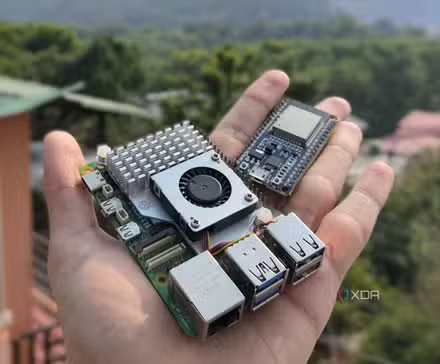
As Cost-Efficient Controller: Replacing an ESP32-driven sensor project? Overkill. Substitute for a $10-$20 Pi Pico? Dramatically oversized and nearly ten times its price. Powering garage door sensors doesn’t need near desktop computing power.
-
As Primary Home Server Node: Limitations emerge under heavy use:
- Bottlenecks emerge: Maximum 8GB RAM (while competitors sport 16GB+).
- 1x Gigabit Ethernet port limits network throughput for multi-service hosting.
- Storage scalability lags behind purpose-built NAS units.
The reality? Without clear segmentation, the Pi 5 awkwardly straddles worlds – seemingly capable of everything, yet often feeling optimal for nothing specific.
| Raspberry Pi 5 “Basic Setup” Cost Breakdown (8GB Model) |
|---|
| Component |
| :———————————————————- |
| Raspberry Pi 5 SBC (8GB RAM) |
| Official Active Cooler/Case Combo |
| Official Power Supply (27W USB-C) |
| Adequate NVMe SSD (e.g., 256GB) + M.2 HAT Adapter |
| Total (Pi Only Setup) |
Navigating a Crowded Field: Competition Forces Hard Questions
The ecosystem witnessed seismic shifts since earlier Pi generations dominated budget access. Now, compelling alternatives actively contest perceived Pi strongholds:
- Budget x86 Mini PCs (e.g., Geekom Mini, Beelink S series):
- Offer integrated CPU/RAM/storage/WiFi/Win11 licensing.
- Provide superior performance-per-dollar for desktops/non-GPU tasks.
- Deliver often vastly superior hardware compatibility and app support.
- Complete Windows/Linux-ready systems frequently land below Pi 5 equipped setups, requiring zero assembly/sourcing stress.
- Specialized ARM/Niche SBCs: Platforms like Odroid or Radxa explicitly target intense IoT workloads, AI acceleration, or cinematic Kodi streaming, declaring priorities upfront – say optimal media hubs with specific AV hardware decoders Pi can’t match.
- Cloud/VM Hosting: Cheap VPS tiers ($5-$10/month) offer globally accessible compute power with preconfigured stacks minus hardware fuss – appealing for prototyping complex labs.
Critically, Raspberry Pi historically dominated affordable learning & tinkering. Price hikes – amplified by memory cost surges (“RAMpocalypse”) – shifted its position significantly. Four years ago Pi 3s were undisputed entry kings at $35. Today, Pi makers targeting cheap experimentation now eye modules like the ESP32 or Pi Pico. The Pi 5’s current pricing takes it beyond impulse-buy territory.
Charting a Clearer Path Forward: Strength Through Focus
The solution doesn’t involve compromises or sanding off engineering brilliance – it demands embracing CERTAIN IDEAS WITH CONVICTION. Potential avenues include:
-
Strategic Solution Bundling: Move beyond generic promotion. Embrace targeted offerings:
- “PiPoint Desktop Kit”: ReadyOffice-alike bundle featuring OS-tuned apps, proper cooling, OS install on SSD.
- “DevLabs Node Kit”: Industry-standard cluster case, optimized Ubuntu Server/CasaOS + guide links for hosting.
- “Embedded Maker Board”: Focus on GPIO/I²C/UART/PWM visibility without high-cooling/case priorities.
Each bundle’s marketing/content steer distinct user expectations appropriately.
-
Embrace Educational Primacy That Scales: Leverage Pi’s unparalleled ecosystem strengths:
- Rich learning pathways (Python/C++ programming, Linux command line mastery).
- Excellent GPIO handling unparalleled versus rivals.
- Thousands of community-led projects.
Positioning Pi 5 as the supercharged learning & prototyping hub, where hands-on experimentation becomes sophisticated using realistic tools, resonates powerfully without competing directly against mainstream computing paradigms.
-
Transparent Messaging Shifts: Shift marketing focus towards encouraging deeper reflection: “Before purchasing: Does your project NEED Desktop Power?” Guides contrasting cheaper Pi Picos (simple GPIO tasks) vs Pi Zeros (small Linux) vs Pi 5 mature environments aid buyer confidence.
The Verdict Surprises: Seeing Woods From Trees
Ultimately, Raspberry Pi 5 architecture represents genuine engineering achievement – significantly outperforming predecessors and enabling meaningful workloads impossible previously. It belongs firmly among respected inexpensive computing platforms. Yet paradoxically, inherent greatness only illuminates a critical gap: A lack of storytelling conviction.
Platforms like smartphones (“iPhone: The easiest camera/wallet”) or laptops (“Dell XPS: Design powerhouse”) thrive upon immediate identity clarity. Raspberry Pi fought past limits crossing thresholds separating hobby curiosity from computational legitimacy – it survived childhood impressively. Now entering maturity demands acknowledging dualism:
It excels as an educational powerhouse scaling into advanced realms AND versatile prototyping foundation approaching micro IT environments. Attempting instead simply being “everything cheap” undermines brilliance amid noisy alternatives proclaiming singular strengths louder.
Why We Can Hope For Clear Horizons
Tellingly Pi excels where focused projects anchor tasks aligned with markable capabilities. Importantly its core strengths remain undeniable strengths wherever deeper technology familiarity grows valued – incredible GPIO assembly harnessing desktop-class tools/chipsets/ML frameworks accessible experimentally exceeds rivals drastically targeted elsewhere. Neither x86 PCs nor ESPs emulate inviting users from zero toward systems mastery unfolding community guides distinctly obvious throughout Pi documentation history – uniquely bridging hardware/software divides remains Pi’s enduring advantage regardless confusion follows formidable traction passing boundaries previous boards accepted intellectually if Pi Directors broadcast roles confidently conveying why purchasing largely incomparable devices befits accelerating skill/build capacity unquestionably beating commodity alternatives fundamentally lacking ecosystem bridges Pi pioneered.
Once Raspberry Pi Foundation embraces assertive positioning worthy formidable internals Pi five reaches destined thriving niche seasoned makers recognize instantly. Why ponder identity limits clearly outweighed capabilities unlocking possibilities? Let discussion unfold robustly!


